
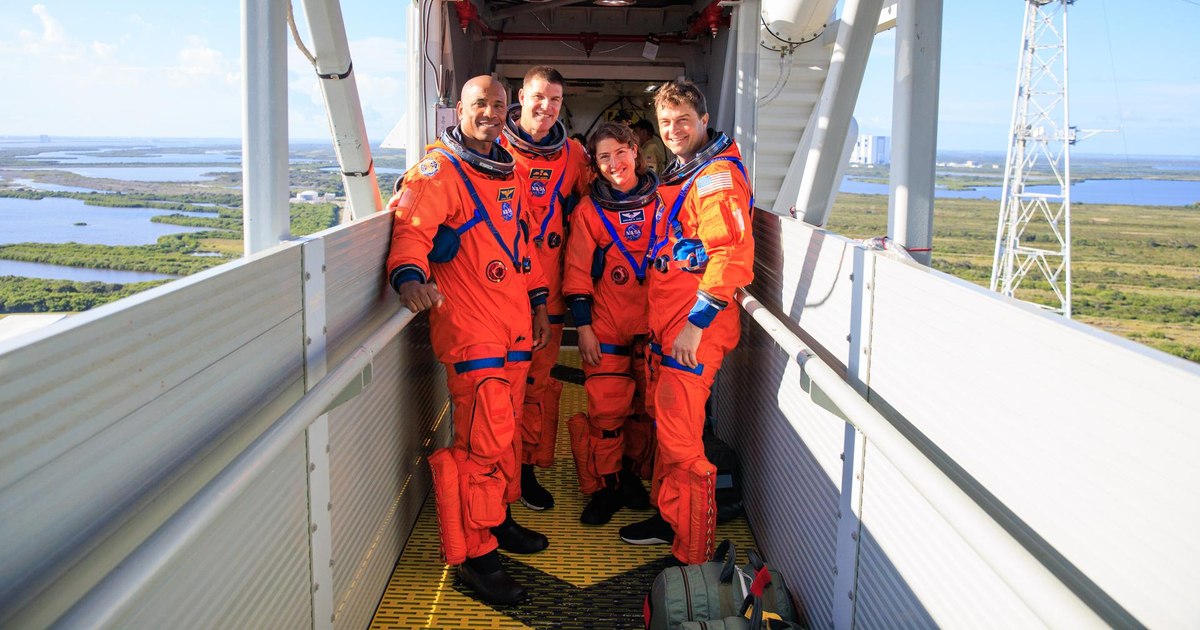
Astronauts on the Artemis 2 mission will spend about 10 days in a confined, zero-gravity space aboard the Orion capsule. The NASA agency has provided details about how the four crew members will live during the historic trip around the moon, notes BBC News.
The four astronauts – Reid Wiseman, Christina Koch, Jeremy Hansen and Victor Glover – will live for about 10 days in a capsule the size of two minivans.
The Orion capsule has a diameter of about 5 meters and a volume of only 9.3 cubic meters, which means limited space, without the usual amenities such as central heating, television or fresh air.
What will the astronauts eat?
Food in space has evolved significantly, but remains strictly controlled. Without refrigeration systems and in weightless conditions, the menu consists of non-perishable foods, optimized for safety and efficiency.
Each astronaut pre-tests their menu, which combines personal preferences with nutritional requirements set by NASA.
Many of the preparations are lyophilized and require rehydration using a drinking water dispenser. There is also a compact heater on board for hot meals.
On a typical day, the crew is scheduled for three meals and two aromatic drinks, of their choice: coffee, green tea, chocolate, smoothies or fruit juices.
Among the dishes included in the menu are:
-
macaroni and cheese
-
quiche with vegetables
-
mango salad
-
blueberry granola
-
broccoli au gratin or green beans
-
dried fruit and tortillas
Fresh food is not transported, both due to the lack of refrigerators and to avoid crumbs that could damage the equipment.
How to go to the toilet in space
One of the most frequently asked questions about living in space concerns the toilet. Astronauts currently use the Universal Waste Management System, which works by air flow to collect waste in the absence of gravity.
Historic mission: humans set off for the moon after nearly 54 years. Artemis 2 has reached Earth orbit
Unlike the International Space Station, where urine is recycled into drinking water, on Artemis 2 it will be ejected into space, and solid waste will be preserved to be brought back to Earth.
Just hours after the launch of the Artemis 2 mission, the crew reported a technical problem with one of the most sensitive systems aboard the Orion capsule: the toilet. Astronaut Christina Koch reported a malfunction when starting the urine collection system, part of the Universal Waste Management System. According to NASA officials, the system’s fan — critical to operating in microgravity — appeared to be stuck, and ground teams quickly stepped in with instructions for a fix. During this time, the astronauts used the liquid waste management backup solutions, while the solid waste function remained operational.
The problem was later resolved in cooperation with the control center in Houston, and the toilet was restored to normal parameters. NASA officials said the system must be allowed to reach optimal speed before use to avoid further jams. The toilet on Orion is a more compact version of the one used on the International Space Station, being integrated into the floor of the capsule and offering a minimum of privacy to the crew. The incident underscores the challenges of living in space, even for essential technologies, in an environment where every technical detail can become critical.
Hygiene, a challenge without gravity
Without gravity, simple activities become difficult. Astronauts will use personal hygiene kits that include toothbrush and toothpaste, dry shampoo, liquid soap and shaving products. There is a space dedicated to these activities, adapted to the conditions in the capsule.
Physical exercises, mandatory
Microgravity quickly affects the body, leading to loss of muscle mass and bone density. For this reason, the astronauts will do about 30 minutes of exercise every day, using a compact “flywheel” type device that allows exercises such as squats or pull-ups.
How astronauts sleep
The daily schedule includes about eight hours of sleep. In the absence of gravity, astronauts sleep in bags attached to the walls of the capsule to avoid floating while resting. As a rule, the entire crew rests in the same interval.
The Artemis 2 mission is a critical step in NASA’s lunar exploration program, a non-salonization test flight that will pave the way for future manned missions to the lunar surface.
