
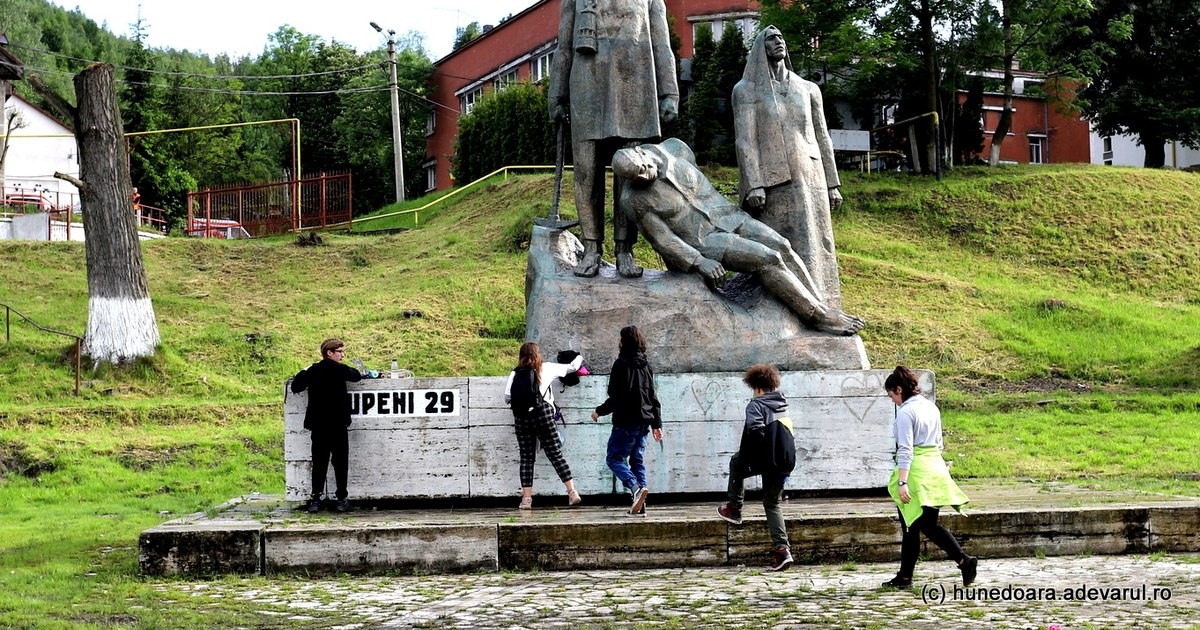
The last coal mines in the Jiu Valley have only a few hundred employees each, and the prospect of their closure is seen by many locals as the end of the industrial era of the region and, at the same time, as an additional reason to leave the area.
Lupeni city. Photo: Daniel Guță. TRUTH
Surrounded by the Parang Mountains, Retezat, Șureanu and Vâlcan, with valuable natural resources and numerous close mountain resorts, Jiu Valley, one of the most tourist bidders in Romania, goes through a paradox.
The population of his six cities has continuously reduced in the last two decades, a phenomenon influenced by the decline of mining, and the vast majority of young people say that they want to leave their native places.
Less than 100,000 people live in the six cities in the Jiu Valley, according to the latest census, made in 2022. In the early 1990s, the population of Petrila, Petrosani, Aninoasa, Vulcan and Uricani mining cities exceeded 150,000 inhabitants and continued to grow. In 1997, it shows some statistics, exceeded 170,000 inhabitants.
Mines in the Jiu Valley, from 40,000 employees to 2,000
Nearly 40,000 people were working in the 14 coal mines along a mining field with a length of over 60 kilometers, which stretched from the east of the region, from Lonea, to the West end, to the Brazi Valley.
The first closures of me took place immediately after 1990. Then the activity was stopped at the Iscroni (Petrosani), Petrila South, Lonea Pilier (Petrila) and, towards the end of the decade, at the Neag (Uricani) field – sectors opened in the 1980s, as part of the expansion plans of the communist regime.
Towards the end of the 1990s, against the background of the waves of restructuring and layoffs from mining, the trend of migration in the Jiu Valley was reversed, and thousands of families have permanently left the cities in the south of Hunedoara.
The string of “mining” deeply affected the perception of many Romanians on the Jiu Valley, and while the mining industry restricted their activity, investors bypass the region, and people were forced to leave it.
In the 2000s, there were closures of historical mines, such as Aninoasa and Dâlja (Petrosani), established in the middle of the 19th century, and of the Valea de Brazi (Uricani) mine, from the western end of the Jiu Valley.
In 2015, another historical mine, Petrila, was definitively closed, and two years later followed the parish (Vulcan) and Uricani mines. The Uricani and Aninoasa cities, the smallest in the Jiu Valley, were thus without the activity around which they were developed and in which almost every family was engaged.
Lonea, Vulcan, Livezeni (Petroșani) and Lupeni mines are the only remaining operations, but the number of employees is reduced to several hundred people for each, and the coal production is negligible in relation to the one from the early 1990s, when the Jiu Valley left over ten million annual coal.
The restriction of the mining activity has transformed the Jiu Valley from the immigration region into the emigration region, explained the sociologist Valentin Fulger. After the waves of restructuring and layoffs from mining, the Valea Jiu Energy Complex reached about 2,000 employees, in the coal mines and at the Parosian power plant, and the population of the region has reduced by over a quarter than that of the 1990s.
The twilight of the Jiu Valley as a mining region
The depopulation and aging of the Jiu Valley population were not mere natural demographic processes, but induced phenomena, accelerated by the consequences of restructuring the mining and losing the industrial functions of the area, the university professor said.
O Recent research in the Jiu Valley shows that the vast majority of young people, who represent about a quarter of the population of cities, want to leave the area.
“The migration of the active population has become a chronic phenomenon and has amplified the demographic imbalances that affect the whole area. The process of selective migration continues today. The studies I have carried with my colleagues at the University of Petroșani, in 2024, shows that about 90 percent of young people (especially between 18 and 24 years old) have expressed their intention to go to Romania, at the University and then give up returning to the valley, which I perceive as a space without economic opportunities and prospects of professional and personal development ”says sociologist Valentin Fulger.
Chances of relaunching, missed in 2000 in the Jiu Valley
The most realistic chance of economic reconversion of the available population would have existed, according to the specialist, at a time when the area had not yet been depopulated. Then, the processes of reconversion of the workforce had to take into account the industrial training of the available and they would be quickly recaptured in sectors of activity with industrial specificity. Currently, relaunching the region is extremely difficult.
“Unfortunately, I witnessed the incompetence of the Romanian state in this area, the experiment of the Jiu Valley being not taken into account in order to avoid its repetition in other monoindustrial areas in Romania. Without exaggeration, I think we can speak of a historical abandonment of the state in the case of the Jiu Valley, characterized by the lack of a strategic vision of future development, and by the social development. Age. shows the sociologist.
Valentin Fulger noticed that both in the Jiu Valley, but also in other former mono -industrial regions, after the collapse of the basic industry, the professional reconversion plans failed. Often, the state did not take into account the training of people, but formally checked projects and courses from which those who organized them, not those who had to be helped.
He added that temporary jobs (3-5 months) could not be a solution for former miners or sidewalks, in the case of Hunedoara, but a need for sustainable jobs, adapted to their competences.
“The state had to come up with sustainable solutions. That’s why I’m talking about a historical abandonment, about the lack of a strategic vision that would consider the time factor. These people did not have to be left and demotivate. Or many have come to retirement refusing to return to the labor market, and their children, and their relatives. A huge percentage of the active force.shows the specialist.
Mining “buried” the Jiu Valley
According to the university professor, the lack of vision made the valley not be oriented towards investments in new fields, such as IT or automation, which could have attracting and maintaining the active population.
The image of the Jiu Valley was seriously severely affected by the mineriads of the 1990s, being perceived as a “wild” and risky region, even if it did not register in the 1990s a high criminality, compared to other areas of the country.
“But any investor, Romanian or foreign, looking at the map of Romania and having a choice, taking into account what was happening in the Jiu Valley and the image he saw, would categorically be chosen rationally and said: I go to an area that is quiet, devoid of social convulsions, to win. Mining and who, after that, caused the restructuring and the availability in mining ”, adds the university reader.
