
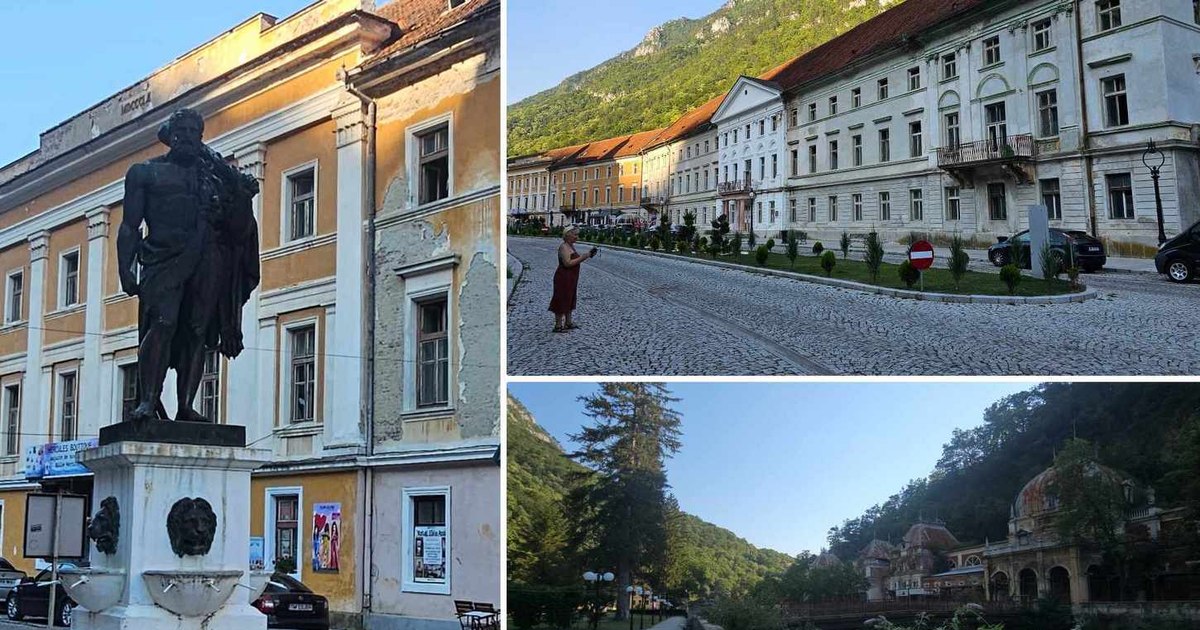
The spa resorts of Banat have been, for centuries, places of relaxation for aristocrats, emperors and travelers from all over Europe. Buziaș and Baile Herculane, the most famous, have preserved valuable historical monuments, even if many of them have been forgotten or left to ruin.
Located in the west and south-west of Romania, the oldest spas have been documented since the time of the Romans, and the archaeological remains discovered on their territory show the importance they enjoyed in Antiquity.
In the 19th century, resorts such as Buziaș, Aquae Călan, Vața, Băile Herculane and Germisara underwent reconstruction, due to the growing interest in their thermal waters, being sometimes extended over the Roman ruins and “adorned” with spectacular period buildings.
Resorts visited by the imperial family
At the end of the 19th century, with the construction of the railways that made them accessible, these thermal baths attracted Romanians from Transylvania, Banat and Muntenia, but also visitors from all corners of the Austro-Hungarian Empire. The resorts strongly competed with the much more famous ones in the western space until then, something that increased their popularity and contributed to their development.
The Herculaneum and Buziaș Baths were visited by the Habsburg imperial family, but also by Romanian and Serbian personalities, and Franz Joseph and his wife, Empress Elisabeta (Sisi), would have been involved in their development.
The communist regime brought important extensions to the old resorts, but paid less attention to the historical value of some monuments from the 19th century and even older. Former palaces adorned with artistic elements, ornate period bridges and unique thermal facilities were ignored and left to decay, with bulky buildings with brutalist architecture erected nearby, which overshadowed the historical heritage of the resorts.
Hotels with hundreds of seats, more accessible to “working people”, gradually took the place of the chic historical buildings, and the expansion of the thermal facilities covered the romantic appearance of the old baths. After 1990.
Buziaș, the site of the first modern beach with mineral waters
Founded in 1811, in Timiș County, after the discovery of the healing properties of the mineral water springs, the Buziaș resort went through extensive transformations in the 19th century, which made it one of the most attractive in Banat. Its beach was built in 1874 and is considered the first European beach with mineral water.
“The reputation of the resort had also reached the ears of Emperor Franz Josef, who visited it in 1898, together with Crown Prince Franz Ferdinand, on the occasion of some military maneuvers”, inform its history.
In Buziaș, the covered colonnade in the resort’s dendrological park would have been built to provide shelter and a spectacular setting for Empress Sisi of Austria.
“An element of great spectacularity and beauty, the colonnade was started in 1856 and was completed by 1875, being a wooden construction of oriental inspiration (Moorish, Ottoman style), the longest in Europe (over 500 meters), integrated into the park. For the construction of the Colonnade, craftsmen were brought from Karlovy Vary, who worked on creating a unified form of the promenade from the Grand Hotel to the springs of Iosif and Mihai, including the ground floor of the Bazar hotel”, shows the National Heritage Institute, on the page dedicated to spa heritage.
The colonnade was made of wooden pillars and frame, being made of perforated wood and panels painted with the motif of the tracery, equipped with an elaborate system for the apparent frames. It was designed as a covered alley that connects the main buildings of the spa complex, being extended in the interwar years with another section.
The unique colonnade, rebuilt with European funds
Under communism, it was remodeled into a simplified, mosaic structure, which reduced its visual impact. After 1990, it was gradually allowed to decay, with mass tourism falling into steep decline.
In recent years, the colonnade in Buziaș has been rebuilt with the help of European funds attracted by the town hall. Over one million euros were invested in the rehabilitation from 2016-2019 of the covered promenade, which had reached an advanced state of decay. The work could only be started after the conclusion of the trial with the heirs of the Muschong family, who claimed the park, and finally received material compensation. The colonnade was tabulated on the Buziaș Town Hall, and the works could begin.
“The project approved by the Ministry of Culture was respected, although there were still discussions. Initially, the alleys were supposed to be made of wood. But it was quite difficult to maintain. Besides, it was made of wood only at the beginning, because after it came into the possession of Muschong, who had a brick factory, brick was put in. We also came with ceramic brick, it can be maintained, it looks good”, declared Sorin Munteanu, the mayor of Buziaș.
The fate of the ancient thermal baths in Romania: established by the Romans, ruined by contemporaries
Forgotten resort buildings in Banat
In the resort’s central park, other period buildings met a less happy fate. The former casino was built between 1853 and 1856, together with the hot baths (current bath no. 2), being among the first buildings built in the resort. It became known in the past for the shows held here and as a summer meeting place for the local and European aristocracy and elite.
“The building, with a rectangular plan, built of brick, with a ceramic tile roof, with the main entrance marked on the side by two columns, has an architecture influenced by the eclectic current of the second half of the 19th century. The building also has a side entrance, on the right side. The mobile metal structure that served to cover the terrace in front of the casino is still preserved today. The building underwent changes, by closing with windows terrace, which was originally an open space. In front of the casino there was a cafe and a restaurant, currently it is privately owned and inaccessible to the public.” INP informed, on the page patrimoniulbalnear.ro.
Built at the end of the 19th century and the beginning of the 20th century, the Bazar and Grand hotels in Buziaș remained in a mediocre state, being closed to the public and degraded by the passage of time.
The Buziaș resort was nationalized in 1948, and its operation continued with the support of the Romanian state. New hotels and service premises were built in the following decades, but after 1990 the tourist resort went into decline. Many buildings, new and old, intended for tourism and spa activities were gradually abandoned and began to fall into disrepair, some suffering irreparable damage.
The Herculaneum Baths, full of historic buildings
At Baile Herculane (Caraș-Severin county), the first baths were built by the Romans in the early years of the 2nd century. Baile was on the route of the first imperial road, near Orșova (ancient Dierna), the place through which the armies led by Trajan crossed the Danube to invade Dacia.
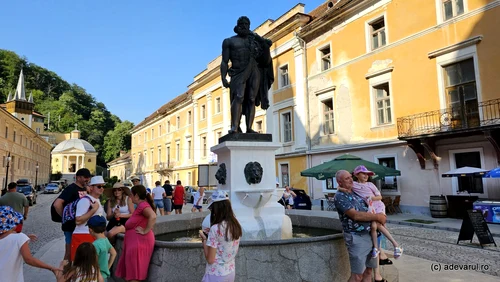
Their ruins were unearthed in the 18th century, and in the following years the ancient Ad Aquas Herculi Sacras was transformed by the Habsburgs into an attractive resort favored by members of the imperial family. Several period buildings, baths and bridges, which have become historical monuments, have been preserved from that period, but only a few could be renovated.
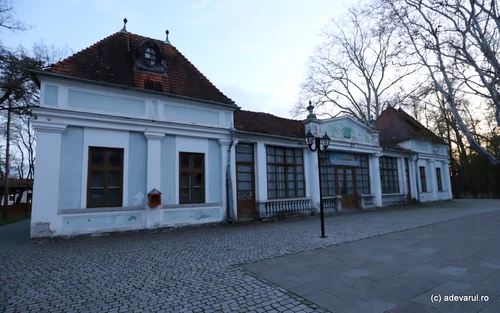
Built in Baroque style, supported on imposing columns and decorated with paintings inspired by Greco-Roman mythology, the railway station of the Banatul Montan resort was established in the middle of the 19th century, together with the construction of the Timișoara – Caransebeș – Orșova railway, inaugurated in 1878.
The thermal water resorts in western Romania, sought after since ancient times VIDEO
Its architecture was inspired by the appearance of a Viennese imperial pavilion, and some historians claim that the station was originally used as a hunting residence for Emperor Franz Joseph of Austria (1830–1916). At the end of the 19th century, the train station had become a meeting place for kings and a popular destination for those who came to Băile Herculane on the train that connected Orșova to Timișoara. After decades of being left to fall into disrepair, the station recently underwent a renovation process to restore it to its former glory.
Neptun Baths, from glory to ruin
Equally old, but currently inaccessible, the Neptun Baths in the center of the resort had a more dramatic fate. The place where Emperor Franz Joseph of Austria and his wife, Elisabeth (Sisi) were accommodated, was engulfed in severe degradation, and the emergency interventions of recent years were not enough to remove the danger of the collapse of some components of the historical ensemble.
In front of the emblematic building of the resort, an old iron bridge over the Cerna River also remained closed, due to the disastrous state it reached.
Baile Herculane preserves a lot of valuable historical places and buildings from the past centuries: Casino Park, Casino, Pavilion 12, Hydrotherapy Pavilion, Pavilion 4, Hygea Spring and Hercules II Spring with the aedic, the Traian, Severin, Decebal, Dacia and Cerna hotels, the station of the resort, the bandstand, Neptun Baths, the Roman Bath with the bas-relief of Hercules, the Hebe baths, Diana and Apollo, Crăciunescu, Elisabeta and Livia villas. Some have been able to be restored in recent years, while others are in an advanced state of decay.
Near the resort’s historic center on the Cerna River, the grand hotels built in the 1970s have met a similar fate, some of which have been closed for more than a decade.
