
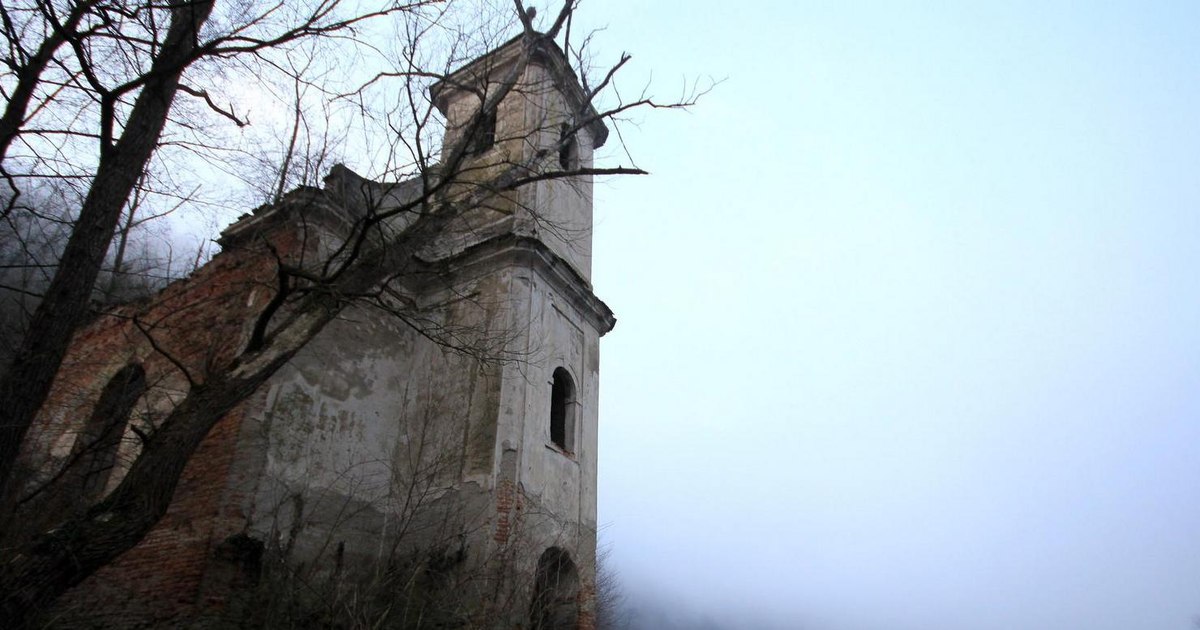
Depopulation and the decrease in the number of believers have left empty churches in Romania, but also in Western Europe. In Romanian villages, many closed places are slowly deteriorating, and their fate is uncertain. In other states, communities have found new uses for them.
Located 30 kilometers from Hunedoara, on an isolated hill in the Poiana Ruscă Mountains, the village of Alun is still inhabited by only a few people, while most of the houses have remained closed.
Churches left deserted along with the villages
Like most of the settlements in the Forest Land, an appreciated ethnographic region of Hunedoara county, so named because of the vast forests that encompass it, the village of Alun remains immersed in silence.
Tourists look for it especially in the summer, due to its unusual appearance: they find here traditional households frozen in time, a road and a marble quarry, but also two churches under the care of nuns. The oldest of them dates back almost three centuries and was built of wood. In the absence of people, although it has been restored in recent years, it has remained closed. The second church was built in the 1930s, made of marble, and is the place of prayer for the two nuns.
The churches in Alun have a fate similar to many other places of worship in the villages of Romania, where services are held extremely rarely, sometimes only once a year, at shrines, until they can be reanimated, or they host the locals only on the days of some funerals.
In Runcu Mare, another village in the Forest Land, around 20 people still live permanently. The settlement on the Runcului valley, located 40 kilometers from Hunedoara, strings its traditional households for a distance of almost ten kilometers, in small clearings at the foot of the steep slopes covered with forest. Here, travelers find three churches erected more than a century ago, two at the edge of the village and one in the middle of it, where most households are concentrated.
“At Runcu Mare, a village with three churches, the service is held only in the one in the middle of the village. In the other two churches, one of the “buzdulents”, as the inhabitants of the lower end of the village are called, and the other of the “goruientes”, as the residents of the upper end are called, the service is no longer held, because the number of people has decreased a lot compared to the last century, when all the churches were functional”. mentioned the ethnologist Rusalin Ișfănoni, the author of the monograph of the Lelese commune, to which the village of Runcu Mare belongs.
The oldest of them, built of wood at the end of the village of Runcu Mare, towards the forests of Vadu Dobrii – another almost deserted village – has stood for over two centuries, almost forgotten. It was built of wood and covered with tiles, but retains many traditional features. It has not been used for several decades, except for some burials in the adjacent cemetery.
Museum churches in Romania
In the village of Vălari in Hunedoara, a church similar to the one in Runcu dates back, according to some historians, to the time of the Transylvanian prince Gabriel Bethlen, at the beginning of the 17th century. The church, located on a hill, has stood the test of time thanks to its “mobility”.
It is so small (eight meters long and 3.5 meters wide) that, in times of hardship, people could dismantle it and cart it to shelter. However, it had reached the brink of ruin, and only the energetic intervention in 2018 of the “Ambulance for Monuments” volunteers, with the support of local authorities, some students from the faculties of history and architecture, and some locals from Hunedoara, led to its rescue.
It continued to remain closed, the services in the village with a few families on the Cerna valley taking place in another, newer church. In nearby places on the Cerna valley, disappeared villages such as Baia Craiului and Curpenii Silvașului have preserved only the ruins of some churches, abolished with the settlements.
Numerous mountain towns in Romania have also locked their churches. Some have been completely abandoned, others are kept alive by a few inhabitants, for whom religious services are held in churches in neighboring settlements, and others have been left without the minorities (Saxons, Hungarians, Swabians) who took care of them. The solution most frequently accepted by the communities was to leave the old churches in conservation, but, in the long term, the measure could not prevent their degradation.
Some monument churches, such as the fortified ones of the Saxons in Transylvania, like Gârbova, have been transformed into cultural and museum spaces, being looked after by the few members of the communities.
Other former places of worship, such as the synagogue in Orăștie, have been “desacralized” and turned into exhibition spaces or places that can host events. However, most of the churches in the villages at risk of depopulation in Romania remained frozen in time, threatened by slow degradation.
Churches for sale in Western Europe
In Germany, the number of church members has decreased in recent years, and the phenomenon has led to the closure of many places of worship, reports the Deutsche Welle (DW) media platform.
“Since 2000, hundreds of Catholic and Protestant churches have been decommissioned. In response to a DW request, the German Catholic Bishops’ Conference announced the closure and deconsecration of 611 Catholic churches between 2000 and 2024. The Protestant Church estimates that between 300 and 350 churches were permanently closed during the same period, although there are no exact figures”shows DW.
Local communities, Protestant or Catholic, found new uses for many deserted, well-preserved and well-positioned churches. Some were taken over by Orthodox churches, according to journalists, but most of the time, the buildings were sold or even demolished. Others are reused.
“In Jülich, a town located between Cologne and Aachen, bicycles are now sold in the former Catholic church of St. Rochus. In Wettringen, north of Münster, an abbey has been transformed into a ‘soccer church’, where balls are kicked without restraint. In Kleve, the former Protestant Church of the Resurrection now functions as a boxing gym. Other former churches house pubs, libraries or bookshops. Entire monasteries have been turned into hotel complexes. In Düsseldorf, a hotel has retained its traditional name Mutterhaus (‘Mother House’), as a tribute to its original use as a nunnery,’ reports DW in a report about the fate of many churches in Germany.
Abandoned churches were given a new role
Similar situations have occurred in other Western states. In Spain, many abandoned churches have been given new life, hosting libraries, museums, concert halls and guesthouses. In England, in addition to cultural destinations, some churches have been converted into pubs and even private homes. In Italy, some abandoned churches have been renovated to be transformed into cultural or educational spaces dedicated to the community.
“In the Netherlands, one in five churches is no longer used as a place of worship, which means around 1,400 churches out of a total of 6,900 nationwide. These iconic buildings are often converted into homes, cultural centers, hotels, libraries and even nightclubs, some becoming famous tourist attractions. According to experts, more and more churches are expected to be deconsecrated in the coming years”shows a study cited by the Interreg Europe program, co-financed by the European Union.
Bookstore Dominicanen in Maastricht is one of the best-known examples of adaptive reuse of churches in the Netherlands. The former 13th-century Catholic church now houses a bookstore that has become a popular attraction.
The Sint-Willibrorduskerk in Noord-Brabant was recently converted into a bouldering center. The venue has partnered with a company that rents the space. Although the interior of the church is occupied by climbing panels, the chapel and the church cemetery continue to be used for religious purposes, according to Girugten’s platform, which aims at the adaptive reuse of buildings.
