
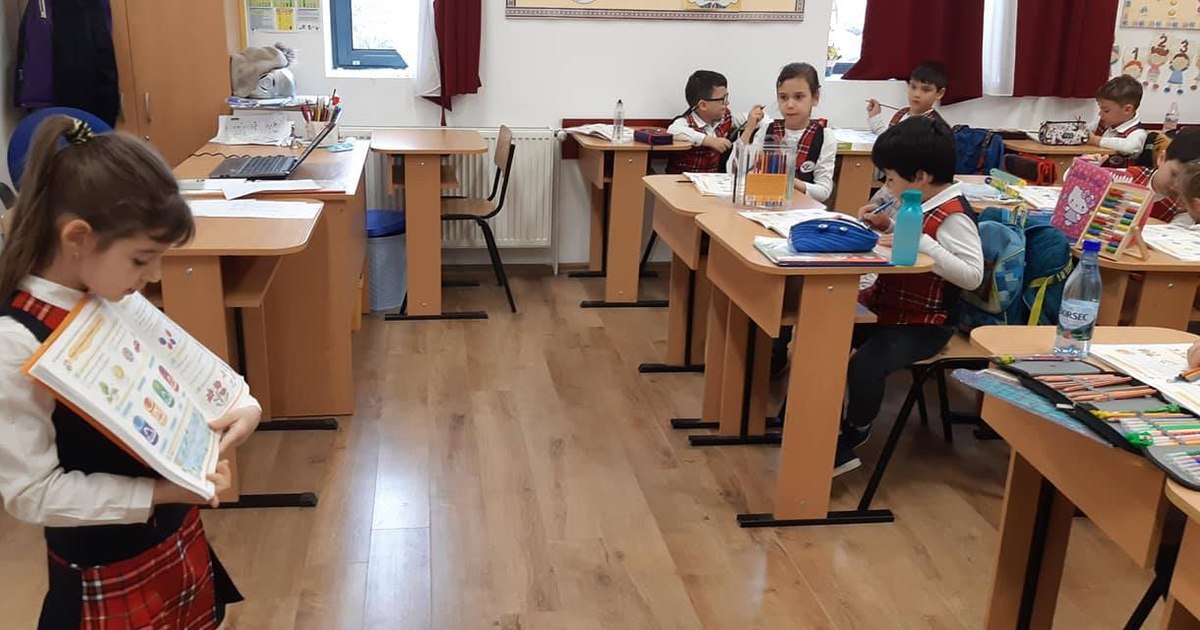
The preparatory class is an essential step in the development of the child who makes the leap from kindergarten to school. Here’s everything that parents need to know about the zero class and what skills are needed for the little ones.
The zero class is mandatory for all children. Archive
What subjects do students make in zero class
The subjects the children go through in the preparatory class are:
- Communication in Romanian;
- Mathematics and environmental exploration;
- Visual arts and practical skills;
Schedule for the preparatory class
- Mathematics and environmental exploration – 4 hours a week;
- Communication in Romanian – 5 hours a week;
- Modern language – 1 hour per week;
- Physical education – 2 hours a week;
- Music and movement – 2 hours a week;
- Visual arts and practical skills – 2 hours a week;
- Personal development – 2 hours a week;
- Religion – 1 hour per week; Optional – maximum 1 per week.
What is the evaluation in the zero class
In the preparatory class the children do not receive notes, but the teacher will complete an evaluation report in which the strengths of the students will be mentioned, but also the cases in which a child needs additional attention or support. Also, in the zero class, no children for home are given.
In the zero class, several students’ development areas are targeted including:
- Socio-emotional development;
- Physical and motor development;
- Development of learning capacities and skills.
Thus, at the end of the preparatory class, children should have developed skills in several fields, essential for their educational and personal development.
School program for discipline communication in Romanian, preparatory class
Receiving oral messages in known communication contexts
- Identifying the meaning of a short message, on familiar topics, clearly and rarely spoken; Example: “Selecting an image from a set, to indicate what it is about in the message; making a drawing to indicate what it is about in the message; providing answers to the question:” What is it about (in this story fragment)? ”
- Expressing oral messages in various communication situations
- Clear pronunciation of sounds and words in simple statements.
- Example: „movement games for the correct practice of the respiratory act, with emphasis on the correct pronunciation;
- Exercises – diction game, songs, rhythmic counts; Forms of responses to riddles;
- Participation in activities of the type “You are my echo” (reproduction of messages formulated by adult or children); the transmission of information regarding itself and to the near universe, through short messages;
- Participation with interest in short dialogues, in usual communication situations; expressing their own ideas in known contexts, showing interest in communication.
Receiving a variety of written messages, in known communication contexts
- The recognition of common words, from the near universe, written in large and small letters of print (recognition and appointment of large and small printing letters on different supports (paintings, cubes, toys kits, associating the shape of a cloud with a letter);
- Identifying the significance of a/ some images that present events, phenomena, familiar events (reading after one or more illustrations/ comics);
- Identifying the significance of symbols that transmit messages of immediate necessity, from the familiar universe (identifying the significance of symbols encountered in daily situations, for example: M – subway, H – hospital, I – information, entry, exit, pharmacy, etc.);
- Expressing in their own words the messages played on visual or auditory support, showing interest in working with the book; observing (intuitive) of books of various shapes, sizes, thicknesses, with or without images, etc.). ”
Writing messages in various communication situations
- Drawing the graphic elements and the contours of the letters, using various resources. “For example: practicing the fine musculature of the hand and coordination of the movements by coloring, chasing inside a contour, string of beads);
- Writing simple messages, in usual communication contexts. For example: making greetings and tickets in torn or cut letters from magazines, newspapers) “.
School program for mathematical discipline and environmental exploration, preparatory class
General skills:
- Use of numbers in elementary calculations;
- Recognition and writing of numbers in concentration 0-31;
- Comparison of numbers in concentration 0-31;
- Ordering numbers in concentration 0-31;
- Making assemblies and decreases in concentration 0-31, by adding /extracting 1-5 elements from a date.
Highlighting the geometric characteristics of some objects located in the surrounding space
- Orientation and movement in space in relation to specified landmarks/directions, using phrases of the type: in, above, below, next to, in front, behind, up, down, left, right, horizontal, vertical, oblique;
- Identification of flat geometric shapes (square, triangle, rectangle, circle) and geometric bodies (cube, cuboid, sphere) in objects manipulated by children and in the environment.
- Identification of some phenomena/relationships/regularities/structures in the near environment The description of some simple repetitive phenomena/processes/structures in the near environment, in order to identify some regularities. For example: Various exercises of associations and correspondences (for example: doll-rochie, shoe-footing, car-driver, rainfall, square-linie, etc.)
- Manifesting care for the correct behavior in relation to the familiar environment. For example: making drawings with the theme of the home, their own room;
- Generating simple explanations by using logic elements formulating some observations on the near environment, using the common language, representations and logical operators “and”, “no” – movement games in which logical operators “and”, “no” (for example: “children who have green eyes and blond hair to raise their hand”);
- Solving problems starting from sorting and representing data sorting/classification of objects/materials, etc., based on a given criterion – grouping objects/bodies according to a certain criterion (form, color, size, thickness, taste, utility, natural/processed, etc.);
The use of conventional standards for measurements and estimates;
- The use of unconventional measures for the determination and comparison of the lengths;
- the right choice of unconventional units (palm, pencil, etc.) to measure the length;
- specifying the size of an object with the help of unconventional units;
