
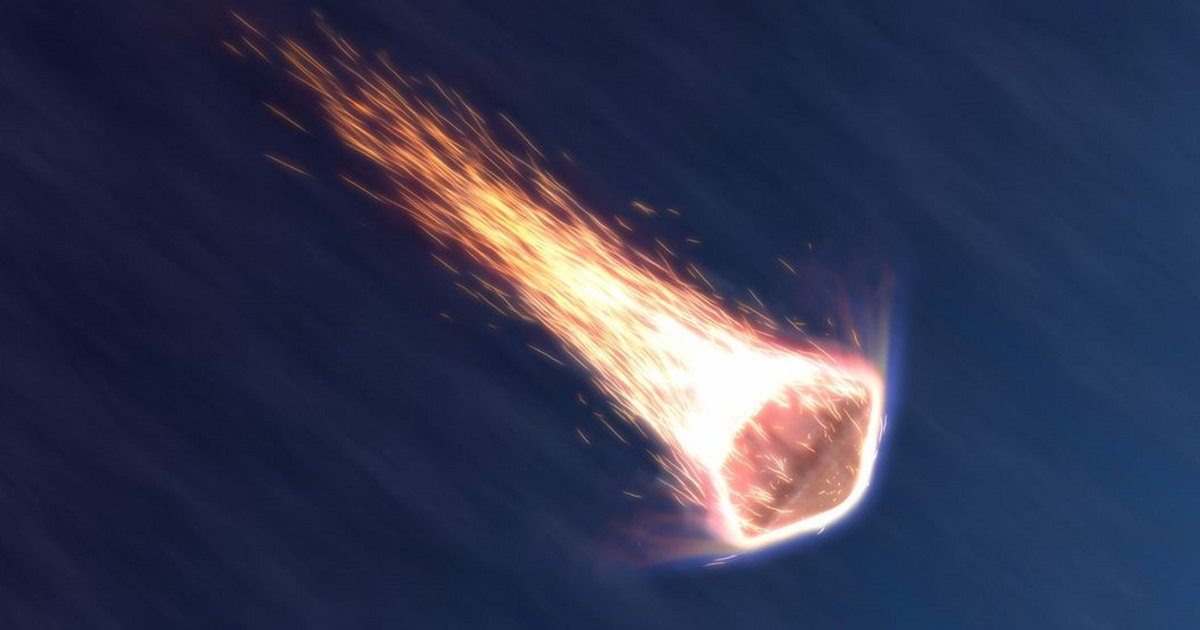
Asteroid Bennu, which is the subject of most scientific discussions about the origin of life after scientists have studied samples on its surface, could, however, hit the earth and determine “a global winter”, a new study shows.
Asteroid Bennu could hit the Earth in 2182, say the specialists. Photo archive
Recently, asteroid Bennu was at the center of scientific discussions, especially after the researchers analyzed the surface samples collected by the Osiris-Rex mission. If most have been excited about what space rock can reveal about the origins of life, a new study has introduced a much more disturbing possibility: Bennu could collide with the Earth.
Although the probability is very low, scientists estimate that Bennu has a 2,700 chance to hit our planet. If such an event took place, it would not happen until 2182, which means that humanity is at least 157 years old to prepare.
Although it is considerably smaller than the asteroid that caused the mass disappearance of dinosaurs 66 million years ago, Bennu is a significant threat.
The effects on the earth
According to the study, published by researchers who are part of the IBS center for climate physics, a direct impact would release about 400 million tons of dust, aerosols and scraps. This would block the sunlight, which could lead to a cooling of the temperature from the surface of the Earth by 4 ° C, which could trigger a global winter.
The reduction of solar light would devastate the lives of plants, disrupting food chains and affecting terrestrial and marine ecosystems. The level of precipitation could decrease by 15 %, further aggravating the instability of the environment, informs Express.
The impact of asteroids has played a crucial role in modeling the history of the Earth, and scientists believe that, in fact, the collisions of the past could have influenced human evolution.
“In the history of the earth, several times different asteroids have hit the planet. It is possible that our early human ancestors may have gone through some of these events to change the planet, with potential impact on human evolution and even on our own genetic baggage ”, explained Dr. Lan Dai, co -author of the study.
The best known impact of an asteroid (which hit the Yucatán peninsula about 66 million years ago) created the Chicxulub crater and is believed to have triggered the extinction of dinosaurs. Since then, the Earth has been largely protected from major asteroid collisions, partly due to the protection effects of Jupiter’s gravity, which helps to divert many potential threats.
Despite his potential danger, Bennu gave scientists valuable information about the basic elements of life. Earlier this month, NASA revealed that Bennu collected samples contain 14 of the 20 essential amino acids for life on Earth, as well as key organic compounds that play a role in the formation of DNA and RNA.
In addition, researchers have discovered mineral salts formed by water evaporation, which suggests that Benu had once liquid water, a fundamental ingredient for life. These discoveries strengthen the idea that the essential elements of life could be common throughout the universe, increasing the probability that alien life will exist in other places.
Although the possibility for Benu to hit the Earth is reduced, planetary defense experts are already developing asteroid deviation strategies. The DART (Double Asdirection Test) mission has successfully demonstrated the ability to change the trajectory of an asteroid in 2022, by collapsing a spacecraft in Dimorphos, a small month that orbits the Didymos asteroid.
If it is ever confirmed that Bennu is on a collision course with the Earth, similar techniques could be used – such as kinetic impactors or gravitational tractors – to deviate from the course.
Although the threat represented by Bennu remains low for now, its potential impact reminds us of the cosmic dangers that the Earth faces.
