
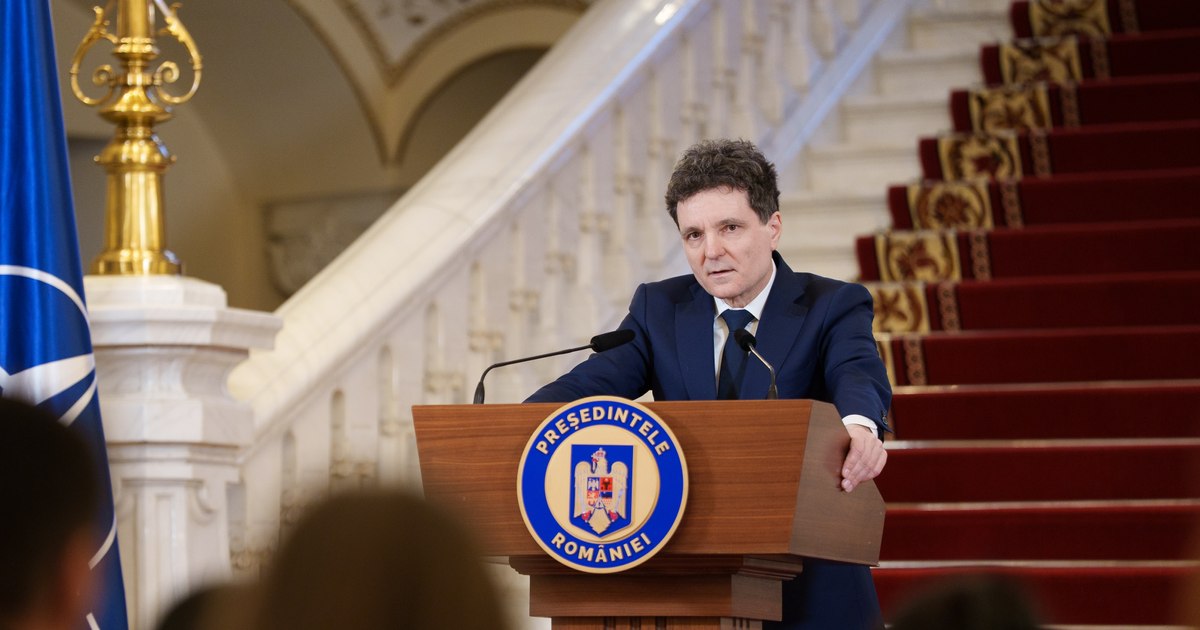
On Wednesday, April 8, President Nicușor Dan approved the proposals of the Minister of Justice, Radu Marinescu, for the leadership of the National Anticorruption Directorate, DNA and DIICOT, with one exception, Gill Julien Grigore Iacobici, proposed for the position of Deputy Chief Prosecutor of DIICOT. The head of state’s decision generated a wave of criticism among his supporters, who accuse him of succumbing to pressure from the Social Democratic Party.
First of all, in order to understand the mechanism of appointments in the leadership of the Grand Prosecutor’s Offices, a careful look at the procedure that governs them is necessary. In the context where Romania is, according to the Constitution, a semi-presidential republic, there are few situations in which one of the state powers can adopt decisions without them being subject to the control or validation of another power.
In the present case, the Government, through the Ministry of Justice, conducts the competitions. The selected candidates are then presented to the Superior Council of the Magistracy, which issues an advisory opinion, after which they reach the President of Romania. The head of state can refuse proposals whenever he wants, provided he does so with reasons. In other words, neither the Minister of Justice nor the President have total decision-making power.
The history of the last decades broadly outlines two distinct patterns. In the situations where the president benefited from the support of a “presidential” party that held the Justice portfolio, the appointments proceeded without difficulties, being obviously assumed by the head of state. Such contexts were found in 2016, when Raluca Prună was minister of justice, but also in 2020 and 2023, during the mandates of Cătălin Predoiu.
A second type of situation, comparable to a certain extent to the current one, occurred in 2013. At that time, the portfolio of Justice was temporarily held by Prime Minister Victor Ponta, while Traian Băsescu was at the Cotroceni Palace. Despite the strained relationship between the two, a compromise was reached regarding the appointments: Băsescu supported the proposals for the leadership of DNA and DIICOT – Laura Codruța Kovesi and Alina Bica – while Ponta bypassed the appointment of Tiberiu Nițu as prosecutor general.
Practically though de facto there is a competition, the system is built in such a way that it invariably leads to a political negotiation, explains former presidential adviser Cristian Hrițuc.
“Do we have a political negotiation for the heads of the prosecutor’s offices? Yes. But when wasn’t there? Only when a party had an absolute majority. Otherwise, it was always negotiated. Specialists say that Cerbu is a good prosecutor, which means that the number one objective could be this very thing. Anyway, really speaking, the president sets the direction.” explained Cristian Hrițuc.
Where did Nicușor Dan give in?
Currently, President Nicușor Dan does not benefit from the support of a “presidential” party in the full sense, and the recently formulated criticisms from within the USR confirm this reality. At the same time, the essential portfolio in this procedure, that of Justice, is held by the PSD, a context that imposed the need for a consensus between the head of state and the social democrats.
The information that has appeared in the public space in recent months indicates that the president wanted to assume the appointment of the chief prosecutor of the DNA, an objective that seems to have materialized. Viorel Cerbu, a prosecutor with extensive experience in handling corruption cases and unanimously approved by the CSM, is emerging as the option supported by the head of state.
The proposal of Codrin Miron, the current head of DIICOT Timișoara, who received, in turn, a unanimous opinion for the leadership of the anti-mafia prosecutor’s office, also follows the same logic. This would practically justify why Nicușor Dan insisted on Wednesday that the prosecutors in question “they are not the PSD proposals”. Sure, the PSD proposals are strictly technical, but de facto there are certain nuances.
Despite the firm support expressed by the president in the press conference, Cristina Chiriac seems to be, first of all, the option of the social democrats. Approved negatively by the CSM with an overwhelming score – the only favorable vote coming from the Minister of Justice -, it was finally proposed by Radu Marinescu. Cristina Chiriac was criticized by the president’s supporters. Therefore, the head of state took a certain risk by initialing her appointment.
Two other possible concessions attributed to the head of state can be placed in the same register: Marius Voineag and Alex Florența, former heads of the DNA and the General Prosecutor’s Office, who will occupy the positions of deputy general prosecutor and deputy chief prosecutor of DIICOT, respectively. Nicușor Dan criticized the two during the election campaign, accusing the weak activity of the prosecutor’s offices they led.
A bigger bargaining chip
The context of these appointments is much broader and includes, without exception, the appointments for SRI and SIE. Here the procedure is somewhat reversed. The President has the attribute to propose, and the Parliament, dominated by the PSD, validates them. Mutatis mutandis neither party has total decision-making power.
“We can speculate that the negotiations regarding the heads of services also came into the package. It is possible that he got what he wanted here as well, but we do not see this yet. We will find out after Easter. It is difficult for the “bubble” to accept the current game of the president, but he has to get used to it: he is not a “player” type president, nor can he afford this approach in a completely different context. He is the negotiator who does not make sudden moves.” explained Cristian Hrițuc.
We do not know yet whether the negotiation of the prosecutor’s offices was done together with that of the services, but it is certain that, considering the parliamentary configuration, Nicușor Dan and the social democrats are forced to coexist.
