
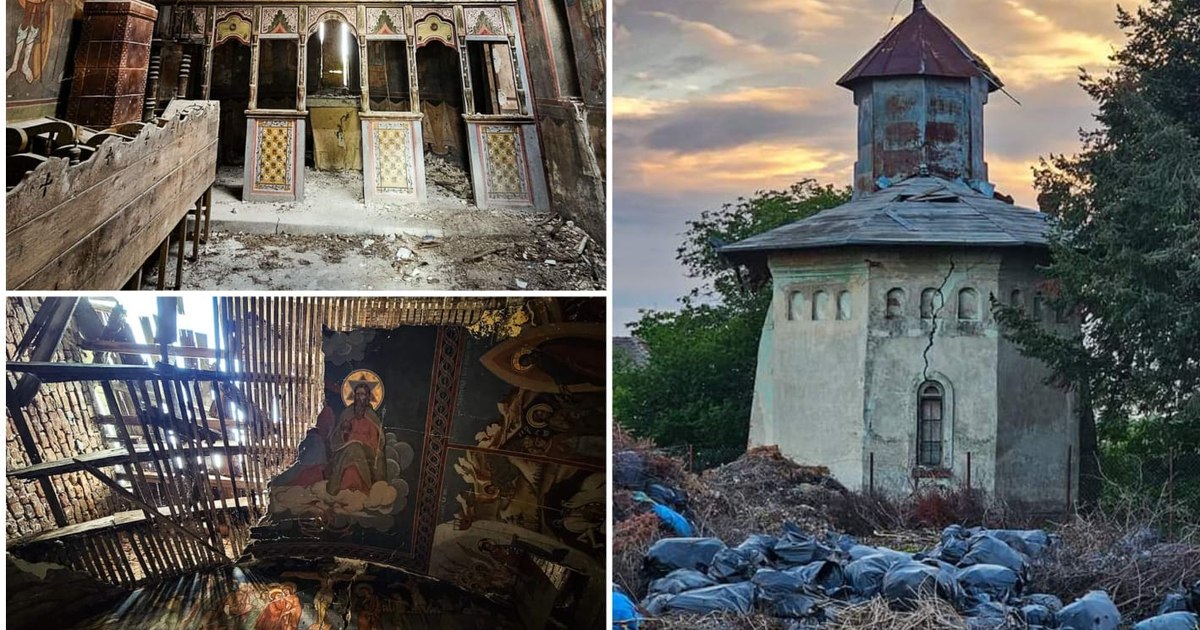
A century old church has been forgotten by the world and surrounded by garbage. Abandoned and left in disrepair, the Moara Vlăsiei Hermitage, in Ilfov county, will remain history because its demolition is being prepared.
The Moara Vlăsiai Hermitage Church is in ruins Photo: Alex Găvan/Green Belt
Alex Găvan drew attention to the Moara Vlăsiai Hermitage in Snagov commune (Ilfov), left to fate, not being noticed by the authorities for several years. The church, dedicated to Saints Constantine and Elena, began to collapse.
The house, located in a field, is in an advanced state of decay. It's raining through the roof, and a heap of rubbish has been thrown around. Until recently, anyone could enter the church at any time of the day.
SOURCE: Alex Găvan/Green Belt
“When I got there, the gate was wide open and so was the front door. The only sign was related to the building of a new church. Otherwise, everything was abandoned“, says Alex Găvan, the founder of the civic platform “Together for the Green Belt”, initiator of the law on the Green Belt Bucharest – Ilfov.
Due to the lack of protective measures, the beautiful frescoes on the walls fell victim to carelessness.
“Even if when it was taken over, it could no longer be restored, the Romanian Orthodox Church (BOR) had the obligation, as a good steward, to cut out and save the frescoes that could still be saved and take them, for example, to the museum of the Căldarușani monastery, which I understood this hermitage to be about,” Alex Găvan also specifies.
Only after his notification, the Archdiocese of Bucharest closed the church to the eyes of the curious, with locks being placed at the entrance and signs with “access prohibited to unauthorized persons“.
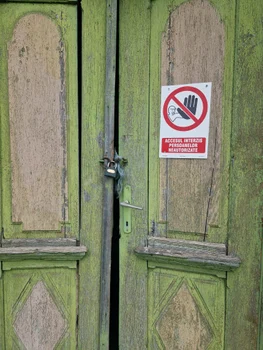
Image 1/2:
The entrance to the church was locked Photo: Archdiocese of Bucharest jpg


“The RAPPS, those who originally managed this church, are responsible for its degradation, and the BOR, who took it over afterwards, are morally responsible for taking absolutely no measures to stop water flowing through roof“, Alex Găvan also claims.
The fate of the church was determined: demolition
The place, until recently owned by the state, is one of the buildings lost in the long conflict of restitution of lands confiscated during the communist period.
“It was built almost 100 years ago by the members of an agricultural cooperative from the communist period and by the Christians of the area, i.e. from the village of Vlăsia. The church re-entered the property of the Archdiocese, and the technical expertise carried out showed that the place of worship is not a historical monument and can no longer be rehabilitated. It was not, therefore, abandoned by the Church and from its takeover, the completion of the necessary documentation for the demolition and reconstruction of a new church is expected“, stated Vasile Bănescu, the spokesperson of the Romanian Orthodox Church.
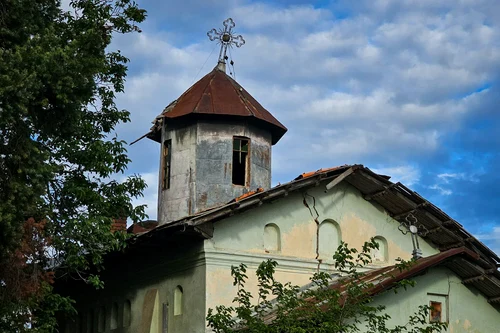
Image 1/3:
Moara Vlăsiei Hermitage Church Photo: Alex Găvan/Green Belt jpg
In 2021, by a Government decision, the church of the Moara Vlăsia Hermitage came into the possession of the Archdiocese of Bucharest, in order to start extensive restoration works and to organize various cultural projects. Instead, there is now talk of demolition.
“The technical expertise concluded the necessity of demolition. Pastoral-missionary, cultural and social-philanthropic projects will be carried out in the new spaces that will be built“, transmitted the Archdiocese of Bucharest, which has also taken several steps for the construction of a new cult building. It will be dedicated to the Sunday of the Roman Saints.
“The necessary steps were taken to build a new church on another site. In this sense, the necessary documentation to obtain the urban planning certificate was developed. The need to obtain the PUZ was specified in the urban planning certificate. The Archdiocese of Bucharest has started the preparation of the necessary documentation to obtain this PUZ. Until this date, the opportunity notice was obtained from the Ilfov County Council and the issuance of the necessary notices to obtain the PUZ is expected“, informs the Archdiocese.
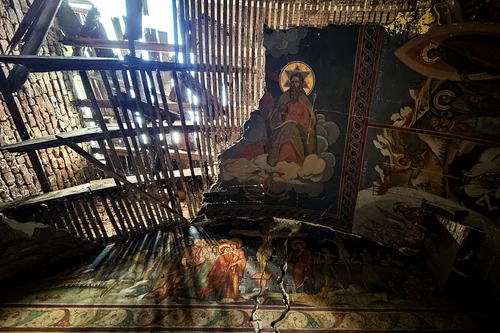
Image 1/5:
The church was left in disrepair Photo: Alex Gavan/Centura Verde jpg
Regarding the steps taken to save the frescoes within the shrine, the Archdiocese claims the following: “The valuable frescoes from this place of worship will be extracted and preserved through a special process, which has also been used in other churches“.
Unfortunately, until then the paintings continue to deteriorate due to the conditions in which the place of worship is located.
