
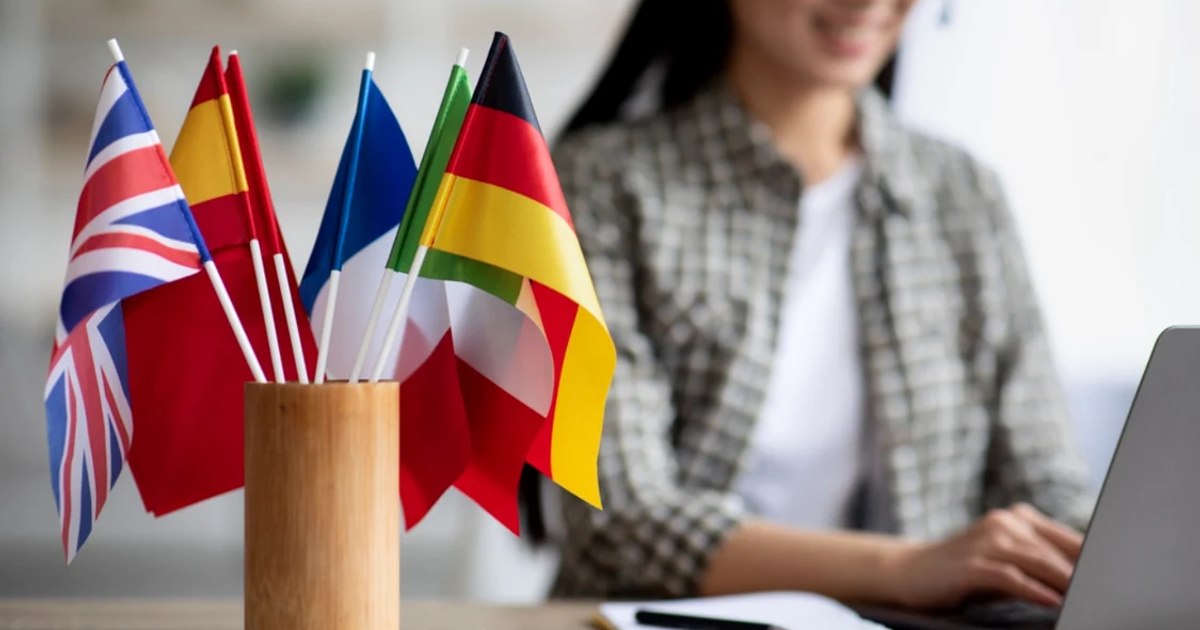
Most Europeans, 86%, think it is important for everyone to speak at least one foreign language, shows the new Eurobarometer published by the European Commission, but too few actually do it. Only one out of three Romanians have this ability.
Europeans and foreign languages - Photo Archive
The latest Eurobarometer published by the European Commission shows that 86% of Europeans consider it essential that everyone speaks at least one foreign language, and almost three out of five Europeans (59%) can communicate in a foreign language. In contrast, only 34% of Romanians have this ability, according to the Eurobarometer. At the same time, there are also Romanians who speak two or more foreign languages. Too few, however.
A percentage of 25% of respondents stated that they can hold a conversation in English, while 7% mentioned that they can communicate in French. Regarding the German language, 4% have a basic level, and 3% of the Romanian respondents can speak Italian, and the same amount of Spanish.
It is the young Europeans who have made great progress in this regard. More precisely, 79% of people between the ages of 15 and 24 speak a foreign language, and 39% even speak two other languages. At the same time, only 28% of Europeans speak two languages.
English, the most spoken language in Europe
Almost half of Europeans (47%) speak English. 7 out of 10 young people can hold a conversation in English, 9 percent more than ten years ago. It is also considered the most important language for children's future by 85% of Europeans.
The most commonly spoken foreign languages after English in the EU are French (11%), German (10%) and Spanish (7%). In Romania, English is spoken by 25% of respondents, and French is spoken by 7%.
Romanians, good at English
Recently, the global education company Education First (EF) published a top of the countries where the best English is spoken, and Romania ranks 15th out of 113 countries analyzed. The Netherlands ranks first globally, with the best results. Austria and the Nordic countries, Denmark, Norway and Sweden, also rank at the top. Romania is included among the countries with a high level of knowledge of the English language. In contrast, France, Italy and Spain have moderate levels of English proficiency.
Among native English speakers, interest in learning a second language remains low, even though English is essential for global communication and cultural understanding. According to a Preply study, Serbian, Portuguese and Romanian are among the easiest foreign languages to learn in Europe.
What is happening in schools in Romania
“In Bucharest and in the good high schools in the country, the emphasis is on learning at least one language very well. All high school students should know the first language at least at B1 level“, explained to “Adevărul” Irina Arimescu, a teacher who teaches several foreign languages, including English and German. This is also shown by the preference of secondary school students for bilingual profiles, where they enter with the highest averages.
Although many of us feel like we forget a language if we stop using it, there are ways we can refresh our memory. “There are people who studied French in high school and thought they didn't know anything anymore. The moment they needed it on the job, when they started reading, they remembered and started talking. The language doesn't look, it's somewhere in a drawer and the moment you touch it it activates“, says the teacher.
What we lack in school is more communication in the language we learn. “At some schools, speaking is not very much done, there is no emphasis on speaking. Many adults and young people who have finished school tell me that they have problems speaking, in all languages. Because they don't have enough practice in the classroom, it's hard to work with 20-30 and get them all talking. Emphasis on speaking is important“, completes the teacher.
The Internet and social media contribute to the spread of the English language. Eurobarometer data show that 45% of Romanians believe that it is best to learn a foreign language in educational institutions, and a percentage of 10% believe that it is better to learn by yourself, watching movies, broadcasts, listening to songs in the language that you want to know. In contrast, only 7% of Europeans consider this a good way to learn a foreign language.
In addition, a recent OECD (Organization for Economic Co-operation and Development) study shows that young people are increasingly learning foreign languages outside of school, using the internet, social media platforms and watching content in the original language.
“Social media and the internet help positively. I had young kids addicted to gadgets, to YouTube, but who learned to speak English this way. There are also all kinds of auxiliary programs, developed by those from Cambridge and Oxford, with all kinds of little games, which the little ones can use, which help a lot. From my point of view, a foreign language also educates your logic, you have several advantages“, says Irina Arimescu.
Another high school English teacher believes that students “they have very well developed language skills”, especially those who study at bilingual high school profiles. He also considers that “ttechnologies and resources available to students make learning a foreign language much more attractive. They especially help to develop vocabulary, because often the content is not grammatically correct“, adds the teacher.
