
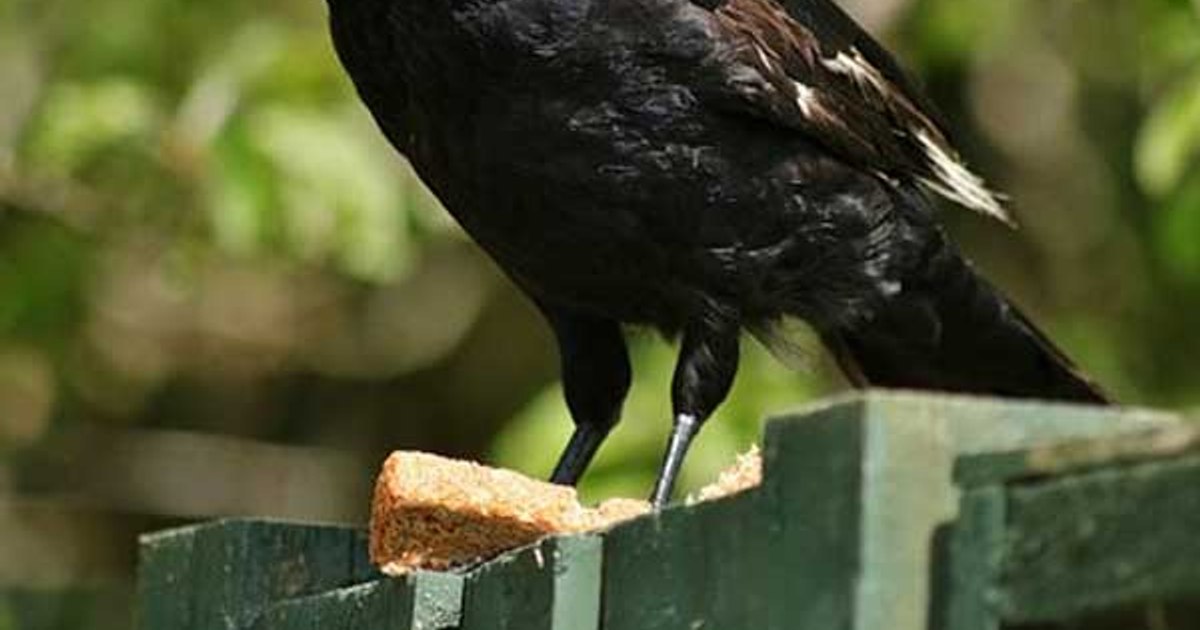
It seems that crows are endowed with “superpowers”. These birds can count up to four and adjust the number of sounds they make depending on the number shown, according to a new study led by a team of researchers from the Animal Physiology Laboratory of the University of Tubingen in Germany, reports CNN.
The research was inspired by young children learning to count. Photo: Archive
The way birds recognize and react to numbers is similar to a process we humans use, both to learn to count when we're little and to quickly recognize how many objects we're looking at.
The findings, published Thursday in the journal Science, contribute to a better understanding of crows' intelligence.
“Humans do not have a monopoly on skills such as numerical thinking, abstraction, tool making and forward planning” said Heather Williams, a biology professor at Williams College in Massachusetts.
Crows are “smart”
“No one should be surprised that crows are 'smart'“, added Williams, who was not involved in this study.
In the animal kingdom, counting is not limited to crows. Chimpanzees were taught to count in numerical order and to understand the value of numbers, just like young children. In an attempt to win over their females, some frogs count the number of calls made by rival males in order to match or even exceed this number.
Scientists have even theorized that ants find their way back to colonies by counting their steps, although the method is not always accurate.
The latest study has shown that crows, like humans, can learn to associate numbers with values - and count aloud.
The research was inspired by young children learning to count, said the study's lead author, Diana Liao, a neurobiologist and principal investigator at the Tubingen lab. Toddlers use words to count objects in front of them: if they see three toys in front of them, their count might be “one, two, three” or “one, one, one.”
Perhaps the crows could do the same, Liao thought.
Liao and his colleagues trained three crows over more than 160 sessions. During these sessions, the birds had to learn to make associations between a series of visual and auditory cues from 1 to 4 and make the corresponding number of squawks. In the example given by the researchers, a visual cue might be a glowing blue number, and the corresponding audio cue might be the half-second beat of a drum.
The crows were expected to produce the same number of caws as the number represented by the cue—three caws for the digit 3 cue—within 10 seconds of seeing and hearing the cue. After the birds stopped counting, they had to tap the “enter” key on the touchscreen displaying the clues to confirm they were done. If the birds counted correctly, they received a reward.
“I understand abstract numbers”
Apparently, as the cues continued, the crows needed more time to react to each cue. Their reaction time increased as “more vocalizations were imminentLiao noted, suggesting that crows planned the number of croaks they would make before opening their beaks.
The researchers were even able to tell how many sounds the birds planned to make by how their first signal sounded—subtle acoustic differences that showed the crows knew how many numbers were in front of them and were synthesizing the information.
“They understand abstract numbers…and then plan ahead as they adjust their behavior to match that numberWilliams said.
Even the mistakes the crows made were somewhat advanced: if the crows croaked too many times, they would stutter the same number. Liao and the researchers were able to identify from the first sound where they went wrong.
The intelligence of crows has been studied for decades. Scientists have studied crows in New Caledonia that create their own tools to access food. Birds seem to set rules, according to a November 2013 study co-authored by University of Tubingen lab lead researcher Andreas Nieder.
