
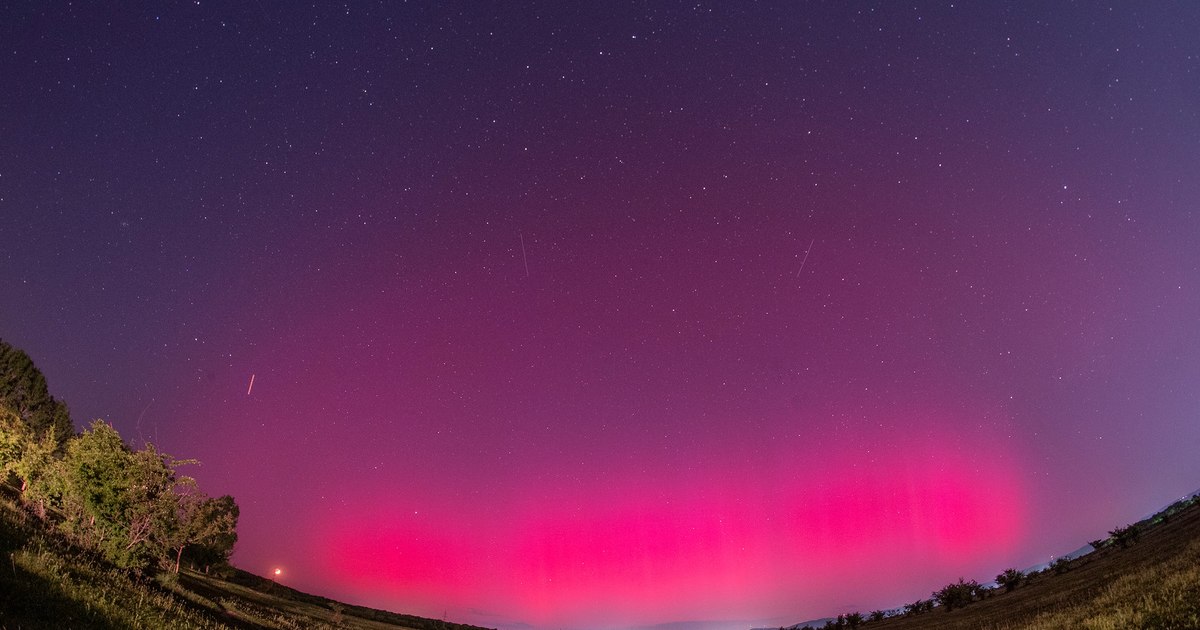
The sunspot that caused the aurora borealis in May, which was also visible in Romania, will soon be directed towards Earth again. It could reappear in late May-early June, according to Live Science.
The aurora borealis painted Romania's sky on May 11 PHOTO Valentin Grigore
Because the sun rotates on its axis once every 27 days, the sunspot disappeared from view about a week later, but it did not stop producing solar flares.
On May 20, it emitted a solar flare rated as X12, the strongest since September 2017. It was observed by the European Space Agency's Solar Orbiter spacecraft, the cited publication writes.
AR3664/AR13664 is now becoming visible again as the sun rotates – and will be facing Earth again during the June 6 new moon.
“It will line up nicely,” said Ryan French, a solar physicist at the National Solar Observatory (NSO) in Boulder, Colorado.
The June 6 New Moon rises exactly 27 days after May 10, so you need to be careful a few nights before and after that date — in case there's a repeat of last month's extreme geomagnetic activity, Live Science writes.
“If the auroras are visible near you, you'll need to move away from dark clouds and city lights to see them. Even after June's new moon, there may still be other chances to catch the aurora near you this year. Sunspots occur with greater frequency — and trigger more powerful solar flares — during the peak of the sun's 11-year activity cycle, known as solar maximum.”scientists claim.
The aurora borealis was visible from Romania, on May 11, 2024, at an intensity that has not been observed for hundreds of years.
The phenomenon could be observed with the naked eye, towards the north, especially from outside the cities, in areas that are not affected by light pollution.
“The aurora borealis was seen from Romania, as it has not been seen for hundreds of years. We do not have any information from history or from our data so far, as if something like this had ever been seen in Romania. Almost all of us who have observed it agree with this. But the pictures lie a little, because the device is sensitive to red and green – especially red. To the naked eye, the colors were not that intense. They were visible only after you got used to the darkness. After 10-15 minutes you could see shades of pink and green, but visually they were not as spectacular as they are in the photos, but they were really visibleAdrian Şonka, an astronomer at the “Admiral Vasile Urseanu” Astronomical Observatory, stated for Agerpres.
