
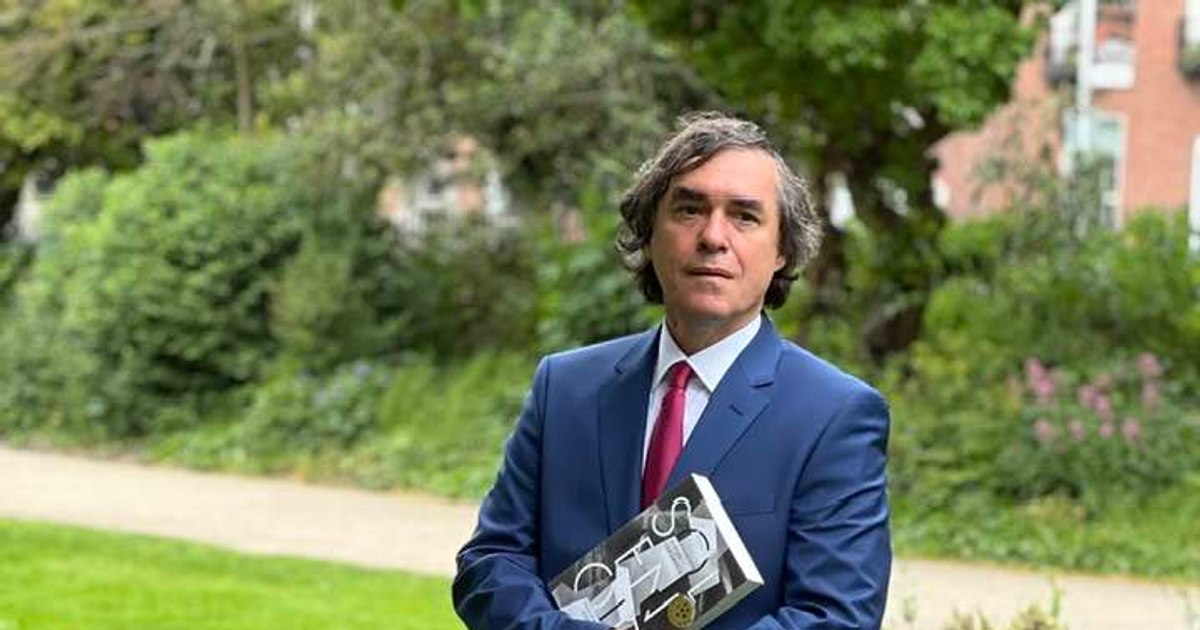
With a continuous duty and joy of writing, as he confesses, Mircea Cărtărescu considers that “Solenoid” is the novel that brought his name to the eyes of many readers.
Mircea Cărtărescu, the most awarded Romanian writer PHOTO personal archive
The great cultural event of the first half of this year bears the signature of Mircea Cărtărescu: for the novel “Solenoid”, the Romanian writer won the prestigious Dublin Literary Award. The prize, sponsored by Dublin City Council, is the largest in the world for a single novel published in English; thus, the author will receive 75,000 euros, and Sean Cotter, the translator of the novel, will receive 25,000 euros. “Solenoid” is the first book by a Romanian author to receive the Irish prize, since 1996, the year of its establishment. The novel by Mircea Cărtărescu (68 years old) was among the first on the organizers' list, being nominated by the “Octavian Goga” County Library from Cluj-Napoca.
“Solenoid” saw the light of day in Romania in 2015, at Humanitas Publishing House, and at the end of 2022, Deep Vellum Publishing House published the edition in English. Becoming a real revelation, it was named one of the best books of 2022 by “New Yorker”, “Publishers Weekly”, “The Financial Times”, “Words Without Borders”, and in 2023 “Los Angeles Times” declared -a fiction book of the year.
With joy and modesty, Mircea Cărtărescu spoke for “Weekend Adevărul” about what “Solenoid” means to him and how difficult it was for him to accept that he won – “it was a moment of soul shaking”. The writer also talks about the new phenomenon of ideologising literature, as well as about happiness – his writing and people's reading.
“Weekend Truth“: You won,
together with translator Sean Cotter, International Dublin Literary Award for the novel “Solenoid”. What were your first thoughts when you heard the news of winning this extremely important award?
MIRC
Cartarescu:
It wasn't that big of a shock because it all came in stages. First there was the long list, comprising some 80 volumes. Then I thought, of course, that I have no chance: who would choose my very book out of so many writings from all over the world, very much Irish and almost all written directly in English? The shortlist followed, with only six candidates. My chances seemed to improve, but not by much: two were Irish and all five had written directly in English. I was the only translated author. So I slept well on, resigned to the thought that, ultimately, even being nominated is an achievement. From this sleep I was awakened one morning by my American editor, Will Evans, who shouted into my ear on the phone: “You won! You won!”. Then, I confess, I had a moment of soul shaking, as if I had received a punch in the plexus. I recovered in just a few hours. It was very difficult for me to keep the secret for two months: I didn't have to say anything, not even to my closest friends, until the moment of receiving the award. It is strange that, during all this interval, I was not aware of the importance of the prize in Dublin. It wasn't until the ceremony that I found out how high he was rated, and I couldn't believe it. For the English-speaking world it is very important, because it is the biggest award given to a single novel, and in terms of financial value it surpasses all those in the American and British space.
Can the International Dublin Literary Award be a prelude to the Nobel Prize for Literature?
I've said it many times: I ask my readers not to have unreasonable expectations of me. I am an author who writes his books modestly, for his soul's satisfaction and for those who read it. Our national obsession with the Stockholm prize is not my obsession either. That's why I answer you: no, there is no connection between the award I recently won and any further development of my artistic career. It is not a prelude, it is not an end, it is an occasion of joy in itself, today and not tomorrow.
The duty to write
How much writing will consume “Solenoid”?
“Solenoid” did not consume me, but clarified and edified me inside. It came at the end of a period of about ten years in which I lived and thought about the lines of force of the novel. I had left behind “Orbitor” and, since 2007, I had entered another world, less spectacular, but more intense and serious. I wrote the book in five years, to the best of my ability, with the feeling, increasingly accentuated towards the end, that I was saying exactly what I wanted – and I must say that I lived for the last decade just so that I could write “Solenoid”. It was my novel of breakthrough
(trans. – major discovery) which, both in Romania and abroad, raised me to a higher level of reception. I have felt this since 2015 when I published it. Confirmation has come from awards abroad, the Los Angeles Times Book Prize last year and the Dublin Prize this year, among many others. Sales also increased worldwide. It was also my most imitated novel, and in our country, and it's crazy, which maybe isn't so bad.
How much liberation there was in the process of creating and writing the novel “Solenoid”?
I have never felt shackled to break free in my books. I write rather with joy, as with a kind of sense of duty and seriousness. I don't know if the lungs do their duty by breathing and the heart beats, but I do my duty by writing, since that's what I live for. But it's true that I wrote the novel with the desire to include in it a vast constellation of convergences and coincidences, and I was passionate about bringing it to fruition.
“Literary value and individual talent clash harder than is natural”
How would you describe your relationship with Bucharest, which inspires you so much?
My truly Bucharest novel is “Orbitor”. “Solenoid” no longer exults Bucharest, but looks at it more with a mixture of nostalgia and horror – “odi et amo”, as Catulus wrote. In “Solenoid”, the architectural space is extremely important, but instead of the baroque and Art Nouveau style of “Orbitor”, we used 19th century industrial architecture and steam-punk, which creates a desolate landscape, in ruins, “the saddest city from the world”. Currently, I don't even live in Bucharest anymore and I rarely go out, with a feeling, sometimes, of alienation.
Is there a need for more meritocracy in the Romanian literary landscape?
Our literary world, as well as the way of writing and understanding literature, have changed a lot, especially in the last decade. The very idea of literary value is changing. The idea of freedom of literature from what is not literature is also changing. Criticism, i.e. expertise, is on the way out, and in its place no one can create the meritocracy you are talking about (but I think it is no longer wanted either). It's a coexistence in bubbles, like Facebook, of the good and the bad alike. Small cores of validation, publishing houses, blogs and magazines, come and go, with their affiliated groups. And, of course, the ideologization of literature is a new phenomenon, which we have not known in significant forms since the 1950s. All this makes the literary value, the individual talent, the artistic consciousness more difficult than is natural. But who am I to discuss these developments? In the writings of Ilf and Petrov, an ins was beaten by militiamen without any fault. As they beat him, he thought: who am I to protest? Maybe it's good to beat me. Maybe it has to be, maybe there is a higher justification…
“I seek bright and constant joy”
How many times have you found happiness in writing?
“Happiness is liquid, while joy is solid,” wrote Salinger. The first slips through your fingers, the second you hold firmly in the palm of your hand. I may have once been very happy when I wrote a good page, but usually I look for the bright and constant joy. I write with joy, with great joy, and no one can take that away from me. As a friend from Venezuela said, no one can take away the dance you danced this summer.
How much do Romanians lack the desire for literary happiness?
It is neither a crime nor a misfortune not to read books, millions of people simply do not have the habit of reading, just as they do not go to the theater, opera performances, exhibitions, etc. They are not uncultured or uneducated people, there is no such thing, because you cannot live outside of a culture. But it does not participate in mainstream culture, but in other types of culture. Those who do not read can live well without books, but they do not know what they are missing. A slogan made famous by a publishing house is “you have as many lives as you read books”. Yes, you read to multiply your life experiences, to see the world, and other worlds, through the eyes of wonderful human beings, authors of poems and novels, playwrights, essayists… You are richer inside reading than not reading. We, the Romanians, are – Caragiale knew this – neither too much, nor very much. We read, but not as much as we could. I haven't done it for a while, but today, I hope not wishful
thinking, I started to see people reading again on buses, in parks and at the beach. Maybe we're tired of running screens on social media. It seems that today people read more, and better books.
