
A wonderful place in our country, “unique” as recognized by foreigners, has once again become the subject of an article in the international press. It is also called the “Amazon of Europe”.
Laudatory article about the Danube Delta in The Guardian Source Photo capture
A recent three-day trip, organized by the famous British journalist Charlie Ottley in the Danube Delta, had among the guests a journalist from The Guardian, established for several years in Romania. “I have lived in Romania for almost 10 years and yet I have never explored the Danube Delta”, he admitted.
And in the trip he experienced with his son and compatriot Charlie Ottley, but also with other tourists, he discovered the magic “the largest wetland in Romania”, the wildlife, history and communities of the Delta and declared himself captivated by its extraordinary flora and fauna, its stories, its seeming place “a country within another country”.
He then described the whole experience in the Danube Delta in detail in a laudatory article that appeared at the end of last week in the historical publication from the United Kingdom.
“Another world”
«”This is the Amazon of Europe”: a journey in the wildness of the Danube Delta in Romania», headlined British tabloid “The Guardian” to detail the cruise where a father and son had the opportunity to meet pelicans, eagles and ibises.
The place with one of the “the greatest biodiversity in the world, not just in Europe”, turned out to be exactly as Charlie Ottley described it to his guests. The British documentary maker, who made Romania known through the two series on Netflix “Wild Carpathia” and “Flavors of Romania”Charlie Ottley promised tourists they would see “another world”, what happened.
As for the title “Amazon of Europe”, it is not used for the first time neither by Ottley nor by the international press, being an emblem acquired during the pandemic, a business card for the chapter “tourism Romania”.
The Danube Delta cruise, through the labyrinth of reed beds, canals, floating islands, marshes, lakes and forests, on board a floating hotel, was described in The Guardian in images, sounds, feelings and words: “What I discover here seems like a country within another country, a wilderness so unspoiled and vast that it equals or even surpasses the well-known Carpathian Mountains in the richness of its fauna and culture”.
“A fairy tale landscape”
The tour through the wilderness of the delta started from Tulcea, crossing at the beginning “blue seagull alley”, as Ottley also named the Trofilca Channel: “We watch as dozens of bright blue bolts of lightning scramble around us, turning the narrow channel into a fairy tale landscape.”
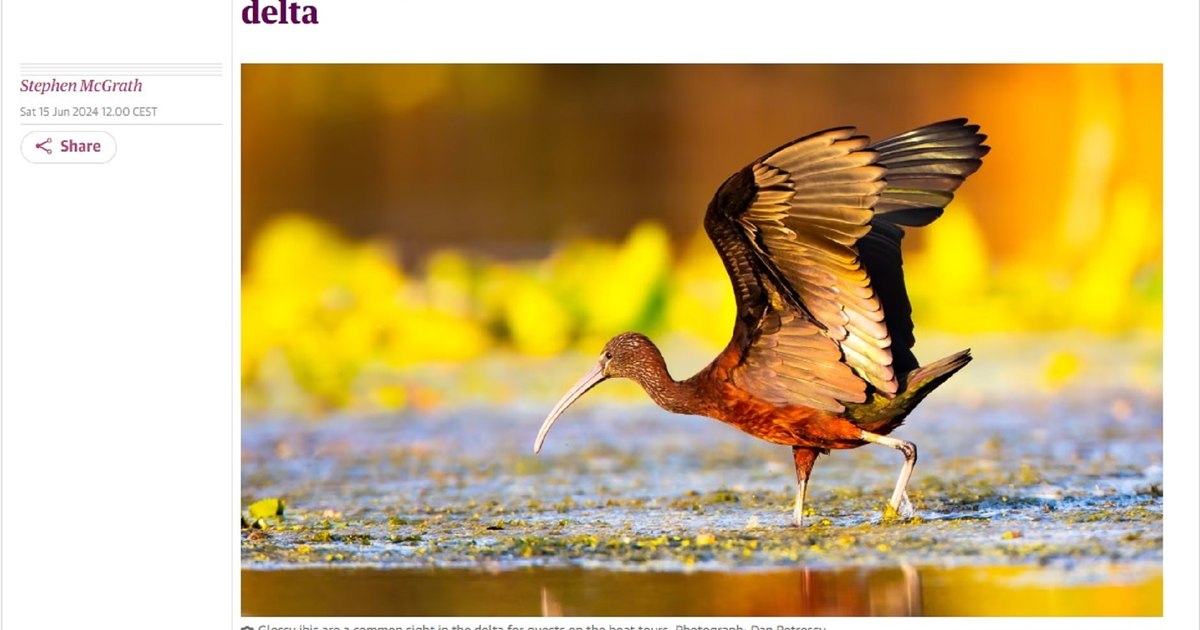
Home to more than 300 species of migratory and resident birds, including white and crested pelicans, purple herons, white-tailed eagles, pygmy cormorants, glossy ibises, or red-breasted geese, the Danube Delta is for nature lovers and nature watchers birds “what the Olympics are to sports fans”, as the British director also told the tourists: “If you are passionate about wildlife and bird watching, the Danube Delta is an absolute must. People also come here for a spiritual break. You really feel like you're leaving civilization behind.”
It was also mentioned that Ottley became “a kind of ambassador of the country” thanks to his documentaries about Romania. The reality is that the British has become the biggest promoter of our country abroad, a fact demonstrated even by the organized trip to the Delta.
“I feel like I'm in David Attenborough's documentaries”
The experience here made the author of the article admit that he felt as if he were the protagonist of a show produced by a famous naturalist, the voice of the UK's Teleencyclopedia, considered by the British a national treasure and known as the father of wildlife documentaries: “As we travel…we feel like we've been cast in a David Attenborough documentary”.
And besides the slow and quiet tour among the wonders of nature, the local gastronomy proved to be another aspect worth noting: from catfish soup, potato salad and “spicy garlic sauce called mujdei”served on the boat, to the pike roe with fresh bread, lemon and onion and the bowls of Japanese sea snails “an invasive species that thrives in the Black Sea”also with garlic and hot pepper sauce, enjoyed in one of the restaurants in Sulina where the tourists stopped for the evening.
“Father of the Danube”
“In addition to the wildlife, the Delta's history and communities are also fascinating. The region is home to the Lipovians, ethnic Russians who moved to Romania several centuries ago after breaking away from the Russian Orthodox Church. Olympic gold medalist canoeist, Ivan Patzaichinwho died in 2021, was inspired to practice this sport by other successful canoeists from his small village in the Delta, Crișan”was also mentioned in the article in the international press.
Also on this occasion, tourists also learned that another Briton, the engineer Sir Charles Hartley, linked his destiny to these places in the 19th century. Because “played a key role in the transformation of the Sulina canal” is described today by contemporaries as “The Father of the Danube”.
“You can get completely lost in this world. It transports you in an incredible way.”
On the second day of the trip, the tourists also understood what the guide meant by the fact that “the big surprise is the grandeur of the place”, when they visited the Letea Forest, to see the spectacular wild horses, undulating sand dunes and the famous subtropical reserve, but also the traditional thatched houses of Letea, mostly abandoned, because “it is not easy to live in such an isolated place.”
At the end of the trip, Ottley's words also reinforced the sense of fascination that this place exerts on its visitors: “You can get completely lost in this world. It transports you in a really incredible way.”
Such an experience, including accommodation on the floating hotel for six nights, food and the rest of the adventures can cost 800 euros/person, it is also specified in the article in The Guardian.
