
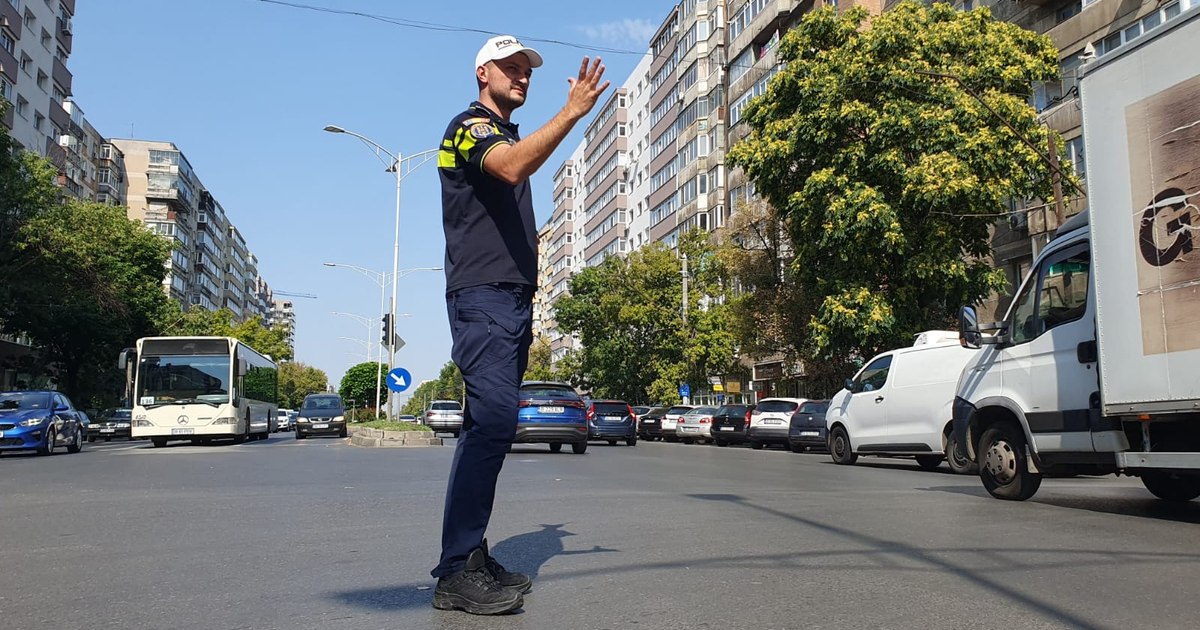
Deafening noise, blaring exhaust pipes, horns, dust, smoke, smell of hot clutch and unbearable heat that boils your brain. Bucharest is breathing heavily and panting in a heatwave bigger than the Sahara. A normal day of work for Liviu Novac (32 years old), main agent in the Police Road Brigade, who directs the traffic in the Apusului intersection, sector 6. It’s only 10:00 a.m., but the thermometers have already jumped for 32 degrees. And the day is just beginning.
Agent Liviu Novac works eight hours a day in three shifts. Photo source: The Truth
“Cement gets hot under your feet, but most of the time you can’t move from here”the policeman explained to us a little later, during a hydration break. “During this Code Red period, there were days with 40 degrees in the shade, 50, even 60 at ground level. But you have nothing to do. This is our job. Between 7:00 a.m. and 9:00 a.m., for example, you must be in the intersection that has been rounded up to you. You can’t leave there. Then you are sent somewhere else. Sometimes, you are told right from the morning: from 9.00 am you go to Ion Mihalache and take action for traffic violations. And you go straight there.”
Liviu does not complain. He likes the job he has been doing for seven years, although he admits that it is quite difficult during this heat wave. “We get mineral water when we leave the field in the morning. There are one liter bottles available and you can take as many as you want. But how many bottles to take with you? You quickly consume the water, and then you buy yourself. I go to the store and get water and food, while my colleague holds my place in the street. We also do the exchange. One takes an intersection, another takes another intersection. Well, there are also situations when we both have to be there and then we have nothing to do”.
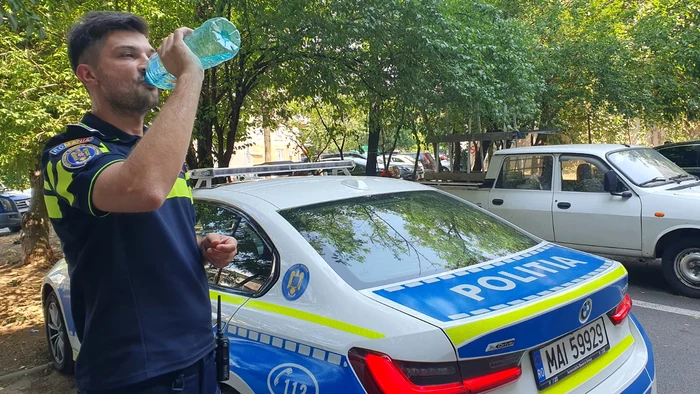
Police officers receive mineral water from the station, but they also buy their own
“The cement melted under me, I left boot marks in the asphalt”
But they manage. Especially when he finds a shady spot. “We look for as much shade as possible. Even when I stop a car I direct the driver, if I can, somewhere in the shade”.
But Liviu cannot escape the sun at intersections. “It’s hard..I remember that last year, somewhere in Victoriei, after I finished conducting in a mission I had, after about five minutes of standing still, just waving my hands and gesticulating, at the end I saw that I left a footprint on the asphalt. The cement had effectively melted beneath me. I think even now you can see the imprint of the boot”.
But, he continues, winter is just as hard. “From December 1, 2018, at the famous parade. I started work then at four in the morning and it was minus 23 degrees outside. I remember having so many thick clothes on under my uniform that I couldn’t direct traffic properly. I couldn’t raise my hand above shoulder level,” Liviu told us laughing now.
But the policeman had even harder days. “When was the first edition organized “Saga Festival”. We had to block several boulevards to allow pedestrian access, and then we stood in the sun from 2:00 p.m., when we entered work, until around 8:00 p.m. – 9:00 p.m., when evening fell. I arrived home broken from fatigue”.
Colleagues from Locala can rest easy: “The shirt is a bit thick and dark in color”
Our policeman is lucky, however, unlike some of his colleagues. “Our car has air conditioning and heating. In the summer we cool off, in the winter we stay warm. But there are colleagues who still drive old cars, with defective or ineffective air conditioning systems”.
And the new uniform helps him a lot. It is about a piece of equipment that sparked a life-and-death war two years ago between police officers and their “smaller” colleagues at the Local. The latter stole the equipment that had been intended for the Romanian Police. But, Liviu Novac reassures them now, they haven’t lost anything because “the shirt is a bit thick”.
“The equipment I currently have on me is the new uniform received at the end of last year. And compared to the old one, it is very good. It doesn’t even compare. We have a t-shirt, a pair of emergency trousers, shoes that are much more comfortable and sports, and a white cap. There is also the option with a tactical shirt, but I prefer the T-shirt. It’s a good shirt, not like the old one you had to iron in stripes. But the t-shirt is more comfortable, although I don’t particularly like it. I find it thick. It could have been made of a thinner cotton. And it’s too dark, it’s almost black, and when you sit in the sun you get warm. But, anyway, compared to what I had…The pants are ok, they have a lighter color”.
Liviu does not remember the old equipment too fondly. “The winter one, for example.. you took a shirt or whatever you wanted underneath, then you had a not very thick sweater and on top – a thin jacket. Then, those thick fabric pants, also ironed with stripes, with which you could also go to the wedding..I’m not talking about the high-heeled shoes..and with those you went to any party..and that white shirt with blue. In appearance, the uniform looked good, but it was not at all practical. I couldn’t run in cloth pants and a shirt up to the neck. You couldn’t even run, you couldn’t move dressed like that.”
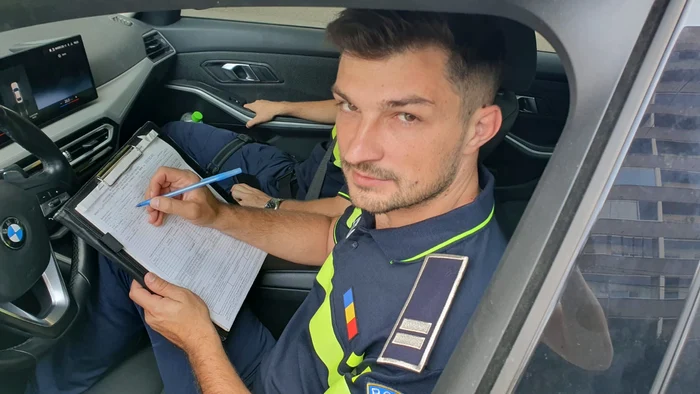
Liviu Novac’s office is the police car. Photo source: The Truth
“Did you have an accident? We are also arriving, but let it cool off a little more”
What does the law say? Because there are laws that regulate working conditions in periods of extreme temperatures. According to the Emergency Ordinance no. 99 of June 29, 2000, during periods with extreme temperatures, employers must provide employees with optimal working conditions, including: reducing the intensity and pace of physical activities, ensuring ventilation at workplaces, alternating dynamic with static effort, alternating work periods with periods of rest in shaded places with air currents, provision of adequate mineral water, provision of individual protective equipment, provision of showers.
Companies that cannot ensure these conditions are forced to reduce the duration of the working day, to stagger the working day into two periods: until 11:00 and after 17:00, to interrupt work collectively, if possible.
However, traffic policemen do not fall under these legal norms. “We receive a toxicity increase of approximately 100 lei per month and that’s it. We have a special state, we are not subject to the same regime as other employees. At 45 degrees, 35 or minus 15, we are in the street. If an accident happens, what do you do? Aren’t you going because it’s too hot outside? Or are you saying the law doesn’t allow you? Or do you say “Wait until it cools down a bit and we’ll get there too?”
The policeman confessed to us that he has nothing to reproach those in the ministry. “At the moment, I really don’t see what the people from the ministry could help us with. They bought new cars, with air conditioning, obviously, we have water at our discretion, they gave us thin and comfortable uniforms… What more can they do? When something breaks in the cooling system, it is repaired..where it can’t be done, that’s it..I understand that the car fleet is to be renewed, they will bring more cars. That’s our job, after all. It’s an outdoor job, and our office is the car.”
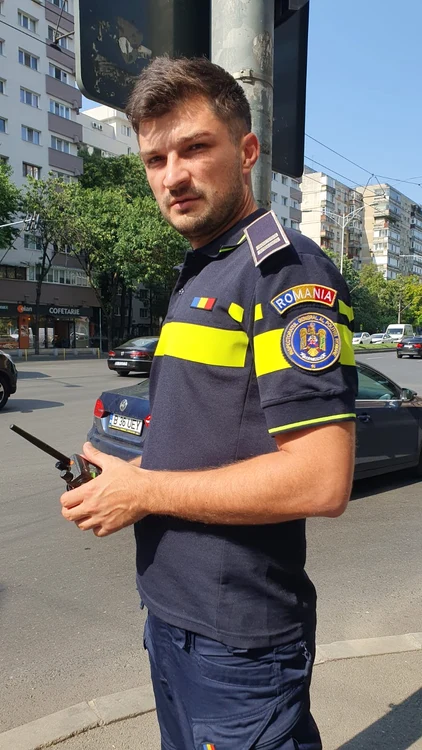
The policeman is happy with the new uniform he received: it’s thinner and cooler. Source: The Truth
For Liviu, the day starts at 6:00 a.m., when he goes to work at the Road Brigade. “You get your gun, you get your body worn camera, all the equipment you need and then you show up for training. There we are told the area of action, where we have to show up on that day, because each of us is assigned to certain positions. I’m on sectors 1, 2 and 6. Most often you’ll see me at the Victoriei intersection, in front of the Government. It is perhaps the most congested in Bucharest and in the morning it needs the flow of traffic. But they can also be at the intersection of Şincai with Tineretului, the University, Charles de Gaulles Square, Arc de Triomphe, Press Square, etc. Practically everything that means the big boulevards of the capital plus other areas where blockages, accidents or other problems occur. But I can also be in Lujerului, in Apaca, on Iuliu Maniu, in the intersection of Păcii”.
There are areas where speeders or undisciplined drivers in traffic should be very careful. The reason? Agent Liviu Novac is keeping an eye on them.
