

In the last month of summer, when many of us still have holidays scheduled, we can also make time for a cultural break. At the beginning of each month, in the pages of “Weekend Adevărul”, you can read about some of the cultural milestones that you can tick off in your calendar – whether it’s a book, a film, a festival or a music album.
A book or an audiobook is only good to take to the beach. PHOTO: Unsplash
FILM
A node of history
After the Olympics will have passed and we will be left with the shadow of the joy brought to us by the medals taken out of the water by our athletes, we can go back, for two hours, in the past, to another node of time when history written. “The young woman and the sea” tells, almost 1:1, the story of Gertrude “Trudy” Ederle, the American woman who, on an August day in 1926, became one with the water and became the first woman to swim across the English Channel. The decision didn’t come out of nowhere, as Trudy won the title of the youngest freestyle world record holder as a teenager. Then, at the 1924 Paris Olympics, he returned home with his arms full of medals, both team and individual.
In the role of Trudy we are pleased to see Daisy Ridley, who brings to the screens another good role of the brave girl – we can almost see in her eyes the power of the Force that accompanies the Jedi fighter, Rey. Between the lines (and between the waves), the film captures the painfully real and present issue of patriarchal society and gender equality in sports – “They don’t want us to be heroes. They don’t want us to be nothing” is one of the lines that best captures the perpetual past that we still live. Therefore, the film directed by the Norwegian Joachim Rønning compresses the effort – in all its forms – of a sportswoman from the interwar period, which made history to be written in 14 hours and 31 minutes.
“The young woman and the sea”
2 hours and 10 minutes
Disney+
BOOK
Pampering, from East to West
Coolness has always been in great demand in July – it is not for nothing that it is popularly called the month of Cuptor. And because the training is already done, August continues at the same hot pace. In the moments when the sun burns too hot, or the afternoon in the shelter, or the morning in the warm sea breeze, or late in the evening, when the chill begins to settle and the crickets dare to sing, open “Baths, hammams, delights. An illustrated history of the baths in Wallachia and Moldova”. A thorough expedition, during which you can discover, in the smallest details, the universe of bathing rituals, passed from the 16th century to the 19th century, from the Eastern world to the Western world, the slow transition from the Ottomans to the Europeans .
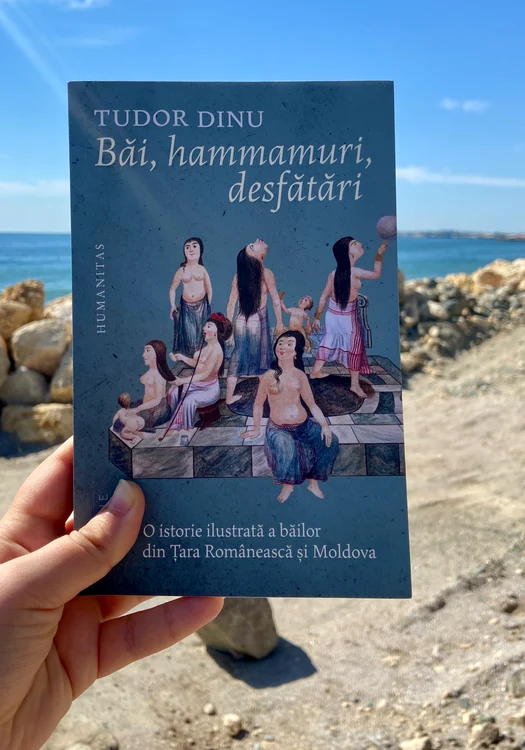
“Baths, Hammams, Delights” was taken on the beach
For hundreds of years, bathing places did not mean body hygiene, but rather an activity of social life, with rules and indulgences depending on status and locality. Tudor Dinu brings to the reader’s eyes buildings and people, necessities and sophistication, from the first public baths to spa resorts – culture and business. The details are especially precious and perfectly complete this little world that came to life every summer – for example, how many changes were offered to the customers during their time there, what fabrics they were made of, how many cushions they sat on or the obligatory coffee ritual from after the bath, in turn, explained at leisure, layer by layer – from the place of origin of the coffee beans to the different types of cups or kettles.
“Baths, hammams, indulgences. An Illustrated History of Baths in Wallachia and Moldova”
Tudor Dinu
Humanitas Publishing House: here you find more information about the book
312 pages
AUDIOBOOK
The sound of the samurai
Time is one of the main resources that people feel they are losing more and more quickly. The endless marathon towards a balanced life seems more like Sisyphus’ job. For those who consider breathing time to be moments when they are doing something – sports, going from home to work, household chores – audio books were invented. Although they have been on the Romanian market for a long time, audiobooks have found a nice (and tidy) home called Voxa. On this Romanian platform you can find books in both audio and digital format (if free time and the desire to read catch you without a book at hand), both in Romanian and in English, plus all the books are organized by categories of interest – it is, however, our largest audiobook bookstore. To access them, an account and the purchase of a subscription are required, the books being available both on the web browser and on the Voxa application (Android & iOS friendly).

If you’re still not convinced that an audiobook might be to your liking, you have a free seven-day trial period. And if you start with the first volume of the novel “Shōgun”, read by the actor Şerban Pavlu, you can’t help but fall in love with this new coat of books. So now James Clavell’s novel not only has an excellent recent screen adaptation (to be seen on Disney+), but also an audio format… just like the book.
FESTIVAL
From the glint of the water or from the foot of the mountains
The last month of summer continues with many festivals – big or small, international or local, from music and film to food or technology. And since the tie-breaking is very difficult, a criterion worth taking into account, especially during the summer, is the geographical one.
For the first time we head to the Delta, where, for 21 editions, the independent film has its home – this year, for a week. The open-air cinema is in Sfântu Gheorghe, where the organizers of the Anonymous Festival have set up a tourist complex that is friendly to nature, but also to the film. Between a screening and a debate, the small village of Tulcea is only good to take a walk – you can’t get enough of the streets that still have dirt, the houses with reeds and small, shady kindergartens, the (semi) wild beach, which remember that there is still a place for fishermen. The feature films and short films, Romanian and international, are carefully watched by a specialized jury, which at the end also designates the winner. There are also debates on the present and future cinematography, the subject being dissected piece by piece by people in the industry, but also by the public.

If you put off the film from the reeds of the Danube Delta, history – both on-screen and debated – awaits you at the mountain. Appeared in 2009, the Râșnov Film and Histories Festival now has a large edition, under the hat of this year’s burning theme: leadership. If in the past the festival took place only in Râșnovului Citadel, this year, the film and history also reach Brașov, Codlea and Feldioara, being hosted in suitable locations. The program is extensive and only by being a superman you could get to everything – but with careful organization, you can check the screenings of films and documentaries (plus the Q&A moments afterwards), the debates with specialists of history and cinema (for example, the year this one, one of the featured guests is the French historian Thierry Wolton), as well as exhibitions, workshops and concerts.
ANONYMOUS INTERNATIONAL INDEPENDENT FILM FESTIVAL
August 12-18
Saint George, Tulcea
www.festival-anonimul.ro
RâŞNOV FILM AND HISTORY FESTIVAL
Feldioara August 9-11
Codlea August 10-11
Brașov August 11-16
Râșnov August 16-25
www.ffir.ro
EXHIBITIONS
Interior perspectives
Arsmonitor, the newest art gallery in Bucharest and the first to open at Casa Presei Libere in Bucharest – here’s how beautifully a space from the realm of oblivion comes to life -, brings art lovers its fourth exhibition this year. Visitors are seated at the table and turned into curators. Therefore, everyone has the opportunity to build their own experience with the pieces of others – art turns into art, the staff goes from artist to visitor. Works signed by Grațian Gâldău, Dumitru Gorzo, Ioana Gorzo, Teodor Graur, Nicu Ilfoveanu, Gili Mocanu, Răzvan Neagoe, Ilie Pavel, Radu Pandele, Bogdan Pelmus, Magdalena Pelmus and Mircea Suciu form an archive to which everyone can give personal significance. As the organizers say, “the exhibition «Table et Tableau» gives the table a function as a critical medium, offering accessibility and inviting touch, engaging the viewer to create his own meaningful organization, tasting the sensation the curator aspires to – that of being author – subjecting the archive to the condition of raw material, which he can shape according to his own limitations”.
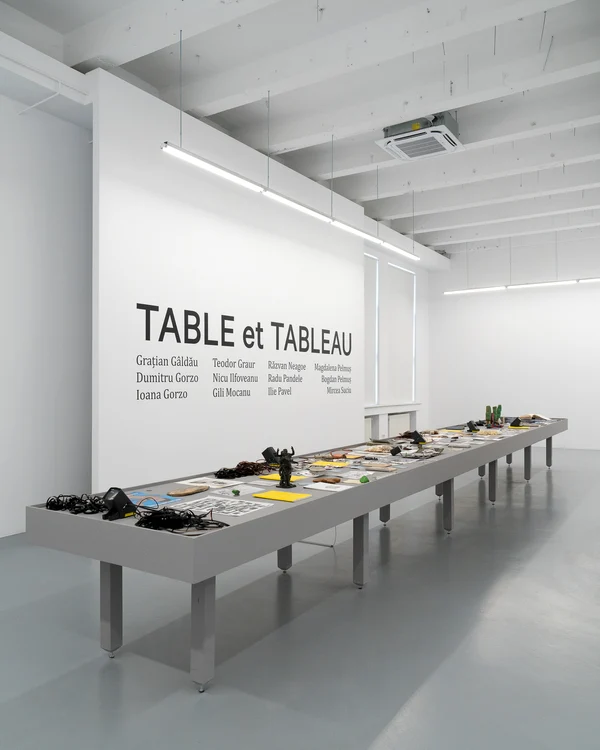
Another interior perspective can be found in the FRONT photography exhibition, to look at and think about. Vadim Ghirda and Larisa Kalik have captured the pain and fear, longing and hope, life and death in which contemporary wars are clothed. Larisa’s photographs have a deeper personal imprint, as she documents the war at home, in Ukraine. On the other hand, Vadim Ghirda, winner of the Pulitzer Prize, concentrates in this exhibition the many years in which the camera stood face to face with the wars of our world.
TABLE ET TABLEAU
House of the Free Press, Bucharest
Until August 29
FRONT
Bastion 1, Timisoara
August 8 – September 15
