
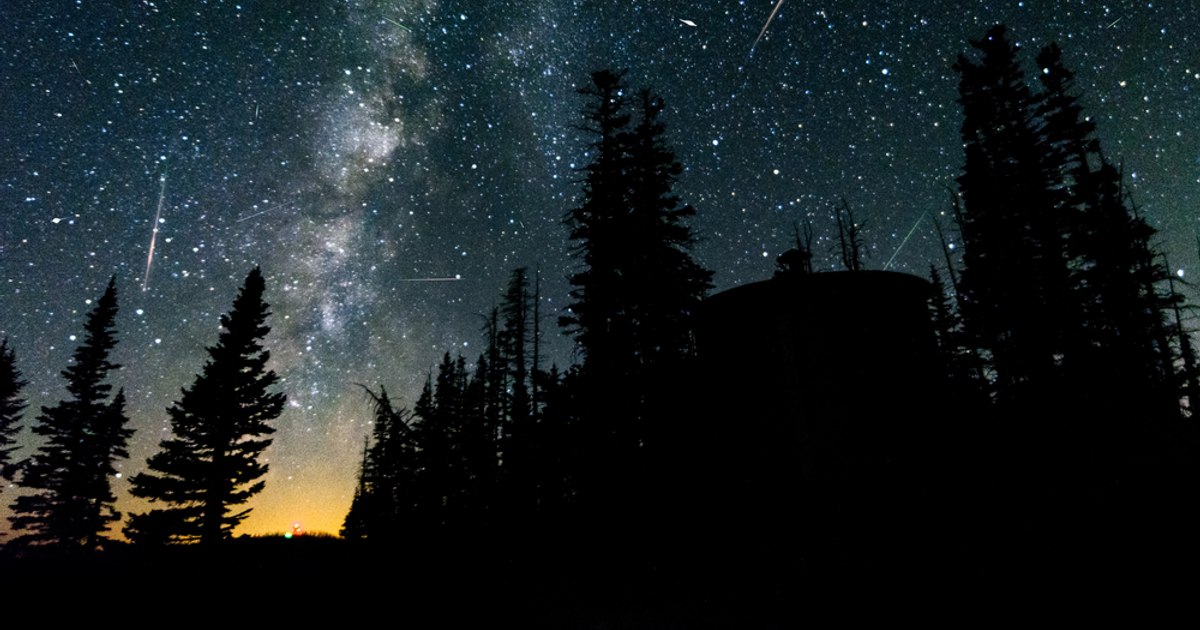
The Perseids, this summer’s brightest star shower, active from July until the end of this month, peaks on the night of August 11-12, before sunrise.
The shower of stars can be seen tonight. Photo source: archive
What are the Perseids?
Named after the constellation they appear to come from, the Perseids are one of the many meteor showers active in a year. It is one of the brightest and easiest to observe such phenomena over the year, producing “bright blue meteors – and lots of them”says astronomer Don Pollacco from the University of Warwick, quoted by the Associated Press.
What is a meteor shower?
Several meteor showers occur annually and no special equipment is needed to see them. Most meteor showers come from comet debris. The source of the Perseids is comet 109P/Swift-Tuttle. When it passes by the Sun, it sublimes and the cosmic dust trapped in the frozen core is released into space, writes astro-urseanu.ro. When rocks from space enter the Earth’s atmosphere, air resistance makes them very hot. This causes the air around them to glow and briefly leaves a tail of fire in their wake—the tail end of a so-called “shooting star.” The incandescent blobs of air around fast-moving space rocks, from the size of a dust particles down to that of a boulder, can sometimes be visible in the night sky.
The shooting star phenomenon is well known. The light trail in the sky is left by a particle less than 1 mm in diameter that ignites the air as it enters the Earth’s atmosphere. For a fraction of a second, we see this phenomenon, called a meteor by astronomers. The particle of cosmic dust that burns in the atmosphere is called a meteoroid, and the stone that sometimes falls to Earth is called a meteorite, says astro-urseanu.
The Perseids result from “larger particles than many other meteor showers”explains NASA’s Bill Cooke, which gives them the appearance of “bright fireballs” – easier to spot than many others.
How can you see a meteor shower?
Meteor showers are usually most visible between midnight and the pre-dawn hours. They are easier to spot under dark skies, away from city lights. Meteor showers are, of course, brighter on cloudless nights, when the moon is at its lowest.
The Northern Hemisphere will have the best view of the Perseids. This year’s peak coincides with a full Moon in a proportion of about 40%.
Any meteor shower has a moment of maximum, when meteor activity is greatest. For the Perseids, the period of activity is between July 17 and August 26. During this period, in addition to meteors that do not belong to a stream (sporadic), meteors that seem to come from the Perseus constellation can be observed.
When is the best time to see the Perseids in Romania?
The maximum current will come on August 12, between 16:00 and 19:00 TLR (Romanian legal time). Because the maximum comes during the day and meteors cannot be seen during the day, you will have to look at the sky the night before the maximum, i.e. the night of August 11 to 12, and the night after, August 12/13. It will be possible to observe the upward slope and the downward slope of the maximum, between August 11-14, according to Astro-Urseanu.
Those who will observe the phenomenon from clear sky areas will be able to see a maximum of 100 meteors per hour. Those observing from cities will see 10-20 meteors per hour.
To see as many meteors as possible, you need to look at the sky for at least an hour, lying on your back. The longer you observe, the more meteors you see.
During the maximum of the Perseids, about one meteor per minute can be seen.
However, one cannot speak of a “rain of stars”. A few thousand meteors per hour can be seen during a shower, but these are very rare.
The next big meteor shower will be the Orionids, peaking in mid-October. Between October 21 and 22, the Orionids produce up to 30 meteors per hour. All the fragments that burn up in the atmosphere come from Halley’s Comet.
