
Cheile Turzii, an emblematic place of the Apuseni, is visited annually by tens of thousands of people, but many of them risk their safety, because of the wrong way in which they approach it.
Turzii Keys. Photo: Daniel Guță THE TRUTH
Turzii Keys (video) were “sculpted” by water and time in the calcareous relief of the Trascău Mountains, located in the eastern extremity of the Apuseni, and the monument carved by the force of nature has become one of the most spectacular places in Cluj.
The canyon bathed by the waters of the Hășdatele stream is located less than ten kilometers from the municipality of Turda, at a similar distance from the junctions of the Transilvania (A3 Turda – Târgu Mureș) and Apuseni (A10 Alba Iulia – Cluj- Napoca) highways and a few kilometers by the Turda – Câmpeni road from the Apuseni Mountains and by the Turda – Alba Iulia road from the Mureș valley.
Visible from distances of tens of kilometers and close to important communication routes in the Transylvania region, the Turzii Gorges have become a tourist landmark of Cluj, but many of those who visit them for the first time do not know what to expect from crossing them .
Cheile Turzii has been declared a natural monument since 1950, and since then the access route through the almost 1.5 kilometer long canyon has been arranged so that it is more accessible to tourists. The road from Turda to the entrance to the Gorge is paved, a few kiosks and parking lots have been set up at the foot of the mountain, at the entrance to the hiking trail, the paths have been widened and smoothed in places, and several footbridges have been built in the gorge, over the stream The laughs.
The usual city shoe on a difficult trail in places
But there is one thing that few tourists take into account, so the trip through the “cleft” of the mountains can end unhappily. Of the dozens of tourists who can be found on a typical day on the narrow paths of Cheile Turzii (video), only a few of them have the appropriate footwear for such adventures.
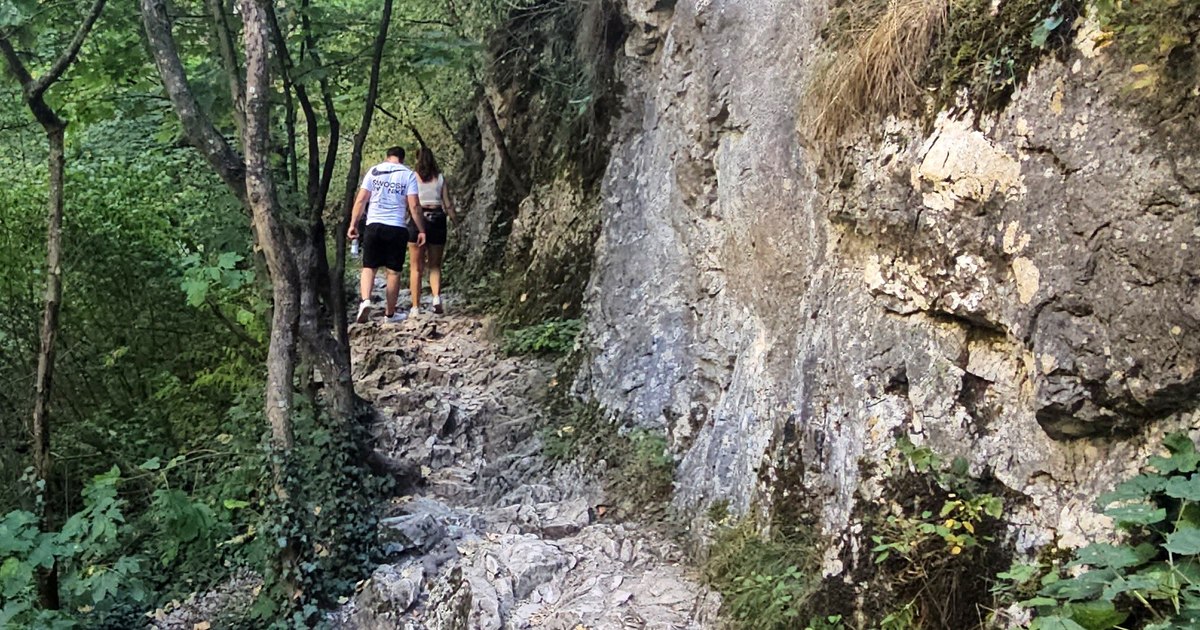
The route of the gorge is of medium difficulty, but the path is mostly covered with sharp and slippery stones, on which tourists can slip.
“Most come in city shoes. I saw old people in sandals or flip-flops, struggling to continue their path on the boulders on which they could slip at any step, not only in the places where the path of a few tens of centimeters separates the mountain from the precipice. Many young people can be seen in tennis shoes, and some young ladies don’t give up high heels here either. Then they complain that they can no longer walk. I also saw children wearing slippers unsuitable for any mountain trip”says a hiking enthusiast who came to the reserve.
Specialists recommend that those who reach the gorge in the Trascău Mountains be equipped with shoes with profiled soles, in no case smooth, to prevent slipping. In some sections of the gorges, metal ropes have been installed for support, hanging from the rock, so it is good for visitors to have a small bag on hand in order to be able to use these ropes more easily.
Tourists frequently leave litter behind
At the entrance to Cheile Turzii, from the parking lot, there is a Salvamont point, which tourists can call in case of need. The rescuers can be contacted via 112 or the O-SALVAMONT numbers 0725826668 (Cluj dispatch) and 0746-057.687 (Cluj Rescue).
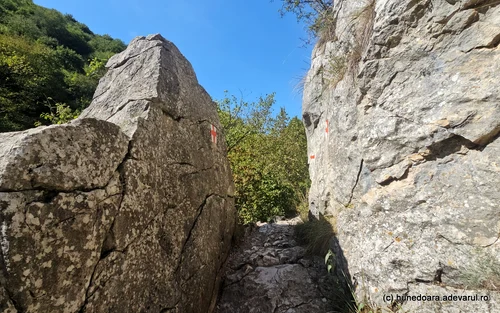
Image 1/15:
Cheile Turzii Photo Daniel Guță THE TRUTH (147) jpg
There are several springs in the area of Cheilor Turzii, but for greater safety, visitors are advised to have water reserves with them. The canyon can be walked in about an hour. Along the way, tourists find some of the more than 60 caves in the area, and the view is dominated by the steep and rocky slopes that border the gorges on both sides. Throwing garbage in places not designed for this in the reserve is prohibited and is punishable by fines of up to 6,000 lei, but many tourists do not heed the warnings, so the area at the entrance to the gorge is frequently polluted by visitors.
Cheile Turzii nature reserve occupies an area of over 300 hectares and appears to travelers from a distance as a huge cleft in the calcareous relief of Petrid mountain.
“The Turzii Gorges, the true sculptural masterpiece of a Jurassic limestone massif, which represents a spur of the Trascău Mountains, located at the eastern extremity of the Apuseni Mountains, were born from the tireless struggle of a flowing water, the Hăşdatele river, which, in approximately 100 million years ago, a huge “axe” split the “body” of Petrid Mountain, originally composed of a compact block of stone, splitting it to a depth of 300 meters, over a length of about 1.5 kilometers. wrote biologist Ferdinand Tauber in 1987.
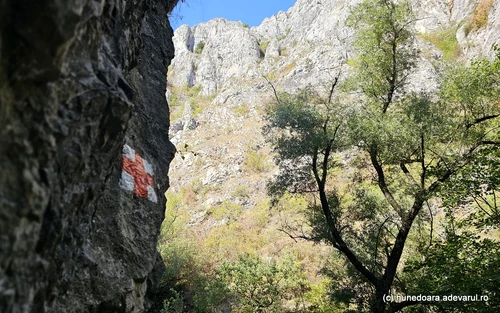
Image 1/15:
Cheile Turzii Photo Daniel Guță THE TRUTH (64) jpg
According to the scientist, the archaeological research that took place in Cheile Turzii attested very old traces of prehistoric human habitation both from the Paleolithic, in the caves located in the upper part of the gorges (Millers Cave, Călăștur Cave), and from the Neolithic (Cave Homarilor, Hungarian Cave) and vestiges dating from bronze and iron eros, discovered mainly in the caves located at the middle and lower level of the gorges.
Reserve with plants protected by law
The Turzii Gorges harbor an extremely diverse flora, adapted to the calcareous relief and climate.
“The karst formations of the calcareous rocks inside the gorges, with steep walls, sunny or shaded, suspended shelves, isolated rocks, with the relief carved in the form of corners or towers, alternating with chimneys or dizzying “cigars”, at the gates of which we find rumblings or noises vroit, of stones, collected from the abyssal slopes, which, all of them, make up a chain of varied and complex microstations, have favored and allowed a rich mosaic of flora. The long geological history of the gorges, the changes in the climate and the varied substrate conditions have allowed the installation various species, from special migration periods that have found a suitable refuge in the gorges”, pointed out the biologist Ferdinand Tauber.
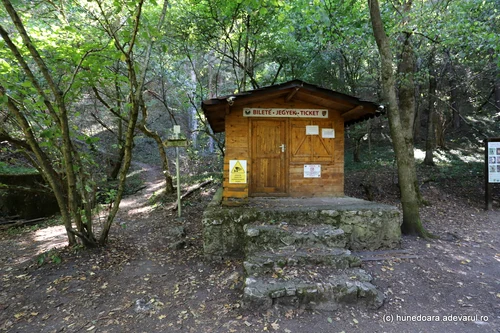
Image 1/20:
Cheile Turzii from Cluj Photo Daniel Guță THE TRUTH (57) JPG
In Cheile Turzii, we can find some plants preserved as descendants from the Tertiary period (about 60 million years ago), when there was a warm climate.
“Famous in this sense is a species of wild onion, with glossy, yellow-green flowers, called by the locals the crow’s onion (Aliium oblicuum), discovered in 1858 by the botanist G. Wolff. It is only found in a few places in the world, in Turkistan, beyond the Volga, in the south of the Ural Mountains, and in the Tian-Shan Mountains of Central Asia. Isolated and well-sheltered specimens on the almost inaccessible rocky shelves of Cheile Turzii, are an indisputable European rarity”the biologist pointed out.
Many other species of plants protected by law can be found in the reserve, but their cutting and actions that can harm them are prohibited and can be punished with fines.
