
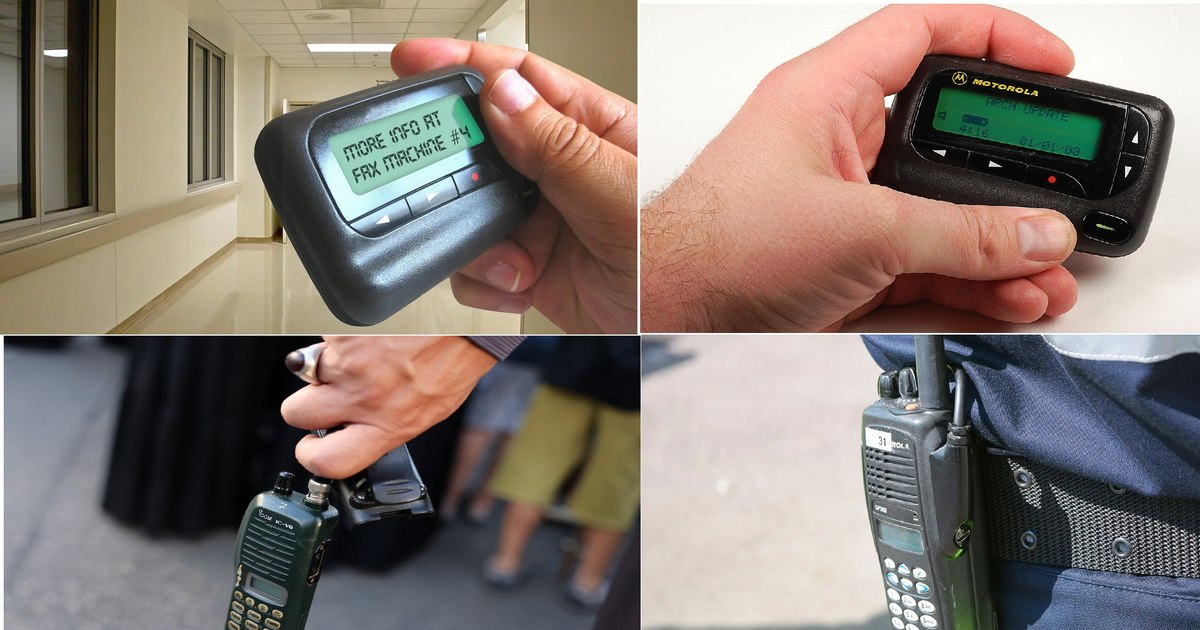
Thousands of portable telecommunications devices – pagers and walkie-talkies – were recently used in the Mossad operation in Libya and Syria on Hezbollah, causing numerous casualties. They are preferred for their reliability in places where mobile signal is lacking. But what exactly are they?
Portable telecommunications devices (SEE ) were used as a trap to set off explosions for two consecutive days. Although both are used for fast and reliable communications in isolated areas, there are important differences in their usage and features: pagers transmit text messages or sound alerts, while walkie-talkies allow two-way voice conversations.
Thousands of trap pagers and walkie talkie stations exploded from Lebanon and Syria Collage
What are pagers and transceivers
Pioneers in mobile communications and a forerunner of today’s smart phones, pagers are currently making a comeback following this week’s explosions in Lebanon and Syria, in Beirut and Damascus, along with walkie-talkies, which killed 32 people and over 3000 were seriously injured.
Also called “beepers”, popular in the 1990s before the advent of mobile phones, pagers are still used in certain fields, such as the military or medical, and are valued for their reliability and simplicity. They are small telecommunications devices, designed to send and receive short messages or alerts via radio waves.
Mainly, pagers are one-way or two-way. Some can only receive messages, usually in the form of numbers that the user must call, while others allow both receiving and sending short messages. They are used when mobile phone communication is not safe or possible, in spaces where mobile signal may be non-existent, such as basements or secure rooms, or in dangerous situations.
Walkie-talkies, or two-way radios, are portable two-way communication devices that operate by transmitting radio signals on specific frequencies. They allow users to communicate with each other, similar to telephones, but without depending on mobile networks or the Internet. They are especially used in situations where other forms of communication are not available or practical, such as in isolated areas, at events, in outdoor activities or for coordinating response teams.
Here is some information on the history, operation and uses of these devices.
When did pagers appear and what are they used for?
Few people know that pagers have a history of over a century. The first pager was invented in 1921 and was initially used in specific areas such as hospitals and emergency services. They became more widespread in the 1950s, and in 1962 Motorola released the first portable pager for doctors.
The 1980s and 1990s were the heyday when pagers became extremely popular, especially among doctors, businessmen and technicians. In 1994 there were over 61 million users worldwide. Towards the end of the decade, mobile phones and texting began to gradually replace pagers.
They were mainly used to receive short text messages or sound alerts. At first, they only received numeric codes, and users had to call a certain number to decipher the message. Later, pagers capable of receiving text (alphanumeric) messages were also developed. For example, someone could send a message from a call center or a landline, and the pager user would receive those messages.
In the medical field, pagers were essential for doctors, allowing them to receive alerts in the event of an emergency. Although largely replaced by cell phones, pagers are still used in some industries and fields. They are preferred in hospitals and clinics for their high reliability, in places where mobile phone signal may be weak or non-existent and where they do not interfere with sensitive medical equipment. They are also used by emergency services (fire, paramedics, police) because they are faster and more reliable than SMS in an emergency. In the nuclear industry and other hazardous environments where the use of telephones is prohibited due to interference or fire risks, pagers remain an effective communication solution.
When did broadcast reception stations appear and what are they used for?
Broadcasting stations appeared during the Second World War. Although the concept of the portable radio dates back to the 1920s, the first walkie talkies as we know them today were developed and used extensively during the war for fast, mobile communications between soldiers.
In 1937, also the American company Motorola (then known as Galvin Manufacturing Corporation) released an early model of walkie talkie, called “Handie-Talkie”, which was widely used by the armed forces. This device marked the beginning of the popularization of portable two-way communication technology.
After the war, walkie-talkies began to be used in other areas such as the police, emergency services and industry, becoming an essential tool for team coordination and communication in the field.
Walkie-talkies continue to be irreplaceable in many fields, thanks to their ability to ensure fast, reliable communication independent of complex infrastructures.
These devices are used in various critical and professional situations: for emergency and intervention – by fire, police, rescue and medical intervention teams to quickly coordinate actions in case of disasters and emergencies; at events and security – at concerts, festivals and other large events, being used by security teams to maintain effective communication and manage security; in outdoor activities – camping, hiking and hunting, where they are essential to stay connected in areas where mobile signal is not available; in construction and logistics – on construction sites and in warehouses, to facilitate rapid communication between teams; in industry and transportation – ports, airports and factories rely on these devices to coordinate operations and ensure the smooth running of activities.
What these portable telecommunication devices look like
The design of a pager varies by model and period, but in general, pagers are small, compact and portable, often rectangular in shape that can be clipped to a belt. They are similar to Bluetooth headset charging cases, but slightly larger. More recent models have LCD screens, which in modern versions are often colored and can display numbers or text. Pagers usually have simple buttons for reading and deleting messages, as well as turning the sound on and off. Some more advanced models include vibration features for silent alerts.
In contrast, a typical walkie-talkie has a compact and ergonomic design so that it is easy to hold in your hand or carry on your belt. These devices are equipped with a robust housing, often built to withstand shocks and harsh environmental conditions. They have a top-mounted external antenna for transmitting and receiving radio signals, an essential “Push-to-Talk” (PTT) button for initiating voice transmissions, and an integrated speaker and microphone for sound capture and playback. Some models of walkie-talkies are equipped with an LCD screen that displays information about the channel in use, battery status and other parameters. They also have a channel selector for changing frequencies and a volume knob for adjusting sound intensity.
How it works. Types
Pagers are communication devices that vary in how they receive and display messages. The main ones are:
Numeric – displays only phone numbers or codes, with the main function of notifying the user to call a number;
Alphanumeric – can receive and display text messages, providing more detailed communication and are popular with professionals;
Unidirectional – only allow receiving messages, used for alerts and notifications;
Bidirectional – allow both receiving and sending messages;
Tone pagers – emit a sound signal to notify calls, frequently used in hospitals and emergency services;
GPS paging – provides both messaging and user location information, useful for real-time position tracking;
Group paging – allow sending a simultaneous message to several users.
Emergency pager – designed for quick alerts, frequently used by emergency services.
Walkie-talkies work on the basis of radio waves and use VHF or UHF frequencies. The user presses the “Push-to-Talk” (PTT) button to transmit messages, which are converted to radio signals and transmitted through the antenna. The other user receives the signal, which is converted back to sound. These devices allow real-time communication, but only one person can speak on a channel at a time. Walkie-talkies are available in versions:
Simple – used for recreational activities, with a limited range of about 1-5 km;
Professional – used by emergency and security teams, construction or industry, having a longer range and advanced functions, such as encryption of communications or connection to signal repeaters;
With additional features – modern models can include GPS, water resistance and Bluetooth connections.
Both types of devices are essential for real-time communications in environments with limited or inadequate infrastructures.
Trap devices used in unprecedented attacks
Trap pagers and walkie-talkies exploded on Tuesday and Wednesday, September 17 and 18, 2024, in unprecedented attacks. Numerous members of the Lebanese militant group Hezbollah became victims.
For more than half a year, members “Resistance” – Hezbollah fighters and the Lebanese Shia militia – have used these devices to communicate without being intercepted, thus avoiding telephone networks that have reportedly been hacked by Israel’s Mossad.
Small amounts of explosives are suspected to have been placed inside the pagers and walkie-talkies, which were detonated by a signal. The first person to use these devices set off the chain deflagrations.
In the attacks – 12 people were killed on Tuesday and another 20 on Wednesday – two children also died. Lebanese hospitals are overcrowded with victims suffering from amputations of limbs, facial and abdominal injuries, and loss of sight.
