
Wallachia, in the 18th century, appears in the memories of various travelers who passed through the Wallachian principality as a land of contradictions: a paradisiacal nature, with forests of fruit trees and vines growing everywhere, where people live in the more severe poverty and misery.
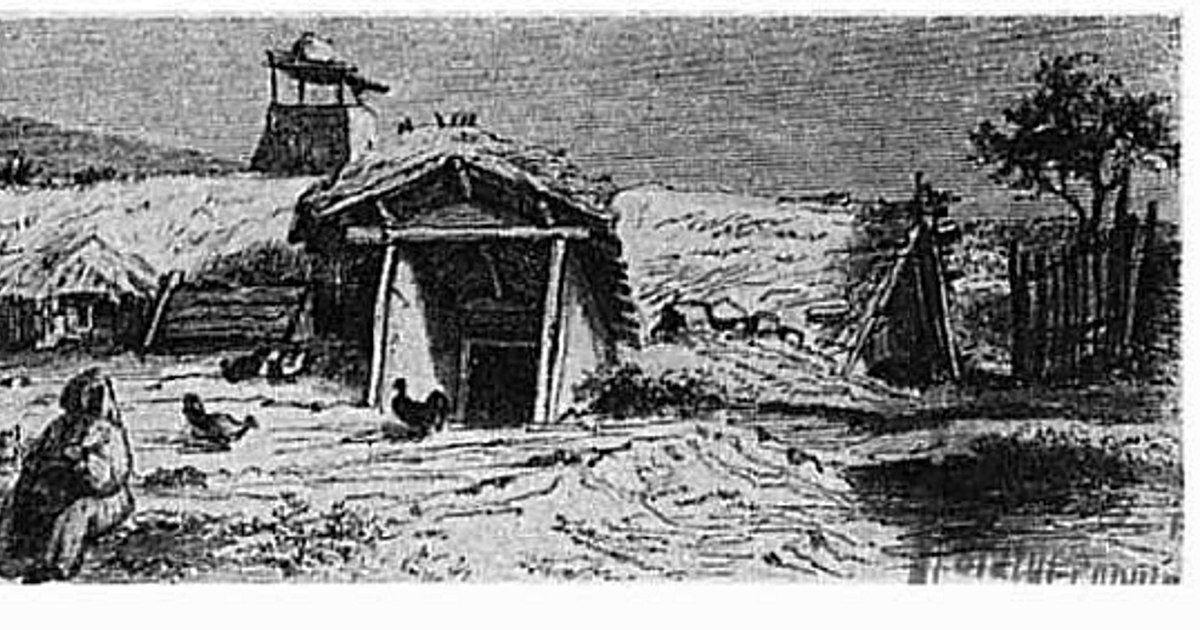
Bordei from Wallachia, image taken by the Frenchman Auguste Lancelot in 1860. PHOTO: Historice
Wallachia in the 18th century appears in the memoirs and travel notes written by various travelers who transited the Wallachian principality as a land of contradictions, notes historian Bogdan Bucur, in the volume “Wallachian Revelation (1716-1828): an anarchic history” of the Romanian space”.
The first of these glaring contradictions that struck the foreign traveler was the terrible contrast between the benefits of a nature that was compared to a true paradise and the massive depopulation caused by the flight to the mountains, forests or across the border of the peasants from the Wallachian estates, the agricultural lands remaining thus often uncultivated, in disrepair.
A paradise on Earth: “whole forests of fruitful trees”
“All foreign travelers noted with enthusiasm the endless multitude of rivers, streams, lakes and springs with which the divinity enriched Wallachia. All the foreign travelers mentioned that the Wallachian lakes and rivers are “full of the tastiest fish”, and their “endless multitude and variety” “passes all plausible description”. The fruitful character of the Wallachian plains (“the mildness of the climate and the generosity of the soil”), watered by a large number of rivers and furrowed by a number of “thousands of pleasant valleys”, was also noted. It has always been specified in the writings of foreign travelers that such a natural richness of the soil amply rewards the “toils of the ploughman”, and “the cultivation of such land generally requires too little care and labor, for the soil to yield in abundance all kinds of fruits and grains” – shows the quoted volume.
Travelers found in Wallachia “entire forests of fruit trees (pears, apples, cherries, wild vines and others)”, “green melons are so large and tasty that they surpassed anything that foreign travelers have seen in other European countries”again vines grow everywhere in Wallachia, the wine being “good and plentiful“.
Animals, both wild and domestic, are still an important element in the food and wealth of Romania.
“The quality and beauty of the horses of Wallachia, the size and strength of the oxen, the fecundity of the cows, the wealth of the sheep and goat herds are known and heralded throughout Turkey and in all the neighboring countries. Big game of all kinds abounded in the Wallachian principality, and the hunter easily found opportunity to exercise his skill. The forests and mountains are infested by: stags, deer, wild goats, wild boars, and the plains, especially, by rabbits”quotes the historian.
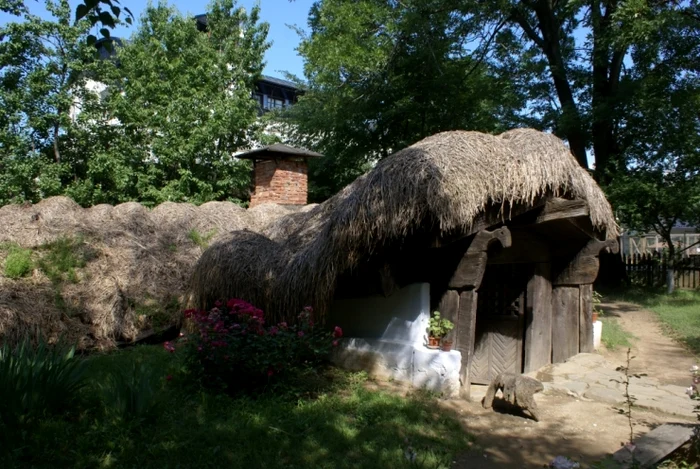
Bordei from the 19th century reconstructed at the Museum of the Romanian Peasant in Bucharest. PHOTO: MțR
Paradise where the population lives in abject misery
After the description of such natural abundance with which Wallachia was endowed, all foreign travelers express the surprise they feel when they come into contact with “the social realities of the Wallachian principality, with the massive depopulation of the plain areas, with the flight to the forests, mountains or across the border of an important segment of the Wallachian population, with the poverty and cruel misery in which they struggle, in the middle of a true natural paradise, the overwhelming majority of the rural population.”
In a Geographical Sketch of Wallachia and Moldova drawn up, in 1769, by a Galician Jew who remained anonymous, he describes natural riches such as grain, wine and melons, beautiful flocks of sheep, herds of cattle and horses, as well as salty springs. “But this anonymous author also notes in a sad tone that the number of inhabitants is always decreasing due to heavy taxes, which make them (the Wallachians) leave their country en masse”. it is shown in the cited book.
In a letter sent from Wallachia by the Italian abbot Lionardo Panzini on December 1, 1776, it is mentioned that “The Wallachia is surrounded by a chain of mountains rich in various copper, iron, silver and gold deposits – which are not exploited -, as well as abundant mines that make up a very important branch of the princely income.”
After this extremely favorable and enthusiastic description, the Italian abbot Lionardo Panzini cannot contain his surprise when he finds that a country so favored by nature reached in the 18th century “an object of pity”, for a foreigner and a European who think about “state of ruin and degradation” in which the Wallachian principality is located.
“Humiliate to the last expression a human being can be”
In 1794, around April-May, the Englishman John Sibthorp, having to spend the night in the first Wallachian settlement closest to the border between Wallachia and Austrian Transylvania, describes the Vâlcean settlement Câineni as “a small village consisting of a few miserable shacks”, where a poor Wallachian peasant offers the English traveler his bed which “it was so full of vermin that I left it for the clay floor on which, covered with my riding cloak, I spent the rest of the night”. Next, several travelers describe, in a selection made on a page dedicated to reading, the misery in which the inhabitants live.
Confessing to his mother, in a letter sent from Wallachia, in the same year 1794, during the months of June-July, John Bacon Sawrey Morritt testifies that during the journey from Sibiu to Bucharest, he hardly entered any house, “let’s not even eat”for the villages and huts are so poor, “so that we always slept in our carriages or under a tree rather than use a bench” (beds being unknown at that time in Wallachia) and “let’s fill ourselves with lice”.
Passing through Wallachia, in the spring of 1802, while going from Constantinople to France, the antiquities collector Edward Daniel Clarke recorded the fact that the first Wallachian post station was the Giurgiuvian locality of Daia – “a sinful village”, where he observes the way of living of the peasants who live in a state of “quasi-sanity”, being “stripped” of everything they should possess and “the entire population is reduced to the humblest state of servitude”, living “in mud huts and covered with reeds, without any sweetness of life”.
In October 1805, the French traveler Louis Allier De Hauteroche mentioned the fact that the village of Daia is “a pile of a few brothels dug into the ground, with the roof at ground level”and the inhabitants “very resistant to fatigue”having all, without distinction, “the humblest countenance” and “humiliated to the last expression that a human being can be, patiently enduring all manner of insults and oppressions.”
The British physician William Michael remarked in January 1818 that “the village where we halted to change horses might well be regarded as the rude abode of the most uncivilized horde“, the Wallachian dwellings being “gross subterranean”.
According to him, “the hogeac looked more like the hiding place of a mole, which, burying itself in the ground, would have thrown a pile of dust on its back, than a human dwelling”.
In 1824, another English traveller, the Anglican chaplain Robert Walsh, noted that brothels “hollows in the ground” of the Wallachian peasants had the smell and appearance of graves.
He also left a testimony regarding the clothing of the inhabitants of the town of Băneasa, Ilfov, dressed in “fur coats that kept all their wool as it is skinned from the sheep’s backs”.
Through March-April 1827, passing through several villages with underground brothels “whose appearance resembled piles of dung”, the English marine captain Charles Colville Frankland records that these wretched huts consist simply of an oblong excavation in the ground, about three feet deep, over which is thrown a roof of thatch and reeds, and notes at the same time that “there can be nothing more decadent than the life of the Romanian peasant”.
The German tailor PD Holthaus notes, around 1830, the extreme misery in which the population of Wallachia struggles and the pitiful state of the villages, the ragged clothing and the miserable food of the Wallachian peasantry (which is the polenta), as well as the fact that in Oltenia “the villages are hidden in the valleys and cannot be seen from afar because the houses are in the ground“.
“In these subterranean dens there is no pot, no vessel; the inhabitants do not know what a bed is, they prefer a bed made of rushes, they go to bed dressed in the clothes they never take off“.
The travelers also give the explanation for this state of affairs: the fault lies with the Phanariote government, which brought insurmountable damage over time, to the harmonious and sustainable development of the Wallachian principality in the long term, making it “Turkish Wallachia” – “a country completely stripped, desolate, looted and burned” in the 18th Phanariot century.
