
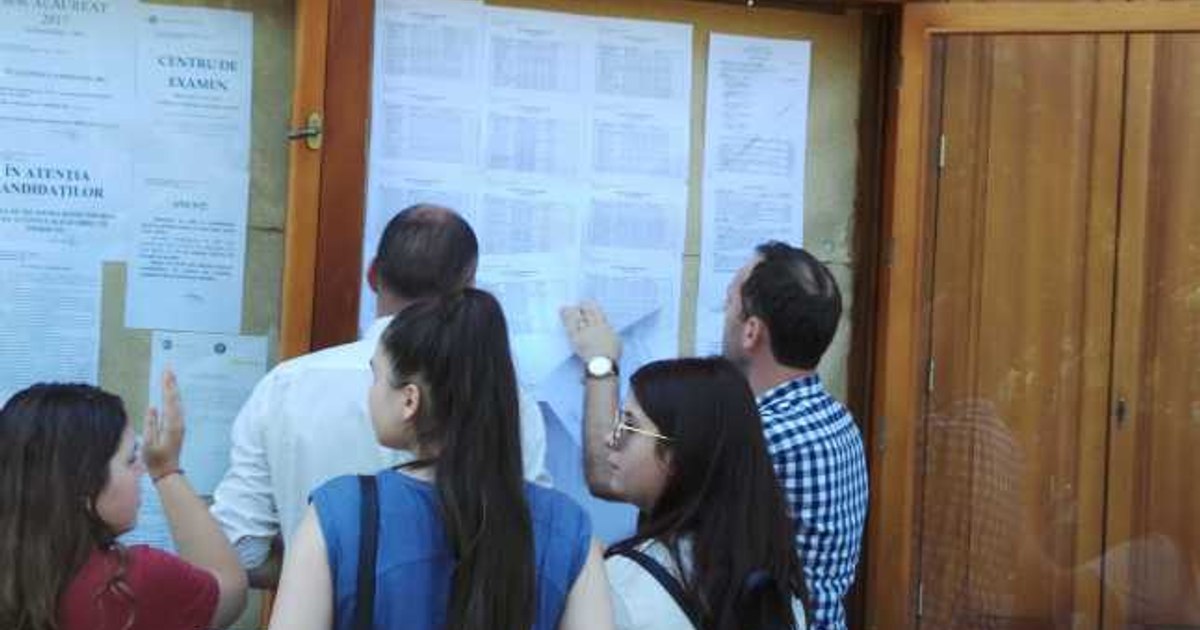
Several Hungarian students from Harghita, who failed the Baccalaureate exam in Romanian Language and Literature will sue the Ministry of Education. “They will ask for moral damages because they were discriminated against,” said Borboly Csaba, the president of the Harghita County Council, for “Adevărul”, who explained in detail the reasons for the whole scandal.
Starting this year, Hungarian students will take a simpler Baccalaureate in Romanian. Photo source: archive
Ethnic students take more tests than Romanian students in the Baccalaureate exam. In addition to mathematics, physics, biology, history, etc., these children take exams in both the Romanian language and the mother tongue. “Hungarian students, Qwhile in all the other tests I get passing grades, in the Romanian language I get below 5. It is the reason why they do not manage to take the Baccalaureate, they cannot enroll in college and their future is compromised from the start”. Borboly Csaba, president of the Harghita County Council, explained to “Adevărul”.
Borboly Csaba, president of CJ Harghita: “The school curriculum must be simplified”
The question that arises is why these children ended up in such a situation? Especially since they already learn according to a special program, simplified compared to the one available to Romanian students. “The curriculum, in the case of ethnic Hungarians, is different, it is much easier, and this reform has been taking place for more than 12 years. They even have different manuals”, Bogdan Rațiu, Romanian language teacher, explained for “Adevărul”.
So what is the reason for failing the exam? Who is to blame? The children, because they didn’t learn enough in their 12 years of school? Their parents, because, for various reasons, they don’t speak Romanian either at home, in the family? Teachers who don’t care enough? “Neither some nor others. The Romanian state, through the Ministry of Education, is solely responsible”, accuses Borboly Csaba.
The official believes that the school curriculum followed by ethnic Hungarian students needs to be simplified even more, and the authorities refuse to take measures in this regard. “These children want to learn Romanian, but they need special attention, they need a school program adapted to their needs. Students cannot keep up with the current school curriculum, no matter how much they would like to. They do nothing but memorize some words, learn some concepts by heart, but if you ask them to speak Romanian, to have a simple conversation in Romanian, they can’t do it. They can’t string words together, they can’t speak in sentences or phrases.” says the politician.
The President of the Harghita County Council warns that, at the moment, many Hungarian students know how to put “Hello“, but I don’t really understand what I’m saying. “How can he take the Romanian language exam when no one cares to teach him the language? What is taught at school at the moment is not enough and is not adapted to their needs, and in the family they have no way to learn for the simple reason that even the parents do not know Romanian very well”, points out Borboly Csaba, who warns that we are, in fact, in a vicious circle.
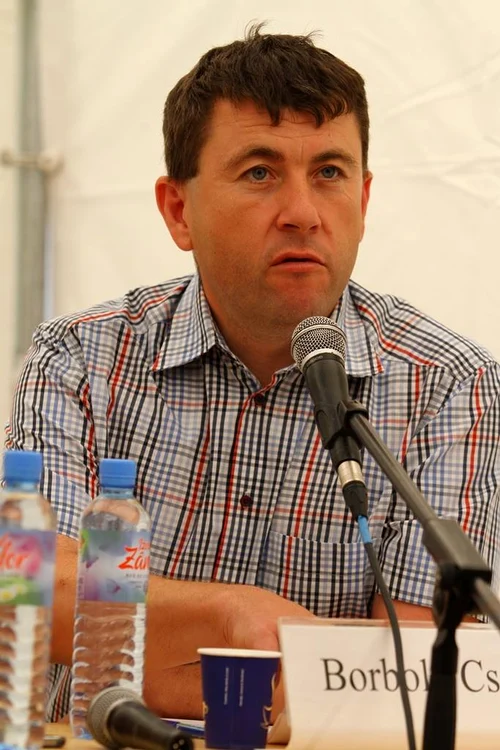
Borboly Csaba, president of the Harghita County Council. Source: Facebook
“We want fewer hours of Romanian language and literature and more of communication”
The President of the County Council is of the opinion that the three hours a week of Romanian Language, which the students have in high school, should be reduced to two. “And the third hour should be dedicated strictly to communication in Romanian. Moreover, the matter should be brushed, simplified, let’s give up unnecessary terms and concepts, which will never help children. Why should, for example, a Hungarian child learn archaisms in Romanian? What does it help them with? Instead, it would help him immensely to learn to communicate better, to speak, to express himself. Obviously, they must know basic things, who is Eminescu or Ion Creangă, to have a general culture because, however, we live in Romania. But, above all, these children have a real need to learn to communicate, to speak in Romanian”.
The official stated that Hungarian students do not want easier or special subjects at the Baccalaureate. They want to learn the Romanian language in school, starting with the small classes, from kindergarten and preparatory class, in such a way that they can meet the requirements at the Baccalaureate. Borboly Csaba stated that ethnic Hungarian students are subject to discrimination, and a decision to this effect was taken by the High Court of Cassation and Justice. “But for a year, the ministry has not done anything in this regard. So 17 students to sue the Ministry is a very small number. There should have been hundreds actually defending their rights. The lawsuit is the next step for these children who will claim moral damages.”
Students’ lawyer: “Hungarian children are discriminated against”
Szikszai Tamas, the lawyer who will represent in court the students affected by the negative results in the Romanian Language and Literature exam, said that “since May 2023, we have a final decision of the High Court, which clearly and definitively found the existence of discrimination at this level, in the process of learning the Romanian language for children of Hungarian ethnicity. Such a decision should have been followed by measures at the level of the competent bodies to try to rectify or improve this situation. Given that the premises of discrimination have been established, they enjoy the authority of res judicata, the next step is to file a legal action through which we will oblige the Ministry of Education to pay moral damages”.
The approach of the group of students is in the preliminary phase, and their lawyer stated that the right to action expires in three years, and it is estimated that students who took the exams in previous years will also be part of the action in court. The students demand that there be also the possibility to take a test of Romanian language and literature with a different status compared to the test for the majority as part of the Baccalaureate.
Teachers, between a rock and a hard place
There is, at the moment, a special program for ethnic Hungarian children, but, says president Borboly Csaba, it is not working. “The Ministry approved a special program for the Hungarian minority, but it is not working. Children entered the 8th grade learning from the 1st grade on this program, but the results were not seen. It means that this program is not well designed. And the teachers, in turn, are struggling. In theory, they must teach what is compulsory, follow the syllabus. In practice, they work with children who do not have basic knowledge. It is not fair for the teachers either, as they are forced to adapt to this aberrant situation. They are forced to resort to all kinds of artifices to find a communication gateway with these children. They work more, they prepare more, they think of their own courses, materials, everyone does as they can. They have to teach what is, after which they have to take the time to teach the children to understand what they are being taught”.
However, Professor Bogdan Ratiu comes up with a counter-argument: “The Ministry has allocated quite a lot of funds for the training of teachers, so that they can teach according to this program. They’ve also made free guides, and teachers have access to all kinds of resources to use in the classroom.”
Demeter Levente, general school inspector within the Harghita School Inspectorate stated that starting this school year the Baccalaureate exam will be held in a differentiated manner, just as the National Assessment is also held. Bogdan Ratiu, Romanian language teacher, explained in detail: “In November, the subject model should appear according to which the children who are in the Hungarian section will be evaluated. So now we are in the process of this transformation. At the moment, I think that the Romanian language and literature discipline for the Hungarian section is what the ethnic Hungarians wanted. They will have other, easier subjects, because the high school curriculum is also different and much easier compared to that of Romanian students”.
Education expert: “The last time I read the Constitution, the official language was Romanian”.
Marian Staș, an expert in education, is of the opinion that “the situation is not set right. That is clear. However, the responsibility may be shared. Of course, they are Romanian citizens, but they no longer speak the Romanian language at all, and then it is obvious that they have impediments in communicating, understanding, etc. It is very bad, because they are citizens of this country. The last time I read the Constitution, the official language was Romanian”.
Marian Staș believes that in this matter “it takes two on the das ring. And if you at home, father, start messing around, saying no and no with the Romanian language, then there is a problem. But it is also a responsibility of the state. I don’t know how many times the state works rigidly and does not provide all possible resources for reasons of treatment with boots. The first essential aspect is the poorly tailored framework plan and, secondly, the inadequately prepared human resource. We are facing a slow cancer, which perpetuates itself year after year, and look at the exploding Hungarian polenta from some children who have decided that they want to do things differently”.
From the point of view of the system, says Marian Staș, it is clear that here the essential theme is “a curriculum model, a content and structurally inadequate framework plans for more special needs, such as those of these children”
