
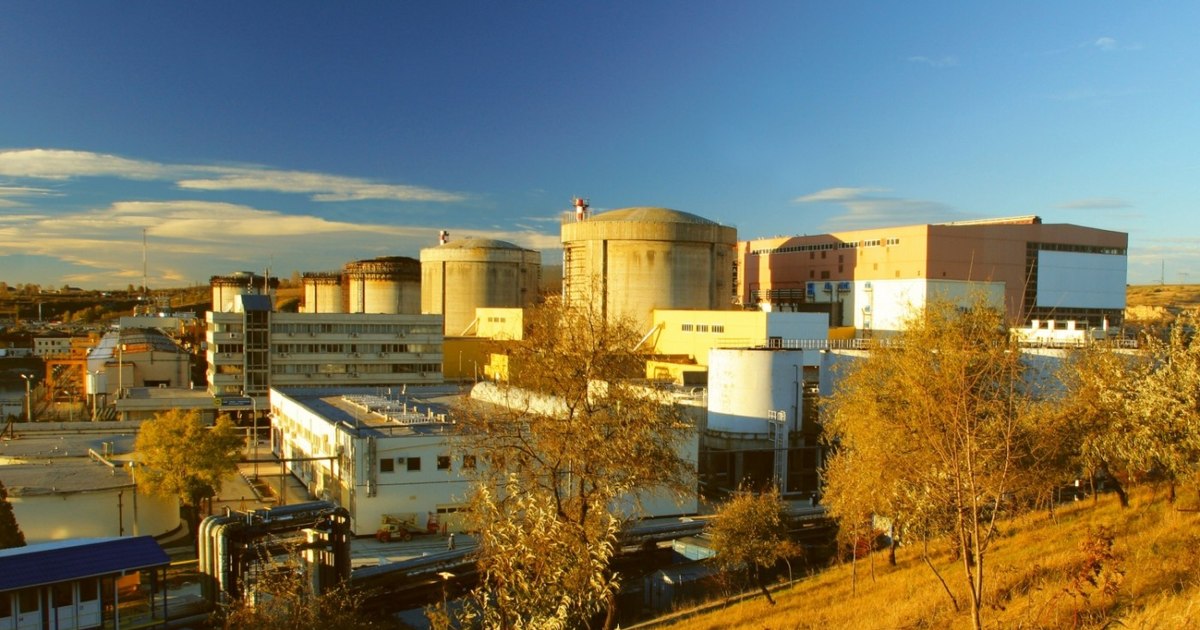
At the Cernavodă Nuclear Power Plant, an anti-cancer medical isotope will be produced: Lutetium-177-PSMA, which will be used in the therapy of several types of cancer, including prostate cancer. The special technology will become operational in December 2027. Dr. Gherghe Mirela, university lecturer, head of the Nuclear Medicine discipline at the “Carol Davila” UMF and head of the Nuclear Medicine department at the Bucharest Oncological Institute, explained to “Adevărul” what this therapy means , what are the benefits, to whom it is addressed and when we could start the procedure.
Production of the isotope will take place in reactor 2 of the plant. Photo source: archive
Nuclearelectrica, the operator of the Cernavodă Nuclear Power Plant, will produce a medical isotope, which has the potential to destroy cancer cells without affecting healthy ones. Production will take place in a special unit, at reactor 2 of the plant.
What is Lutetium-177 therapy
Lutetium-177 therapy is a treatment based on targeted radiation, which uses the radionuclide Lutetium-177. At the molecular level, it attaches to a binder that directs it to PSMA receptors on cancer cells, ultimately binding to them. Once attached, Lu-177 emits radiation that attacks these cells, eventually destroying them. Lutetiu therapy increases the life expectancy especially of patients with prostate cancer, according to the conclusions of some studies carried out so far.
Why do Romanian oncology patients not have access to Lutețiu-177 therapy
Dr. Mirela Gherghe, head of the Department of Nuclear Medicine at the Bucharest Oncological Institute, told “Adevărul” that in Western Europe, even in countries in the east of the continent, this therapy has already been done for many years.
“It’s been working there for years, so it’s not exactly brand new. In neuroendocrine tumors the therapy has been used for at least 10 years, and in prostate cancer for 4 years”, the expert specified.
“The treatment is in the European treatment guidelines and targets prostate cancer, but also neuroendocrine carcinomas. These are rarer, prostate cancer is more common. In addition to these, there are clinical trials in which the therapy of other types of cancer is also tried”.
The isotope, however, is not produced in those countries. “There is a product registered by the European Medicines Agency that can be imported from one country to another. There is only one manufacturer that, at the moment, has all the European authorizations and from which, in theory, we could also take. But we don’t take because we don’t have all the authorizations at the national level”, the specialist also declared.
Who benefits from the treatment and what is the therapeutic procedure
The isotope is not used as such, but in combination with a non-radioactive molecule. “In very simple terms, the patient comes to the hospital and is given an intravenous infusion. The procedure takes about an hour. However, according to CNCAN regulations, the patient must, in principle, remain hospitalized for one day”, the specialist explains the procedure.
The treatment is given in the advanced stages of the disease. “That’s how it originally started, but nowadays the treatment is used for increasingly earlier stages. That is, from stage 4, now it goes right to stages 3 and 2, in which to be administered. But that’s how it started, as a therapy to be administered when the others don’t work: radiotherapy, hormonal treatments, which are well known and which we generally have approved”.
It should be known, however, that the treatment does not work for all patients in the same way. “And especially if we are referring to an advanced stage of metastatic cancer. However, all studies have shown much better results compared to all other treatment options. So, for sure, he saves some patients who, at this moment, are not saved by the therapies we have”.
We have everything! And equipment, and trained doctors
Lutetium-177 therapy falls under the competence of the doctor specialized in nuclear medicine, who has both diagnostic and therapeutic competence. However, determining the indication and caring for the patient is done in a multidisciplinary team, as in any oncological case. “This, after studying the patient’s file and seeing what therapy he followed and what treatment options he still has available. Then, the procedure, as such, is done by the specialized nuclear medicine doctor”.
Iolanda Gheorghiu, the founder and president of the Association of Oncological Patients, stated for “Adevărul” that the therapy can, indeed, be of real benefit to the general public. “However, it also depends on the patient. Some people need it. Some may need it, some may not. But that doesn’t mean that if it doesn’t help some, it isn’t good or it isn’t needed. If they treat only one patient, the procedure has made all its money. It is important, however, to have the specialists who actually work with this new technology. And I say this because in Romania we don’t have enough doctors in general. The equipment sits unused in hospitals because there is no one to use it”, considers Iolanda Gheorghiu.
However, the doctor Mirela Gherghe specifies that “in Romania, there are few hospitals equipped at this level, but we, at the Bucharest Oncological Institute, fit in with everything we have there. We could start treating patients tomorrow if we had the treatment available. Theoretically, we also have the training“, the expert also specified.
The doctor stated that nuclear medicine specialists know the procedure in theory. “We would probably need two, three days to do a training. And know that we also have doctors. We are not lacking. At least in the last six years, since I started the activity with the residents in Bucharest, every year I had series of about 10 people who finished. And in the next two years, others will also finish”.
The doctor stated that therapy with the Lutetium-177 isotope has been expected for a long time in the Bucharest Oncological Institute.
Lutetium-177 therapy, side effects
Univ. Prof. Dr. Martha Hoffmann, expert in nuclear medicine at the Wiener Privatklinik hospital and member of the Thyroid Committee of the European Association of Nuclear Medicine, explained that to see if Lutetium-177 therapy will be effective, patients must first undergo a tomography and prostate-specific membrane antigen imaging. “These tests show whether all or most of the organs involved in the cancer would support Lutetium177 therapy in a relevant amount. In addition, kidney and blood function should be checked. In some cases, a salivary gland scintigraphy and/or renal scintigraphy may be required,” the expert also stated according to the medical platform 360medical.ro.
Side effects of Lutetium-177 therapy include kidney failure, low red blood cell and platelet counts, and a life expectancy of less than 3 months. Moreover, the function of the salivary glands can be temporarily hindered (dry mouth, loss of taste, local discomfort). Kidney function and blood cell counts (leukocytes, platelets) may also decrease and should be carefully monitored.
