
The granting of first aid remains in Romania at “and others”, a law that has been waiting for its turn through the drawers for many years. All this time, tragedies happen near us because we do not know how to act in emergency situations. At what point are we and how things could change – we sought answers in the discussion with Adrian Armășel, First Aid manager at the Romanian Red Cross (the largest provider of courses and interventions in this field in Romania).
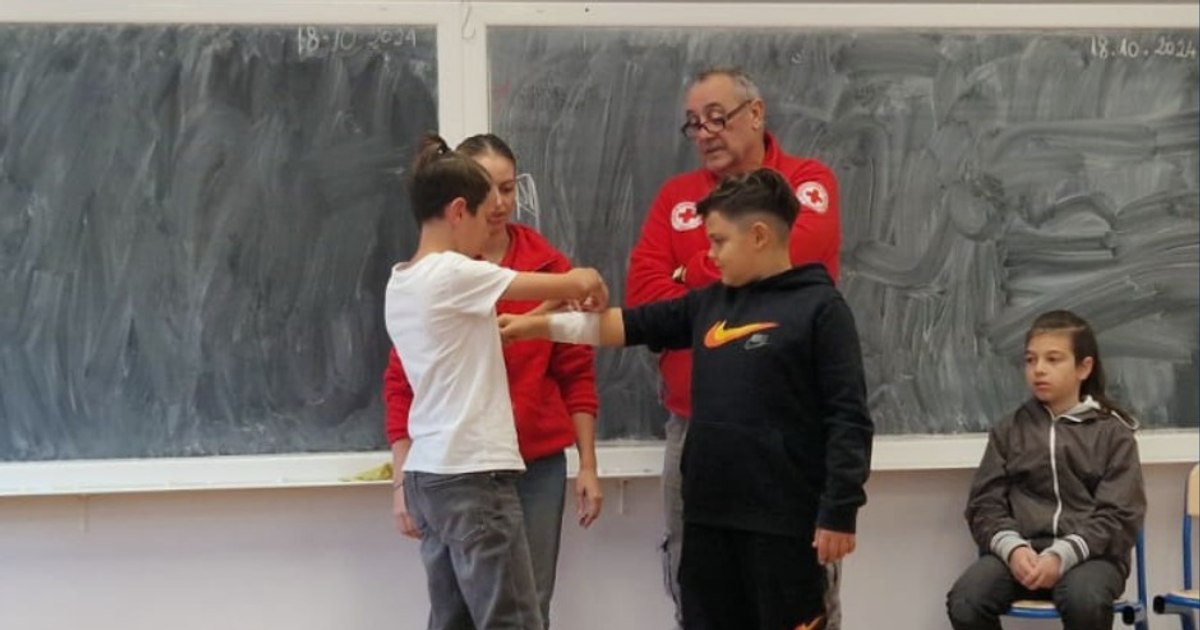
The children want to learn first aid techniques PHOTO: FB/Romanian Red Cross
After every tragedy that reaches the media, we ask ourselves the question whether things could have been different. Otherwise, the victim of a heart attack, stroke, drowning or other emergency could be saved if bystanders knew what to do until emergency crews arrived. And then the alarm signals that the specialists raise periodically have, suddenly, a different meaning.
The Red Cross spoke about the extremely low level of training Romanians have in providing first aid exactly two months ago, on World First Aid Day (September 14).
“There are no official statistics. Unfortunately. Perhaps only in this way, written in black and white, would this worrying phenomenon be made aware. But the situation is alarming: the Romanians do not know how to intervene. And those who do don’t have the right knowledge. For example, if we get a burn, many of us still apply egg white to the affected area, and if our baby drowns next to us, we shake it upside down. In such situations we can do more harm than good”, drew the attention of Adrian Armășelu, First Aid manager at the Romanian Red Cross.
“We keep insisting that this knowledge be acquired starting from school”
I spoke with Adrian Armășelu to understand how many fronts we have to fight this battle on and what would be more appropriate to start with. “On all fronts, if possible,” says our interlocutor, because the goal of learning these skills is saving lives, especially saving the lives of those close to us.
“We keep insisting that this knowledge be acquired starting from school, something that happens in many European countries and beyond. Children know how to act, they discuss cases, what they have to do in different situations. For example, when I stay with grandparents or a family member who for one reason or another loses consciousness: how to alert, what to do. It is very important. But these things are not done (n. ed. – in Romania), or if they are done, they are done here and there, a small number. We keep insisting that a first aid law be promulgated, which has not happened for a very long time. The law would determine who, what, how and where it is done and who must do it,” explains Adrian Armașel.
What is happening in Romania, because there are no laws that state otherwise, is that anyone can do these first aid courses. A law on safety and health at work only stipulates the obligation that at workplaces there should be, for every 10 workers per shift, one person prepared to provide first aid, and most employers, at least in writing, fulfill this obligation, regardless of who is providing such courses.
“Now, since there is no law, anyone can do them. There is no accreditation in the first aid course, other than the European ones. This is a big, big problem. But having a law you can work on methodological norms, you can make partnerships with the Ministry of Education to introduce first aid concepts, first aid courses and so on in schools”, says Armașel.
As there is no first aid law yet, we continue to debate after each tragedy. There are situations, some end up being made public, others not, in which children lose their lives. The accident can also happen at school, but also at home, near the parents. Unfortunately, it often turns out that neither the school staff nor the parents know how to act properly, and until the rescuers arrive, those very minutes that make the difference between life and death are lost.
“You take the first aid course to keep your loved ones safe, it is assumed that you spend most of your time with your family. What happens if something happens to a loved one in the family and you don’t know what to do. It’s very sad to hear that the parents lost their child because they didn’t know what to do”points out Armășel.
Young people are interested, the system is not ready
Even in the Romanian school there is no discipline in which students are taught life-saving notions, which is done being the fruit of occasional collaboration between the school and the various organizations. The representatives of the Romanian Red Cross are also called when there is a “window” in the extremely busy schedule of the students. It often happens in the “Otherwise School” or when good-hearted teachers realize the importance and find time for it. But it happens systematically, as things happen in other countries.
Such notions could be taught either as part of an optional subject, or even represent a subject that appears in the school curriculum, says Armășel.
A first-aid course at the Red Cross lasts 12 hours, but there is almost never that much time in school that can be “kidnapped” by other subjects in the timetable. For this reason, today such courses are held only with volunteers who complete them in their free time, and when invited, representatives of the Romanian Red Cross give demonstrations in schools.
These courses cannot be conducted online, at least the Romanian Red Cross does not, no matter who the students are, and it is easy to understand why.
“We never do first aid courses online, because you can get the information, but if you don’t put your hands on the mannequin, you don’t practice, you don’t make a bandage, you don’t practice… You see it on Youtube, yes, but it’s not the same thing. In addition to that, we have an exercise at the end where the participants are divided into victims and rescuers, we use make-up and they see what it’s like to intervene in an accident with multiple victims, for example”, says Armașel.
Children are much more interested in such notions than adults. Where there is availability on the part of teachers, complex concepts are learned and children compete to demonstrate their knowledge. It happens in the framework of the national competition “Skillful Sanitation”. It is not carried out on a large scale because it is increasingly difficult to find interested teachers, explains Armășel.
“It’s interesting, the problem is that fewer and fewer teachers – usually Biology teachers, they prepare young people according to the materials that we provide to prepare for the competition – fewer and fewer teachers take the time let these children, these young people live. It is optional. (…) The level is high, the children are extraordinarily receptive. Many of them, from the old volunteers, and many of those who participate, access a career in Medicine. Because they become passionate about it, they like it. What’s more beautiful than saving lives?”says Adrian Armașel.
Adults also realize the need for these first aid courses. “Always, after the first aid courses, the vast majority of the participants who have children say: Sir, why don’t you do these things in schools? Well, look, we do it in schools, but at the request, I don’t go to school – you know, I came to do that. But I also understand the teachers”, says Armășel.
Completing a first aid course does not mean that the acquired knowledge will be there for life. They need to be refreshed periodically, and the representative of the Red Cross says that for the 12-hour course this “refresh” is done every two years, while for the eight-hour course (there is also such a course) it is repeated annually with the repetition of the concepts .
It is not too early to learn certain concepts even in kindergarten, even if at that age children cannot be taught to perform first aid maneuvers. In other states, children of such young ages are taught to do various things related to first aid. “How adults report, how healthcare professionals report. The babysitter, or grandmother, the person who takes care of him has lost consciousness, what to do. These measures are first aid, because the child can be taught to call 112, to explain the situation. And by doing that, it reduces the response time of rescuers.”
explains Adrian Armașel.
“We are between 5% and 8%. No statistics have been made, it is an estimate”
The training continues, in the case of children and young people, also at school, with dedicated programs. There are countries that have reported 100% first aid training among citizens.
“The Nordic countries – Sweden, Norway, Denmark – reported, and we watched in amazement, the degree of readiness of 100%. You would be surprised, Germany about 36%. But the Nordic countries, 100%, because they have this since school, it was seen, and very clearly, in that traffic stop at the European Championship, when the captain of the team acted as per the book – evaluation, he saw that his heart was not beating, gripped by compressions – compared to situations when this was not done”says Adrian Armășel.
There are not even such statistics for Romania. “We are between 5% and 8%, around, no statistics have been made, it is an estimate”says Armășel. We are talking about people who have completed a first aid course and who know what chest compressions, ventilation, obstruction, etc. mean.
Although such a course does not cost particularly much, it has not yet become a priority for Romanians.
When it comes to the interest of employers to train their employees in providing first aid, Adrian Armășel says, it is noticeable that many of the companies with connections in Europe know their importance and organize such courses for employees.
