
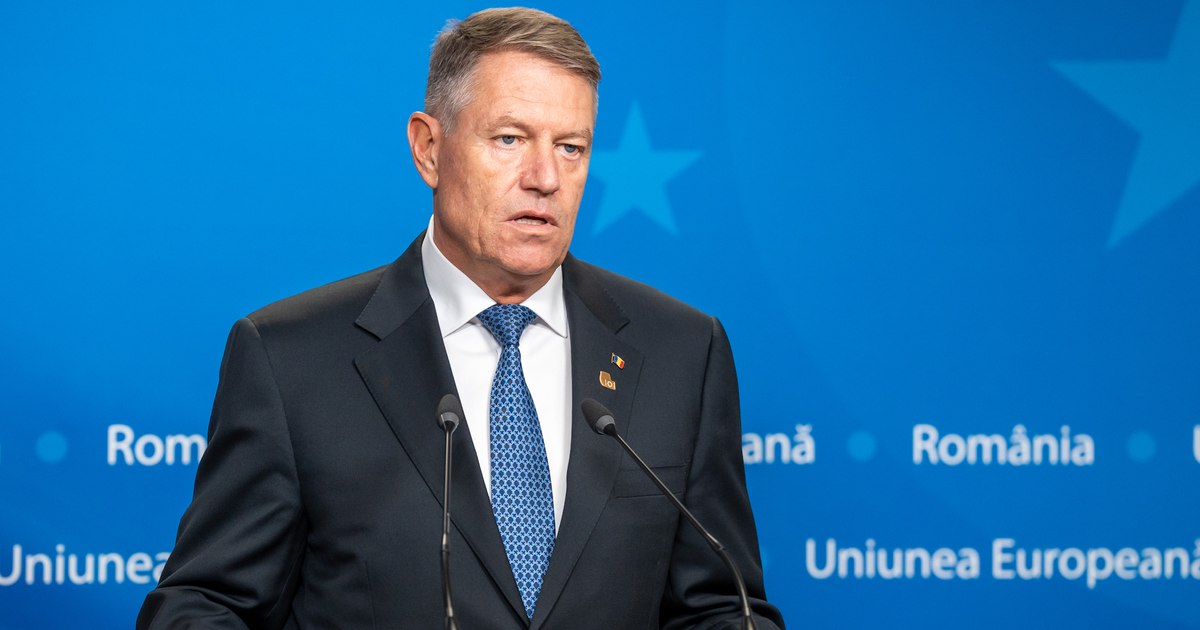
President of Romania for ten years, Klaus Iohannis was rather appreciated externally, because he managed to honor Romania’s Euro-Atlantic commitments, but his way of communicating with Romanians was not excellent, on the contrary, according to political specialists .
Klaus Iohannis. Photo: Presidency.ro
On November 16, 2014, Klaus Iohannis, then mayor of Sibiu and candidate of the National Liberal party in the 2014 presidential elections, was elected president of Romania, with almost 6.3 million votes.
Iohannis then obtained one million more votes than Victor Ponta, his opponent in the second round of the presidential elections, representative of the Social Democratic Party. The former teacher from Sibiu began his first of two five-year terms at the head of Romania on December 2, 2014.
On November 24, 2019, Klaus Iohannis was elected president of Romania for the second time, with over 6.5 million votes, defeating the PSD representative, Viorica Dăncilă, in the second round of voting. The difference in votes between the two finalists of the 2019 presidential elections was more than comfortable for the current president of Romania: more than 3.2 million votes in his favor.
“Klaus Iohannis was not a president who created emulation. He was the alternative to Victor Ponta and Viorica Dăncilă. It was not chosen because it was extraordinary, but simply because it was considered the better option than the others. Many hoped that the experience at Sibiu City Hall would be replicated in Romania, but, you see, the mandate of the mayor is different from that of the president. The latter does not allow very many things”says political scientist Cristian Pîrvulescu.
The main achievement of President Klaus Iohannis was in terms of foreign policy, says political scientist Ioan Stanomir.
“His reign has managed to be a factor of stability and predictability. He managed to honor all our Euro-Atlantic commitments and despite a certain discretion at certain times, I believe that the President of Romania has honored his mission to be a credible and respected representative of Romania on the external level, especially in Euro- Atlantic”says political scientist Ioan Stanomir.
Klaus Iohannis had the right instincts from time to time, believes Radu Magdin, specialist in political communication.
“He promoted the increase in the Defense budget during Trump’s first mandate, he understood that then it was important for Romania to give a signal in this regard. On the other hand, he launched into a reckless, unplanned race for the leadership of NATO”he says.
The President of Romania, without his Government
Regarding internal politics, the “legacy” that Klaus Iohannis leaves behind is problematic, and his mandates are less successful in this respect, argues political scientist Ioan Stanomir.
The most famous project of Klaus Iohannis’s ten years in office was “Educated Romania”, the program aimed at ensuring the necessary reforms in education, which led to the adoption of the Education Laws of 2023. The increase in education funding, the decrease in the early school leaving rate schooling, reducing functional illiteracy, acquiring digital skills and increasing the number of higher education graduates were among its targets.
“The President had a Government in 2019, but that Government was a minority, the Government of 2020 was a coalition one, and the one of 2021 an oversized Government, in which the PSD, which is not even remotely a supporter of Klaus Iohannis, played a important role, and the only program they accepted and carried through to the end, mocking and criticizing it, was “Educated Romania”. As for “Educated Romania” it was an honored promise. Of course it’s highly criticized, but it’s a point made”says political scientist Cristian Pîrvulescu.
The achievements of Klaus Iohannis were not related to his programs, which could not be applied as long as he could not rely on a presidential majority in his mandates. They depended on the context, adds the political science specialist.
“The first mandate was an important one for the defense of the rule of law and liberal democracy. There was an assault by PSD – Dragnea on the rule of law, supported by other political parties, which failed, because it was Klaus Iohannis. He objected intelligently, given the fact that the president of Romania has a great weakness. It can be suspended and then dismissed by a referendum that requires a 30 percent turnout. Klaus Iohannis was permanently in the situation of being suspended”, says political scientist Cristian Pîrvulescu.
The second mandate of Klaus Iohannis was centered on stability, the chronic governmental instability installed after 2007 being one of Romania’s main problems. The president tried through the oversized government the experiment meant to ensure stability, says the political science specialist,
“Some say stability is very dangerous, but stability is one of the main political benefits. I pray, looking back, the president probably had an erroneous assessment of the impact of this stability and the pedagogical therapy he wanted to apply to the PSD. But he had no way of knowing that the experiment would fail.” says Cristian Pîrvulescu.
The president is silent with the Romanians
Klaus Iohannis’s public appearances during his ten years in office were discreet, at least compared to those of his two other predecessors in office, Traian Băsescu and Ion Iliescu, and the President of Romania was often perceived as distant from Romanians.
Political scientist Ioan Stanomir believes that the people who elected him twice would have expected more empathy and solidarity from him.
“I think that the vote given to a president of the republic is more than a vote, it is a sign of trust and at certain times and of affection, and I think that trust and affection must be reciprocated in life”, says Ioan Stanomir.
Klaus Iohannis can be criticized for his lack of communication, but a president exists not by what he communicates, but by what he does, says political analyst Cristian Pîrvulescu.
“Anything can be blamed on Klaus Iohannis, only that he was not a populist. Klaus Iohannis did not communicate even as mayor of Sibiu, being a character who communicates very little. There was, especially after the pandemic, a lack of communication, and during the pandemic there was very formal and official communication, which created many problems. Politics also means talking, lack of communication can be a handicap, but he was elected president twice”says political analyst Cristian Pîrvulescu.
Radu Magdin, specialist in political communication, says that President Klaus Iohannis had the advantage of still being a presentable character, who knows English, German and French.
“He was a president who, at least formally, in the pictures, did well. He didn’t manage, as the people say, to make us laugh, but he also didn’t manage to inspire anything, because he always had a very cautious language, what we can call the death of passion. He was always somewhere between “attention and concern” and “with our allies”, always avoiding to express a clear opinion with subject and predicate, of Romania, on almost any topic. shows Radu Magdin.
Klaus Iohannis has, however, caused controversy with his “extravagances”, such as excessive spending on private jet travel, but this could be forgiven, political experts believe.
“Although some have criticized him for his tours in more exotic areas, the truth is that it was only then that Klaus Iohannis did his job. He suffered from provincialism, not really interested in our region, only interested in a good relationship with Brussels, Washington, Berlin and Paris. There were few other relationships that he could be said to have cultivated closely, while at the same time proving either ignorance or disinterest in our region as well as in global dynamics. So from this perspective, the fact that he was in a final in Africa, in Asia and in Latin America, in tours where he was in three or four countries, is, paradoxically, a good thing”shows Radu Magdin.
The fact that he is criticized for traveling on a private plane and that a protocol villa would be prepared for him for the post-presidential period are trifles compared to the corruption scandals that rocked the period of Traian Băsescu’s terms, according to political scientist Cristian Pîrvulescu.
