
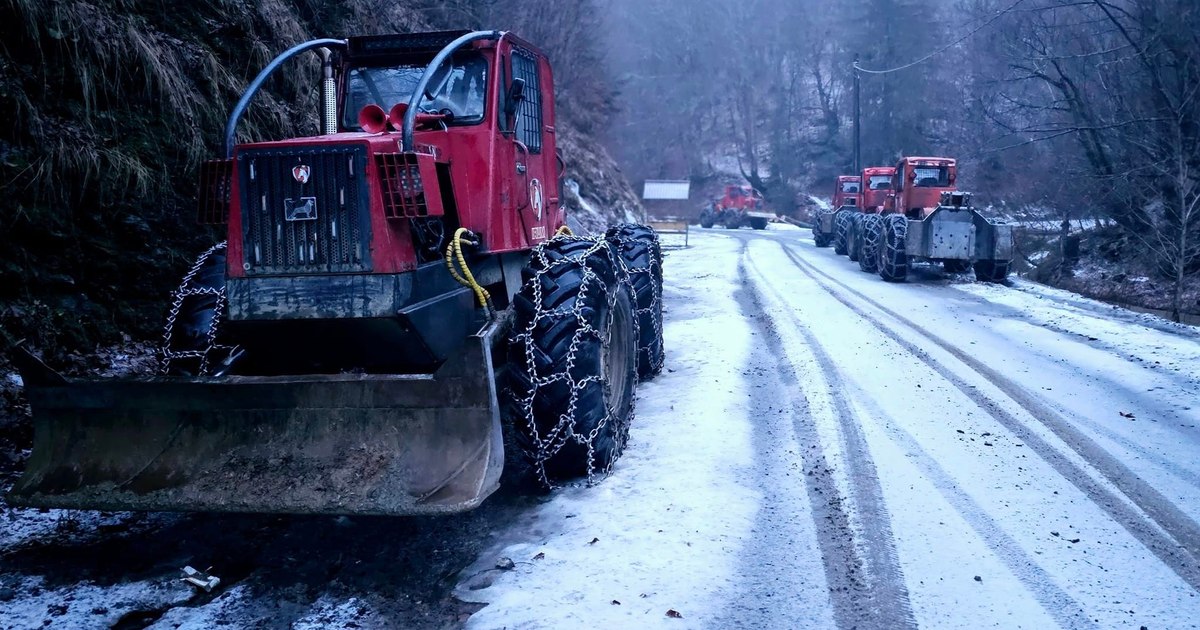
During the winter, many mountain villages in Romania become almost deserted, but also inaccessible, due to the roads degraded by forestry equipment. The forest covers most of their surroundings, but the traces left by the exploitations are getting deeper.
Forestry equipment at Lunca Cernii de Jos, Hunedoara. Photo: Daniel Guță
Most mountain villages in the Western Carpathians (Apuseni Mountains, Poiana Ruscă Mountains, Banat Mountains) have been affected in recent decades by the phenomenon of depopulation and the aging of the population.
Forest roads impassable in winter
Some localities, such as those in Șinutul Pădurenilor – Hunedoara, have remained almost deserted, and their stable population consists mostly of elderly families. The people of these mountain villages have a hard time getting through the winter, both because of the harsher climate in the mountains, but also because of the condition of the roads that connect them to the cities tens of kilometers away.
In the Poiana Ruscă Mountains, the logging found on almost every road that goes up into the Hunedoara Forest Land makes it difficult to access the villages on the ridges, even when the weather would normally allow the access routes to be used. Some people complain about the condition of the forest roads, while other locals say they are resigned. Their problems recur every winter, even on recently rehabilitated roads.
“About a year ago, on the 10-15 kilometer road between Runcu Mare and Vadu Dobrii, then repaired, I could go up to Vadu Dobrii, from Runcu Mare, even in winter, in about half an hour, by car. It was the road we used to go down to Hunedoara. Now it is impractical, especially in the areas where there have been forest exploitations. There are areas where you sink your car into the mud or get stuck in the trenches made by heavy machinery”says a local from Runcu Mare (video).
And other roads that go down from Vadu Dobrii to Hunedoara, located 50-60 kilometers away from the village in the mountains, depending on the chosen route, are difficult to access in some places, due to forestry works.
Aerial images (video) from the areas crossed by the roads show how deep are the traces left on the slopes by the forest exploitations and the areas covered by the cutting of trees. While some locals complain about the condition of the roads, forest workers say the forest must be logged and cleared year after year.
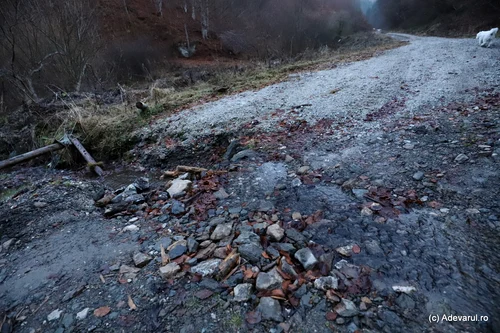
Image 1/16:
The road between Runcu Mare and Vadu Dobrii Photo Daniel Guță THE TRUTH (32) JPG
Despite the numerous logging operations, the communes of the Poiana Ruscă Mountains are rich in forests, the areas of the forest fund for each commune stretching over thousands of hectares. The forests cover not only the outskirts of the mountain towns, but also extended over the former pastures, orchards and agricultural lands maintained in the past by the locals, and some villages, abandoned by people, were almost completely covered by the forest.
“I grew up in Alun and all this land around the village, as far as we can see, you can’t even believe how much wheat was here and what harvest was in the field. People had more than 100 cows and thousands of sheep”, recounted a local from the commune of Bunila in Hunedoara, pointing to the wooded hills surrounding the settlement with a few inhabitants.
And in this area, the roads are degraded under the weight of the machines.
Currently, through applications such as the Forest Inspector, real-time information is made available about the authorizations issued for forest exploitation, the companies authorized to transport wood, the volume and types of wood transported and the route taken by the wood trucks from the harvesting site, to the destination. The application can also be used by those who want to venture on the forest roads, the presence of parquet on the routes being an indicator of their condition.
Forests in Romania: how much is exploited and how much is regenerated
Romania includes over 6.5 million hectares of forest, of which approximately 200,000 hectares are cut down annually. In 2023, according to the reports published by the National Institute of Statistics, the surface area of the forest land on which forest exploitation took place was 193,362 hectares, decreasing compared to 2022 (205,629 hectares), but in an almost constant increase in the last three decades.
At the end of the 90s, the area of the forest fund covered by cuttings in Romania did not exceed 50,000 hectares, according to official data – but illegal exploitations were more difficult to notice.
In Romania, according to the data published by the National Institute of Statistics, in 2023 a volume of almost 18 million cubic meters of wood was exploited, slightly decreasing in recent years, but a third more than in the early 2000s.
According to the National Forestry Authority – Romsilva, annually thousands of hectares of land are affected by forest regeneration works. At the end of this year, about three million forest saplings are planted, thus regenerating 2,096 hectares of forest land, 1,212 hectares being naturally regenerated, and 884 artificially regenerated, through afforestation works, show the institution’s representatives.
“In the autumn campaign, afforestation sites are concentrated, for the most part, in plain areas in the south of the country and areas in the meadow and the Danube Delta. In the last five years, the National Forestry Authority – Romsilva has regenerated 72,330 hectares of forest land owned by the state, of which 48,604 hectares through natural regeneration and 23,726 hectares through afforestation works, for all current regeneration works, afforestation works, restoration and additions, being used about 132 million forest saplings, produced in our own forestry nurseries“, informs Romsilva, on the institution’s page.
