
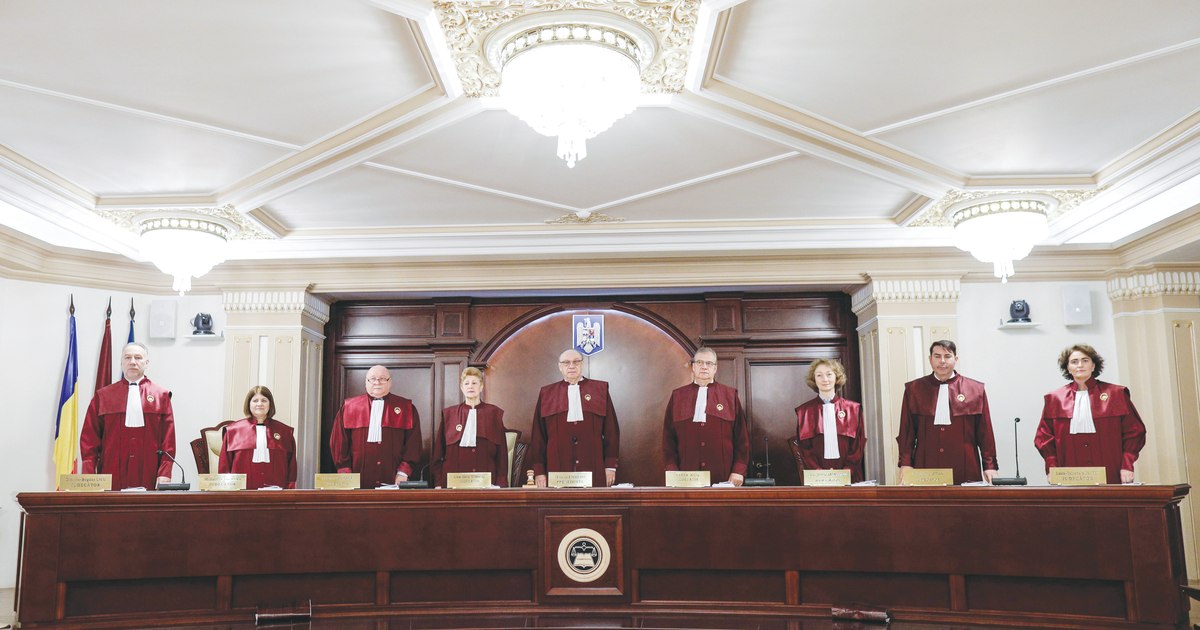
Bogdan Iancu, PhD in constitutional law and lecturer at the University of Bucharest, explains, in an interview for “Adevărul”, why the CCR’s decision to cancel the elections is and is not inspired and who is to blame for all the chaos that arose from this .
The Constitutional Court of Romania – CCR. PHOTO: Inquam Photos / Octav Ganea
– The truth: The CCR’s decision to annul the presidential elections is disputed by numerous political analysts, and among their arguments would be that, in reality, the Court is not allowed to refer itself and that there would be an express prohibition, precisely to limit its powers anyway big and violated it. How are things in reality?
– Bogdan Iancu: You see, decision no. 32 of December 6, 2024 can also be seen as a kind of emergency surgery, but the patient was taken from the street, without consent and without forms. His impromptu diagnosis was made and he was promptly operated on, perhaps even saving his life for the time being. At least his death was postponed. Law, however, even constitutional law, functions in a normative key of analysis and justification, the end cannot justify the means, no matter how much we would like it. Courts of any type do not decide the extent of their jurisdiction, they do not decide in the absence of due process, they do not decide without notice and they do not meet informally to make decisions.
Their powers do not extend to infinity, freely deduced from general provisions, but come from the norms that provide for concrete attributions. And Mr. Georgescu shares the vision of the freely-interpretable, “living” constitution, considering that from “represents”, “watches” and the “guarantee” from Art. 80 does not result in a President but a “glie leader”. There is no clear constitutional or legal basis for this solution of the CCR. No matter how much we search in the Constitution, in Law 47/1992, in Law 370/2004, we still will not find a basis.
– How do you find the motivation of those at CCR?
The motivation is laconic and lacunar. For example, the idea that one candidate monopolizes the Internet at the expense of the others borders on the absurd, especially given that media information sources are diverse and have been monopolized quite asymmetrically. Service briefing notes contain amateurish conjectures, not evidence. Some notes are or contain post-dated information, which means that they were not “declassified” (“declassified”, as they say), but partially post-buried after the CSAĞ meeting. The court knows, understands these things.
– More and more voices claim that serious precedents have been created by the fact that first Şoșoacă and now Georgescu were “banned”. Can it be said that there is now a precedent and the risk that in the future any inconvenient candidate will be eliminated in this way? And if so, would there still be someone above the CCR in a position to correct any errors?
-A judge of the US Supreme Court, Nuremberg prosecutor Robert Jackson, said beautifully: “The court is not supreme because it is infallible, but it is infallible because it is supreme.” (We are not final because we are infallible, but we are infallible only because we are final.) Regarding the interpretation of the Constitution, there is no one and nothing above the Court. There are some possibilities of appeal, for example a complaint to the EDO Court within the limits of its jurisdiction, but a possibly contrary solution (in the case of Koevesi, for example) does not change a certain state of facts, but can only, possibly, create damage to the image our constitutional court.
The CCR judges are not the main ones responsible for the appearance as the first candidate of a gentleman who talks mystically-legionary-medieval about “glie” and describes his candidacy for the position of President of Romania as “work” (his with us all and everyone’s with God). It was obvious, as the days went by towards the date of the second round, that Mr. Georgescu had a good chance of winning. The social tension and the resentment of Mr. Georgescu’s supporters coagulated more and more clearly, palpably. It remains to be seen what we will do with the time bought by this novel solution to a serious problem. For now, we will be able to enjoy our Holidays in relative peace. As a private person, I am also somewhat grateful to the CCR, especially since the judges are not the main ones to blame for this fiasco of gigantic proportions.
As a lawyer, I have the apprehensions already described in the answer to your first question. They are dangerous precedents, which, repeated, can seriously call into question what is left of our democracy and our state, claimed to be the right one. The Court is formally infallible, but it is practically infallible only as long as it does not completely undermine its appearance as a neutral arbiter, bound by the Constitution and the law.
– Is there a possibility that, based on these decisions, we will soon see the first political formations banned, and their leaders sent behind bars, just like what happened when the communists came to power?
Communism was of course a catastrophe for Romania. I will not put a sign of equality between the periods of our complicated history, nor will I affirm (like the ÎCCJ, in the Ursu case) that there was no state of hostility between the communist regime and the people in the sense of the Criminal Code after the dejist period, 1948-1965.
I note, however, that in general we were a managed democracy and that our interwar period is also full of various forms of vote suppression and illiberal public and private instrumentalism, from the six-fold extension of the state of siege after the assassination of IGDuca, from rigged elections and censorship, until the Maniu-Codreanu electoral pact of non-aggression. In a superb monograph on interwar parliamentarism, the German historian of Romanian origin Hans Christian Maner observes that mythologies about our interwar democracy, which would have resisted authoritarianism more, grossly mystify reality. We didn’t last longer, we were early authoritarians, more precisely since the rapid dissolution of the only freely elected parliament, the one from 1919. Besides, we didn’t have real democracy, with its minuses, until after 1991, let’s say from 1996, from the first alternation through free elections. It would be a shame not to develop this short road of Romanian constitutionalism for the better.
– How could politicians like Soșoască and Georgescu be held accountable in the future for breaking the law and not because someone would not want to see them in key positions? And in the end who would be best able to decide what is the national interest?

Bogdan Iancu. PHOTO: Personal archive
– A criminalist answers these questions best, not a constitutionalist, whose area of competence is different. A constitutionalist can note, however, that the national interest is not an independent absolute, it is contingent. I believe that the national interest is exactly the product, the result of following constitutional and legal procedures with good faith and balance. In the same spirit, I believe that people are sent to court for concrete facts, with strict adherence to all procedures and guarantees, and I believe that we must be interested in everyone, including Mrs. Șoșoacă and Mr. Georgescu, benefiting from all procedural guarantees. Otherwise, the law must also apply, including the provisions of GEO 31/2002 (in general and not only on occasions).
– It is said that politicians like Şoșoacă and Georgescu did not appear out of nowhere and that they are the result of the break between the mainstream parties and the population, if you will, of the loss of people’s trust in the authorities and in politicians. But what would be the solutions to not end up here in the future?
– I am not a sociologist, but constitutional law is the right of fundamental questions, which is why privatists do not consider it right (pure), and the constitutionalists thus attacked kindly point out the Greek etymology for the word “private”, idiotes. Constitutional sociology is a subfield of constitutional law in more settled states with higher-ranking universities. Anyway, constitutional law as an academic discipline transcends art.-para positivism. (and practice for that matter, as we see from the CCR’s forays into the field of “values”).
In conditions of universal suffrage, harmony can be preserved through minimal economic and social homogeneity (I am not referring to an extended welfare state, but at least to small and large public infrastructure, meritocracy, education, health). If there is no such homogeneity, other outlets are sought for “common becoming into being”, of the kind we observe. A third option, which we are experiencing feverishly, is the management of bankruptcies through forced procedures, discursive instrumentalism, massive securitization. However, I believe that the latter is not a long-term solution, especially, paradoxically perhaps, in the current context. I believe we should invest a bit more in schools, universities, health, railways, swimming pools, parks, playgrounds and last but not least in meritocratic procedures for training and selecting elites.
