
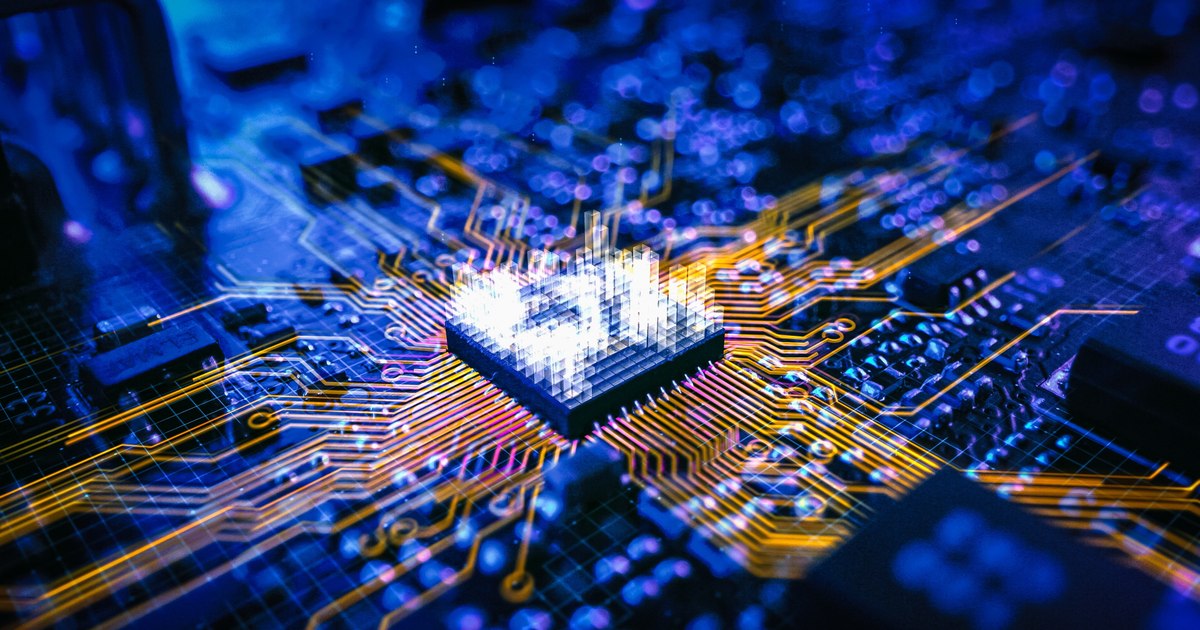
Google announced on Monday that its new state-of-the-art chip, Willow, has overcome a key challenge in quantum computing by solving a problem in five minutes that would take a classical computer longer than the history of the universe. “Wow!” reacted the American technology entrepreneur Elon Musk.
Google announced a new generation of quantum chips PHOTO SHUTTERSTOCK
In a blog post on Monday, Hartmut Neven, founder and director of Google Quantum AI, wrote that the Willow chip paves the way for a quantum computer that can “to benefit society by advancing scientific discoveries, developing useful applications, and addressing some of society’s biggest problems.”
Willow has 105 qubits, the building blocks of quantum computers. They are fast but prone to error because they can be affected by something as small as a subatomic particle from events in outer space, according to Reuters.
As more qubits are included on a chip, these errors can accumulate, a problem that scientists have been trying to solve since the 1990s.
In a paper published Monday in the scientific journal Nature, Google claims to have found a way to allocate qubits to the Willow chip while managing to decrease error rates as the number of qubits increases.
The company also stated that it can correct errors in real time, an essential step for its quantum machines to become practical.
“We have passed the break-even point”Neven explained in an interview.
In 2019, IBM disputed Google’s claim that Google’s quantum chip solved a problem that would take a classical computer 10,000 years, arguing that it could be solved in two and a half days using different technical assumptions about a classical system.
In the message posted on Monday, Google wrote that it took some of these concerns into account in its latest estimates. Even under the most idealistic conditions, Google stated that a classic computer would need a billion years to achieve the same results as its newest chip.
Some of Google’s rivals produce chips with more qubits than Google, but Google is focused on producing the most reliable qubits, Anthony Megrant, chief architect at Google Quantum AI, said in an interview.
Google said its new chip-making facility will speed up the speed at which Google can manufacture future chips, which are cooled in giant refrigerators called “cryostats” for experiments.
“If we have a good idea, we want someone on the team to be able to … get it into the cleanroom and into one of these cryostats as quickly as possible so we can get a lot of learning cycles.”Megrant explained.
After Alphabet CEO Sundar Pichai announced the new chip on social media, X CEO Elon Musk tweeted “wow,” followed by an exchange with Pichai saying, “We should a quantum cluster in space with Starship one day :)”.
“That will probably happen,” Musk replied.
