
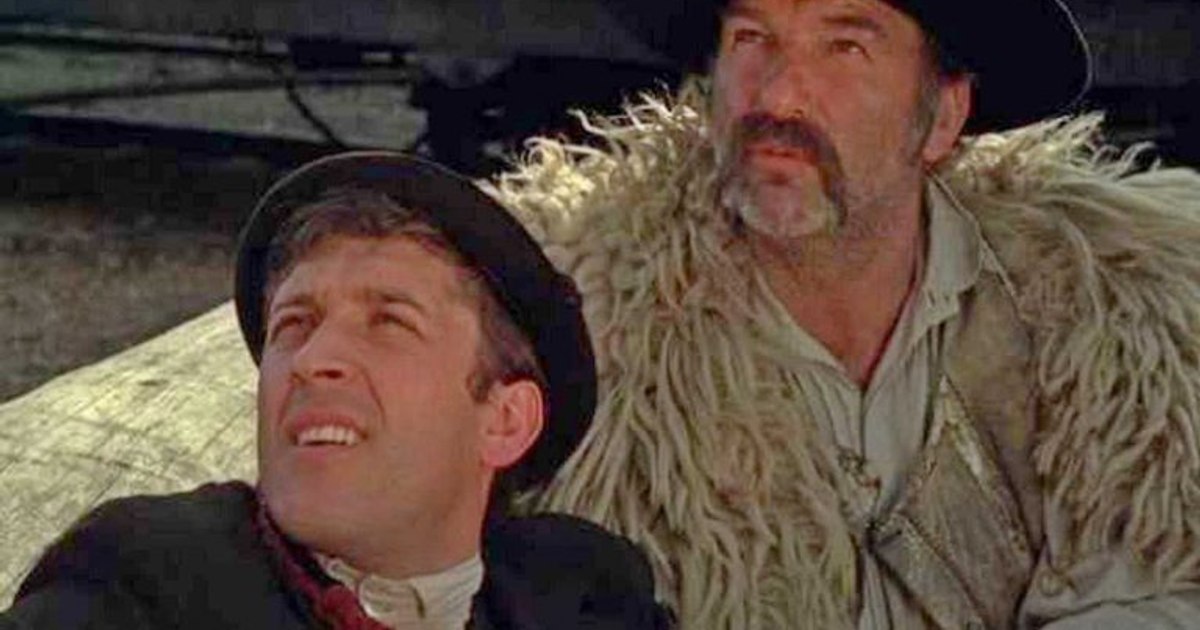
Mircea Diaconu had an impressive career in Romanian theater and cinema. The great actor passed away on Saturday at the age of 74, after facing a serious illness.
Mircea Diaconu in the film The Prophet, the gold and the transylvanians PHOTO Archive
Born on December 24, 1949, in Vlădești, Argeș county, Mircea Diaconu graduated from the IATC “Ion Luca Caragiale” from Bucharest in 1971. In the same year, he made his debut at the Bulandra Theater with the play Harfa de grăbă by Truman Capote, under the guidance of the great director Liviu Ciulei. He offered him a place in the Bulandra team, where Diaconu performed memorable roles for a decade.
In 1982, he joined the Nottara Theatre, marking a new stage in his career. In 1990, he became the first Romanian actor to opt for freelance status, a rare and brave choice. However, in 2001, he returned as an employee of the theater.
Roles that consecrated him
At the Bulandra Theatre:
The Reviewer by Gogol, directed by Lucian Pintilie (1972);
Shakespeare’s 12th Night, directed by Liviu Ciulei (1973);
The Tempest by Shakespeare, directed by Liviu Ciulai (1978).
At the Nottara Theatre:
How do you like Shakespeare, directed by Lucian Pintilie (1982);
The last ball after Liviu Rebreanu, directed by Dan Micu (1984);
The Gentleman Bourgeois after Molière, directed by Alexandru Dabija (1986).
A landmark of Romanian film
His roles were appreciated for their naturalness and subtle humor, but also for the emotional intensity with which he captivated audiences.
Representative productions include Actorul si savlailii (1975), Buletin de București (1983), Pruncul, petrolul si Ardelenii (1981) and Filantropica (2002).
What displeased him in his teaching career
Mircea Diaconu had a different vision on education. He created an acting workshop where students worked directly with directors and screenwriters. However, he was displeased by the fact that young people were not interested in the history of theater and cinematography. Every time he told them about the great moments of art, they didn’t know what he was talking about. The lack of connection with the past was a great disappointment to him.
“Teaching, that’s what it meant in my head. And we did a kind of film acting workshop, together, the directors with students, with actors, with screenwriters, so, somehow, small groups of young people, to whom we gave a task of work, and I was watching how they grow, how professional relationships are created between them. That was my concern, I always started from what was happening and saw, from old examples, from incidents, moments of professional grace, and film, and on the theater, and from time to time, talking and telling what happens in the shows of the ’60s, ’70s, even ’80s, of the big, huge ones that were, I could see in their eyes that nothing!
And I would stop and ask, “Did you hear what I’m saying now?” “No!” And in my turn, in my eyes, the desert was beginning. I asked: “You don’t have the history of contemporary theater? That it’s discipline!” “Yes!” “So who’s the teacher there?” And they told me who, I’m not going to give names now. He was exactly a famous person, a very good teacher, known, who had been a colleague of those I was talking about”revealed Mircea Diaconu, in an edition of the Avangarda podcast.
How the role of politician affected him
During the period in which he was active as a politician, Diaconu saw politics as a plea for values, similar to his roles on stage. He was convinced that, as in art, politics should aim at the good of the other
“As I understood acting from them, it is a form of communication that must necessarily contain the good of the other. Enlightening the other. Helping him… when I sit there to do what? Prestidigitation? What am I doing? I’m not doing that! I’m communicating with the other, a story! Some emotions, to be discovered on him. Shouldn’t this be the same type of communication? That’s how I see it. At that time, not this one, but the old one, I wrote an article in Literary Romania, the Mircea Diaconu Institute.
Strange that in literary Romania it could be published. And I said there: I feel like a kind of activist for good. I plead for something! Some values, as of the moment I play. My instrument, of my plea, is the actor’s art, or the story, or the stage, but the target is this! To help the other, or shouldn’t politics be the same? And when I was also a politician with the liberals, during the time of Crin Antonescu, I say this to be understood, because then liberalism still existed, in Romania, now it’s different”said Mircea Diaconu.
As a sign of recognition, Mircea Diaconu was decorated in 2000 with the National Order “For Merit” in the rank of Officer. His talent, charisma and dedication turned him into a symbol of Romanian culture.
