
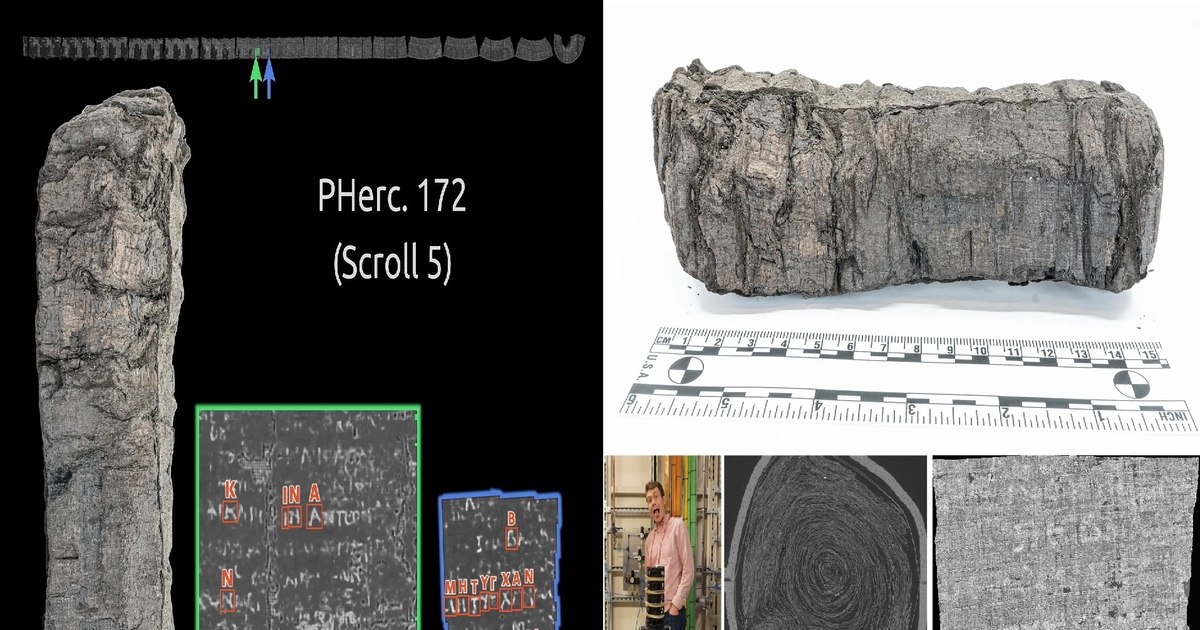
Reduced to charred pieces by the catastrophic eruption of Mount Vesuvius in AD 79, the hugely important Herculaneum Scrolls remain a fascinating mystery. Now researchers are offering a £400,000 reward to anyone who can decipher these burnt manuscripts.
Nearly 2,000 years ago, the eruption of Mount Vesuvius charred 1,800 scrolls, turning them into extremely fragile fragments. Made of papyrus – a material similar to paper – they are believed to contain profound philosophical and literary texts written by Greek and Roman scholars.
Because of the extreme fragility of these rolled parchments (scrolls), any attempt to unroll them by hand would result in their complete destruction. As a result, researchers turned to innovative methods such as X-ray scans, ink-detecting software and artificial intelligence to digitally scan the texts.
The research team is currently seeking additional solutions from engineers and artificial intelligence experts to decode as much of the charred scrolls’ contents as possible, offering a substantial reward for significant results.
Earlier this year, students already won $700,000 (nearly £550,000) by using artificial intelligence to decipher what is written on one of the scrolls held by the Institut de France in Paris (the Institut de France brings together several institutions, including French Academy).
Herculaneum Scroll waiting to be deciphered for £400,000 Vesuvius Challenge
New fragments of ancient texts, decoded with the help of cutting-edge technology
Researchers at the University of Oxford used the Diamond Light Source scanning facilities in Harwell, Oxfordshire – a state-of-the-art research facility that uses X-rays to obtain detailed images of materials at the atomic level – to decipher new fragments of the Scroll Bodleian P Herc.172, held in the Bodleian Library, Oxford.
They claim that the newly decoded text is in Greek and have been able to decipher a few fragments, but have yet to make out complete sentences.
An intriguing aspect is that the ink seems to be more visible on the outer layers of the parchment, and in certain segments, it is only clearly visible on every second line. This detail suggests that the scribe dipped his quill once every two lines.
“For us it is an unforgettable experience to be the first to see after such a long time a text written by hand 2,000 years ago”, the researchers said.
December 31: Deadline to claim your reward
The deadline for this year’s top prize — awarded for deciphering complete passages of the Herculaneum scrolls without touching them — is December 31, 2024.
right The Timesnearly £400,000 will be offered to those who make further progress in reading the Herculaneum Scrolls.
“One thing we know for sure: we will be able to recover the text from this scroll, but we will need your help to do so,” added the research team.
Scholars are therefore asking for the public’s help in decoding the messages from these ancient relics. The effort is part of the Vesuvius Challenge, an international competition that uses AI to read the Herculaneum scrolls.
Millennial scrolls, exchanged in a royal transaction involving kangaroos
In total, about 1,800 papyrus scrolls were charred by the eruption of Mount Vesuvius two millennia ago.
The scrolls were kept in a villa in Herculaneum, an Italian city that, along with Pompeii, was buried under extremely hot lava and ash flows from the volcano’s eruption.
In the 1750s, archaeological excavations started at the villa in Herculaneum led to the discovery of several scrolls, but many of these were destroyed or thrown away, being mistaken for pieces of charcoal.
Unfortunately, hundreds of scrolls were destroyed in the attempts to unwrap them, most of which are preserved today in the National Library of Naples.
Several hundred other scrolls were discovered, but none were opened, remaining rolled up with their contents sealed.
In the early 1800s, the Bodleian Scroll, along with five other scrolls, were given to the future King George IV of England by Ferdinand IV, King of Naples (Sicily), in a transaction that would have involved and some kangaroos.
“Plato is only the beginning”
Modern attempts have focused on digital methods to decipher the texts without physically unfolding the papyri to prevent their damage.
Known as “digital scan”such attempts typically use X-rays and other light sources to explore objects and reveal fragments that hide unknown secrets.
A team of researchers in Italy used a technique called short-wave infrared hyperspectral imaging, which looks at how the way light reflects off the black ink on the papyrus varies.
A recently discovered passage on one of the scrolls scanned with this technique revealed that on his last night, Plato criticized the lack of rhythm of a female slave playing the flute. The philosopher, suffering from a fever, had been listening to music and receiving guests before he died at the age of 80 or 81, around 348 BC.
Graziano Ranocchia, a papyrologist at the University of Pisa, Italy, said: “Plato represents only the beginning.”
