
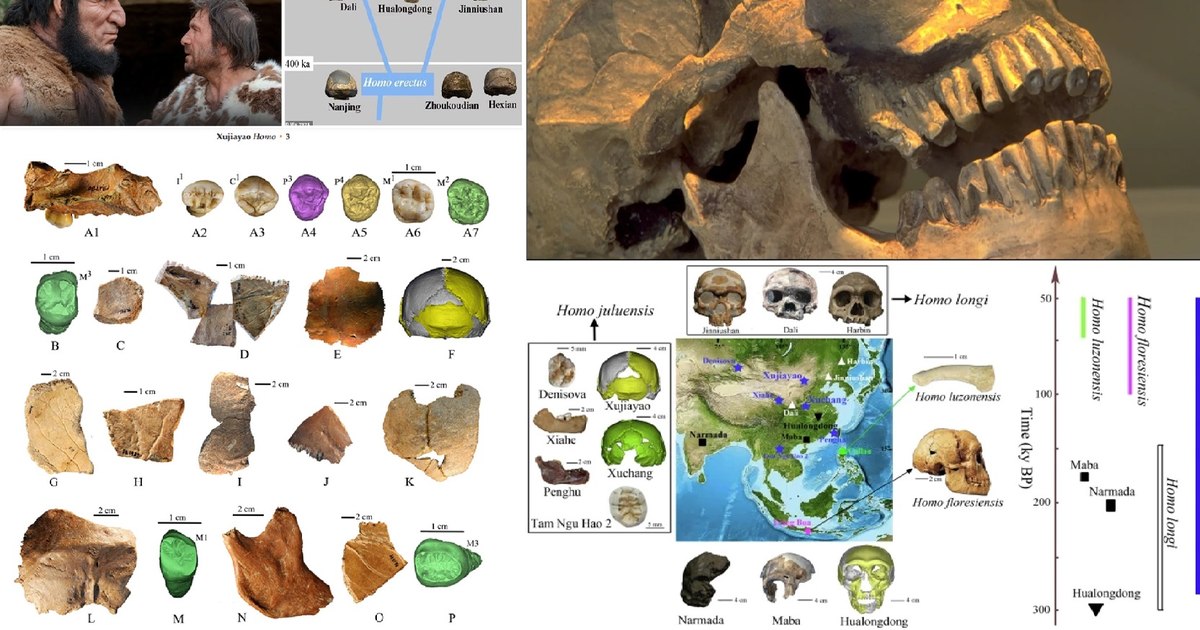
Researchers have discovered a species “lost” of humans, called Juluensis (julureni), which had a larger skull and brain than any other known hominin species, including modern humans. This species lived alongside Homo sapiens, in China, 50,000 – 300,000 years ago.
New ancestor with giant head and brain – Juluren and Homo Juluensis discovered in China Collage
Homo Juluensis – the Julurens – would have hunted wild horses in small groups, made simple stone tools for cutting, and possibly processed animal skins to make clothing.
This form of “big-brained hominin” would have been a close relative of Neanderthals and Denisovans – other branches of ancient human ancestors, the researchers say.
Previous studies tend to group various fossils into one group. However, paleoanthropologist prof. Xiujie Wu, from the Chinese Academy of Sciences (CAS), and anthropologist Dr. Christopher Bae of the University of Hawai’i says key features have been missed in the fossil record.
In a work “provocative”they argue that some fossils show a combination of traits that do not match any known human species.
The largest human brain discovered, of a mysterious species – Homo Juluensis
In the past, any fossil that did not belong to Homo sapiens or Homo erectus was grouped under the name Denisovan, a type of early hominin related to Neanderthals that interbred with modern humans in Asia.
However, dr. Christopher Bae argues that some of these fossils should be recognized as a separate species, called Homo Juluensis.
The researchers analyzed 21 hominin fossils from an unknown number of individuals discovered in China in the 1970s, as well as skull fragments from two individuals found in 2005 at another location in China.
Using modern techniques for analyzing fossil evidence, Dr. Bae and Prof. The Xiujie Wu have identified a set of traits that do not match any known species.
The most distinctive of these features is the abnormally large skull, which inspired their name Julureni.
By assembling the remains of the skull, the researchers estimate that it would have had a volume of 1,700 ml, significantly larger than the 1,330 ml skull of Homo sapiens.
The stunning skull with an unusual shape from the Nihewan Basin: a species with unique features
An extremely well-preserved skull has been discovered in an area of China known as the Nihewan Basin, which, 300,000 years ago, was covered by a large lake.
Paleontologists believe that this ancient human species settled on the shores of the lake, and today the remains are buried in its thick sediments.
The skull was not only abnormally large, but also unusually shaped, being much wider at the base than a typical skull. In addition to the skull fragments, researchers later found pieces of the jaw and teeth.
According to them, the fossils show enough distinctive features to support the existence of a new category of people.
In their paper, published in the journal PaleoAnthropologyProfessor Wu and Dr Bae argued: “Together, these fossils represent a new form of hominin with a big brain”.
This complex combination of traits suggests that there was far more significant interbreeding and common ancestry between the various groups of hominins living in Asia between 300,000 and 50,000 years ago than previously thought.
The New Species Controversy: Challenging a New Understanding of Human Evolution
However, these arguments have sparked controversy, with some researchers pointing out that the fossil evidence for Homo Juluensis is still quite limited.
Professor Jonathan Hawk, from the University of Wisconsin-Madison, described this new work as “provocative” in a post on X. However, Professor Hawk believes the core idea of the Juluren theory is sound.
And in a blog post from this summer, he wrote: “I think the evidence is more extensive than most specialists assumed. Calling all these groups by the same name makes sense only in contrast to modern humans, not as an accurate description of populations across space and time.”
The new species has not yet been officially recognized scientifically – a process that requires the approval of a taxonomic authority.
Regardless of how Homo Juluensis is ultimately classified, the researchers argue that the simplistic story of human evolution in Asia no longer holds up in the face of recent discoveries.
Dr. Bae states: “This study clarifies the fossil history of hominins, which until now have often been lumped generically into categories such as Homo erectus, Homo neanderthalensis or Homo sapiens, without a detailed analysis”.
Prehistoric Man: Surprising Discoveries and the Reappraisal of the Family Tree
The family tree of the human species, once considered relatively simple, has become much more complex in recent years as new branches have been discovered.
For example, in 2003, scientists discovered the fossil remains of Homo floresiensis, the smallest known human species, which lived in Indonesia about 100,000 years ago.
In 2021, the existence of Homo longi, a nicknamed species, was officially recognized “dragon people”discovered in China. Homo longi had a brain comparable in size to that of modern humans, but featured large and almost square eye sockets, prominent brow ridges, a wide mouth, and larger teeth.
As these discoveries continue to emerge, more and more researchers are calling for a re-analysis of the classification of some Asian fossils.
In an article published in Nature Communications, Professor Wu and Dr. Bae concludes: “It is increasingly apparent that hominin fossils from East Asia are not only multiplying with the new discoveries, but also exhibit far greater morphological variation than originally anticipated.”
Who were the Denisovans?
Denisovans are an extinct species of humans closely related to Neanderthals, but separated from the modern human lineage (Homo sapiens) about 600,000 years ago. They lived in Asia and their remains were discovered in the Denisova Cave in Siberia, but their DNA has also been found in other regions of Asia, including Tibet.
Although very little is known about their lifestyle, archaeological evidence suggests that they were capable of sophisticated tools and jewelry, similar to modern humans. Additionally, genetic research has shown that the Denisovans interbred with other species, and their DNA is present in some modern humans, particularly the aboriginal populations of Australia and those of East Asia.
It is believed that they had a wide range and may have been the first to arrive in Australia. Also, recent studies indicate at least two waves of admixture between Denisovans and modern humans, 50,000 – 200,000 years ago.
