
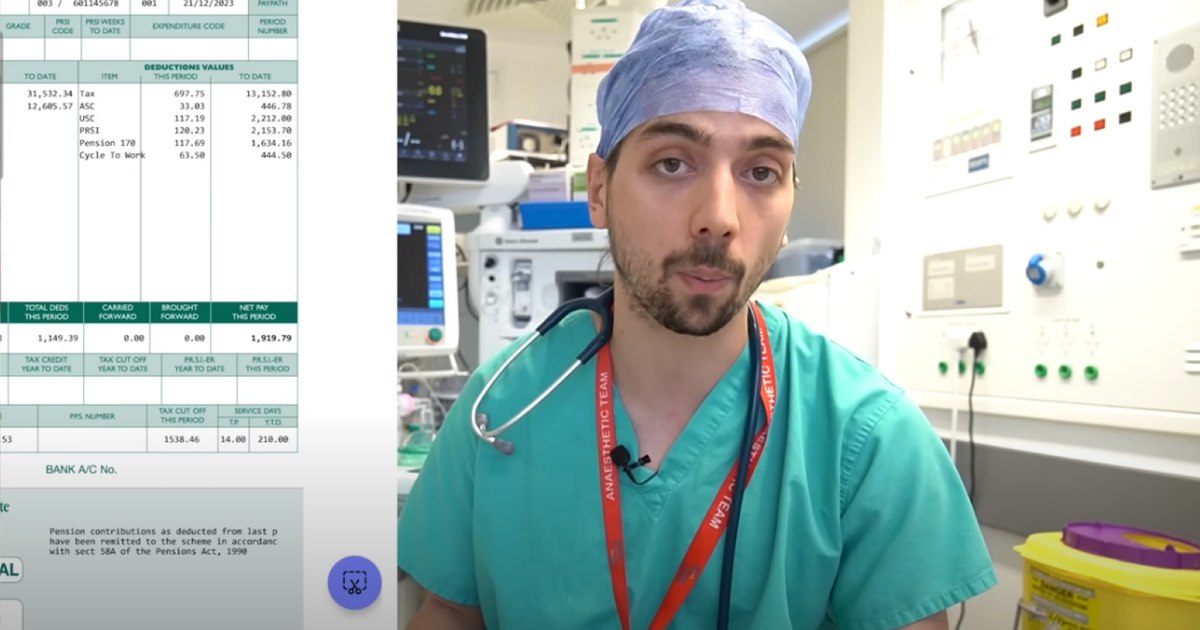
Resident doctor Paul Oargă presented his salary sheet: he earns almost 2,000 euros net monthly at an ATI department in Cluj. He claims that Romania has the highest percentage of doctors in relation to the population who have left the country, but not because of salaries. In Ireland, he was winning twice.
Paul Oargă earned almost 2,000 euros in two weeks in Ireland. PHOTO: Video capture
Paul Oargă, the resident doctor at Anesthesia and Intensive Care who explains to everyone in YouTube videos what the work he is passionate about consists of, presented his salary flyer. He is a V-year resident doctor at Cluj-Napoca County Emergency Clinical Hospital. Paul returned home in May 2024 after working for about a year in an ATI ward in a Hospital in Ireland.
“I continued to work as a resident doctor at ATI in the last year, year V. In the fall I also took the specialty exam and I want to let you know thatUm I’m a specialist, yesUm I haven’t completed the entire residency period yet. I have until the end of March. I took the specialized exam and I could even say with flying colors after 5 years of residency”he specified.
Paul also passed the College of Anesthetists in Ireland and could have continued his work there. Although the wages and conditions are better in Ireland, the resident decided to return to Romania: “I want to practice in Romania, to be a ATI specialist here, in my country. It’s very hard to be away from the Romanians, no matter how many problems they have. On the other hand, the fact that we are part of the European Union helped me a lot. I went to Ireland very easily, I was able to see things that maybe I wouldn’t have seen in our country and that I can bring here, whether it’s practical things or mentality. I saw how people interact nicely with each other, I saw a greater respect than we have in hospitals in Romania”.
“The main reason, although hard to believe by public opinion, is not salary”
Orgă claims that, unfortunately, Romania has the highest percentage of doctors compared to the population who have left the country (37%) and are working in different places in the world.
“The main reason, although hard for the public to believe, is not the pay, but rather the working conditions, the poor management of the hospitals and the fact that you feel that your personal development is done ‘in spite of’ not ‘because of’ the working environment . We still haven’t overcome paternalistic medicine, “as I say, it’s good because I’m the boss here”, mutual respect between colleagues, and we still have a lot of work to do in developing emotional intelligence, primarily of doctors”he explained.
He added that the pay level is “really good”, the problem being rather “the inappropriate work environment, the arrogance in the departments and the working conditions, where the lack of respect for you, for your job, makes you think if you really belong to that place and maybe you would be better off somewhere else, where is the continuous medical exodus that Romania is experiencing”.
Despite these conditions, Paul believes that his role is to bring added value to Romania. “I have a lot of hope, but also ideas, projects and the will to work. Romania comes with the advantage of having a better place in (almost) all branches of development”, he concluded.
Salary of a 5th year resident doctor in Romania: almost 2,000 euros net
Paul presented his salary slip from Cluj-Napoca Emergency County Clinical Hospital for the month of October 2024.
From the basic salary, after all fees and taxes have been deducted, the resident is left with 9,642 lei, i.e. almost 2,000 euros. More precisely, 1,928 euros. Paul divided the salary by the number of working days and 8 hours per working day and arrived at the amount of 52.73 lei per hour, which is about 10 euros per hour.
“This is my net income as a resident physician at the end of year 5 of residency,” he specified. Guards are not included in this amount.
“I did two shifts in October, one of which was either a Sunday or a public holiday. These guards were one for 24 hours, another for 16 hours, so in total there were 40 hours. The total amount of these guards plus the allowance of 500 gross lei for residents who do more than two guards is 1,994 gross lei. After deducting taxes, 1,166 lei remain net. That means 30 lei per hour (6 euros per hour). So that’s what you’re left with. I leave it up to you to decide whether it is a lot or a little, but you have to consider that this 30 lei per hour comes after 6 years of medical school and 5 years of training in anesthesia and intensive care“, he claimed.
Is it worth it to work in Ireland on double salary?
Paul spoke in another clip about how much he was earning in Ireland.
He presented the salary slip received on December 21, 2023. “They pay every 2 weeks. The working week has 39 hours, so you must have 78 hours at the end of the two weeks. So for those hours you get 2,382 euros, but this is the gross income. For the 15 hours in which he worked extra guards, he received 687 euros gross. We see here that after taxes, I am left with 1,900 euros in my pocket, net. That’s two weeks away. Good, some really good money that allows you to live a good life, even here in Ireland. The rent is quite expensive. The rent I pay is 1,800 euros per month“, he explained.
The basic hourly pay for Paul – who was a 3rd year resident at the time – was €30 per hour worked. “The amount increases depending on the experience you have. An advantage I had is that my experience as an anesthesiologist in Romania was recognized. So I came with 3 years of experience in the field of work which greatly increased my hourly pay“, he claimed.
Practically, Paul earns in one month in Romania, roughly, the salary he used to earn in Ireland in two weeks. It is true that practically almost half of the wages in Ireland went to rent.
“One thing I can’t help but notice is that no matter how much experience you have, whether you’re in your first month of work or your tenth year, you get paid for the work you do. In Romania, during the first two years, as a resident doctor, the guards are not paid”claimed Orgă in the clip filmed in 2023.
What he learned in Ireland
Regarding the experience in Ireland, Paul Orgă says: “If I’ve learned anything in a year, it’s that with good management systems, work protocols, people adhere to them and things go very well. In their absence, everyone does as they see fit and discussions and arguments occur, which are not done in a constructive manner. I think if we could implement these things, we would all be better off. And we don’t even have to think about them, we can import them from centers that go “clock”, in Romanian.”
He believes that he is one of the doctors who really wants a change and wants to make things better in Romania. “I needed to come here to see how others organize. Now more than everagiven it’s time for people who really want to make things work, really want a change for the better, we need to put the bone to work and not just let bad mouths have a voice in public space and assert ourselves too, to we also come with views and opinions that would serve society in the long term”he concluded.
