
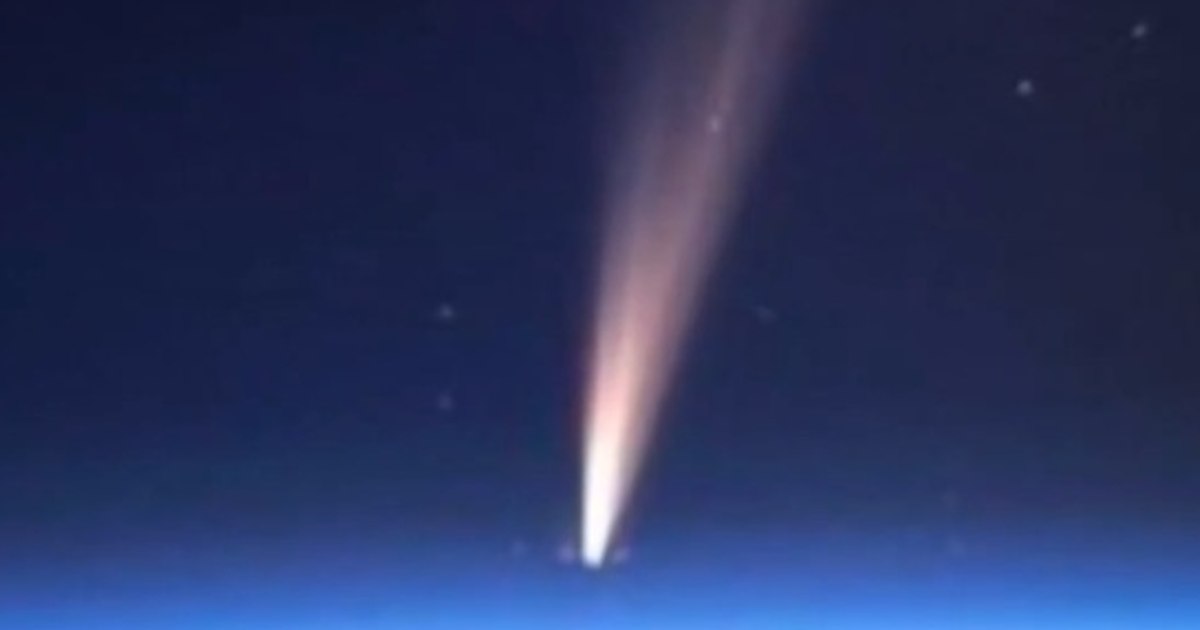
Comet C/2024 G3 (ATLAS) is due to reach perihelion, its closest point to the sun, on January 13, 2025. Dubbed the “New Year’s Comet,” it will come within just 13.5 million kilometers of the Sun.
Comet C/2024 G3 Photo: X video capture
It could be the brightest comet of 2025.
“It (the comet) is expected to approach the Sun (known as perihelion) around January 13, 2025. However, as with all comets, visibility and brightness can be unpredictable. Observers may have opportunities to observe it in the days around perihelion, depending on local conditions and the behavior of the comet“, stated Dr. Shyam Balaji, a researcher in astroparticle physics and cosmology at King’s College London, reports the Daily Mail.
Comets are frozen remnants from the formation of the solar system composed of dust, rock and ice. NASA estimates that there are billions of comets orbiting the Sun in the Kuiper Belt, a region of the solar system that hosts Pluto, and in the more distant Oort Cloud.
“The comet will only be in the sky during the day, setting just after the Sun. It is estimated that its brightness may reach magnitude -4 or -5. (…) Theoretically it means that it could be seen with the naked eye or through binoculars during the day. Practically, in the sky, the comet is very close to the Sun, only 5 degrees away. It will be very difficult to notice!“, wrote on Facebook the Romanian Astronomical Society of Meteors – SARM.
The comet may also be visible in the coming days.
“If you’re an experienced observer or astrophotographer and have perfectly clear, clear skies, you can try one or more shots (for the stack) throughout today (no Monday). (…) Tomorrow and the day after tomorrow the comet will move a little further from the Sun, but its brightness will decrease dramatically. Photo captures can be attempted, most appropriately at sunset. However, there is also the possibility that due to this very close proximity to the Sun, the comet may not survive and disintegrate“, the representatives of the Romanian Astronomical Society of Meteors also sent.
The comet will be most visible to people in the Southern Hemisphere, who will be able to look toward the eastern horizon before sunrise or toward the western horizon after sunset.
However, if you are in the Northern Hemisphere (including the UK), viewing conditions may be slightly more difficult due to the comet’s position in relation to the sun.
According to New Scientist , the comet will be visible until January 14, and the best viewing time, for places like the US and Europe, is thought to be Tuesday, about 30 minutes after sunset.
