
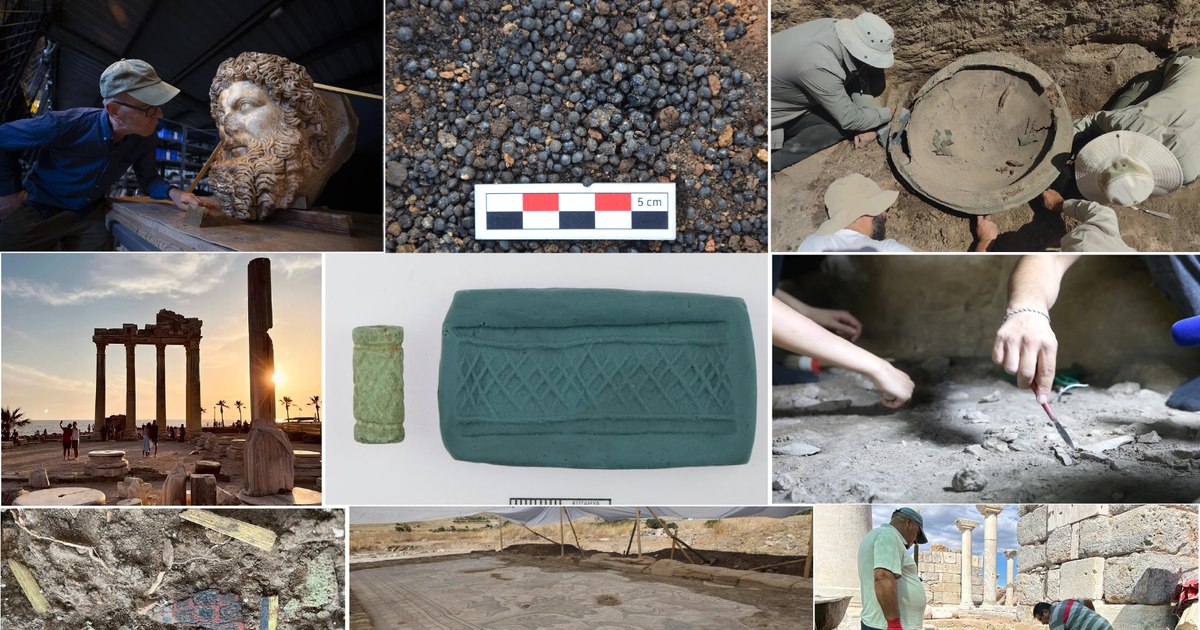
Turkey, the epicenter of revolutionary archaeological discoveries, continues to amaze the scientific world. With a record number of excavations held in 2024, the country strengthens its treasure status of the world heritage. If 720 archaeological studies were registered in 2023, this number increased impressive to 765 in 2024, and the ambitions are clear: by 2026 to reach the threshold of 800 active projects.
The archaeological discoveries of 2024 that rewrite the history of Turkey and the world collage
The year 2024, already called “The golden age of archeology” In Turkey, according to the Authority for the Promotion and Development of Tourism in this country, it was marked by remarkable discoveries in all corners of Anatolia, from ancient artifacts that reveal mysteries from forgotten times, to sites that rewrite the chronology of ancient civilizations.
Discover the most spectacular archaeological revelations that make Turkey a true capsule of time in 2024!
A 4,000 -year -old seal discovered in western Anatolia
In Seyitömer Höyük in Kütahya, a cylindrical jade seal was found, dating to 4,400 years ago. The unique seal from Movila Tavșanlı comes from the period of the Assyrian commercial colonies. The artifact, the first of this type found in the west of Anatolia, confirms the existence of new commercial routes between the east and west of the region, comparable to those of the famous shopping centers such as Kültepe and Acemhöyük.
A minoic dagger in Antalya’s deep waters
During the underwater excavations held in the Kumluca district of Antalya, at a depth of 50 meters, a minoic bronze dagger was discovered, with silver rivets, under a copper bullion in the form of a pillow. This rare relic, specific to the ancient creation, strengthens the cultural links between minoic and anatolian civilizations.
The goddess of health and mythology take color to Denizli
Archaeologists from Laodikeia – Denizli, southwestern Turkey, discovered a statue head dedicated to hygieia, the goddess of health, dating from 2,100 years ago. The head of the statue represents a refined work that reflects the rebirth of the classic art during the late Hellenistic periods and the Emperor Augustus (27 BC – 14 AD). In addition, several colorful statues depicting Scylla offers a rare look at the vibrant Hellenistic art.
The Figurine of the storyteller in ̇zmir, 7,800 years old
At Movila Uluacak, in Kemalpașa district, in the province of ̇zmir, an impressive female figurine was discovered, with a detailed mouth, suggesting that it could be a woman who told the locals. This is a rare testimony of social life almost eight millennia ago. It is estimated to date from 5800 – 5900 BC.
The memories of the battle of Manzikert, buried in the land of Mus
No less than 39 peaks of arrows used, both the Selgiucide and Eastern Roman armies, in the famous 1071 battle of Manzikert, between the Turks and the Byzantine Empire, were discovered, telling the drama of this historical moment.
Millefiori jewelry shines in Antalya
Archaeologists have brought to light in the ancient port Andriake in the ancient city of Myra, in the Department district, the first millefior panels discovered in Antalya. These are numerous impressive panels of interior decorations made by the ancient “millefior” technique (which means “a thousand flowers”), a method of processing the glass that creates distinctive floral patterns, a refined ancient technique that reflects the artistic refinement in Myra.
The shopping list of a 4,000 -year -old king discovered in Hatay
A cuneiform tablet discovered in 2024 describes a furniture command – tables, chairs and stools – which illustrate the prosperity and advanced craft of the Bronze Age in the Kingdom of Mukish. The ancient shopping list was found among the ruins of the Açana Movile in Hataay. The table, written in ancient Akkadian, has been identified as a royal command.
Selgiucid food warehouse in Kars
The ANI digs – a UNESCO World Heritage site in Kars – revealed a silo with eight large vessels full of supplies, a testimony of the economic organization from the XI -XI centuries. The deposit of the Selgiucide period contains conical vessels, each with about 1.5 m high and a diameter of the mouth 50 cm.
Ugly weapons from distant times, discovered in vain
At Ayanis Castle, the billion equipment discovered by archaeologists – bronze shields, a helmet decorated with religious symbols and a huge vessel – demonstrates the military and artistic mastery of the ugly civilization from the 7th century BC. The artifacts were found in the complex of the temple dedicated to the god Hali.
About the amazing discoveries in the Van area, clear evidence of the remarkable Urartu civilization, “Truth” He has already published a series of articles, which will continue with new revelations about these treasures.
Returning to the latest discoveries, the ones from Ayanis Castle in the Tuşba district (Tusha) reveal the greatness of the ancient fortress, once a symbol of the Urartian Kingdom, and the recently discovered walls highlight the imposing structure. During the archaeological excavations of this district, a basalt stone statue was discovered, weighing about a ton, and in the fortress of the Ipekyolu district, the archaeologists brought to light 42 “Pithoi” – large vessels used for storage.
Zeus’s head, a sculpted treasure from Aydın
Made of fine marble, the head of statue of Zeus, discovered in the ancient city of Aydın, dates from the 2nd-III centuries AD. The impressive details of the beard and hair, carved in a medium-grained Aphrodisias marble block, underlines the refinement of ancient art.
Ancient agricultural treasures of the Bronze Age, found in Kahramanmaraș
Wheat seeds and carbonized wheat seeds, dry apricots and grapes reveal the agricultural habits of antiquity, buried for millennia at Movila Yassı, from Afşin district in Kahramanmaraș. Extraordinary agricultural treasure, discovered in a silo pit, contains about 21 kilograms of carbonized nostrils, two different types of wheat, apricot seeds, dry grapes and even garlic, lentils and poppy seeds.
The first moving animal, immortalized in stone, found at Sullıurfa
A carved plate depicting a wild donkey was discovered in Karahantee. It is the first representation of an animal in motion found in Sullıurfa. The dynamism of neolithic art is obvious in this masterpiece.
Apollo’s altar, a relic of ancient Antalya
An altar dedicated to Apollo, but also statues depicting lions and men from the 7th-8th centuries BC, were discovered in Phaselis, in Kemer district, demonstrating the veneration of ancient deities.
These remarkable discoveries bring to life history, connecting the past and present through fascinating stories carved in stone, metal and earth.
