
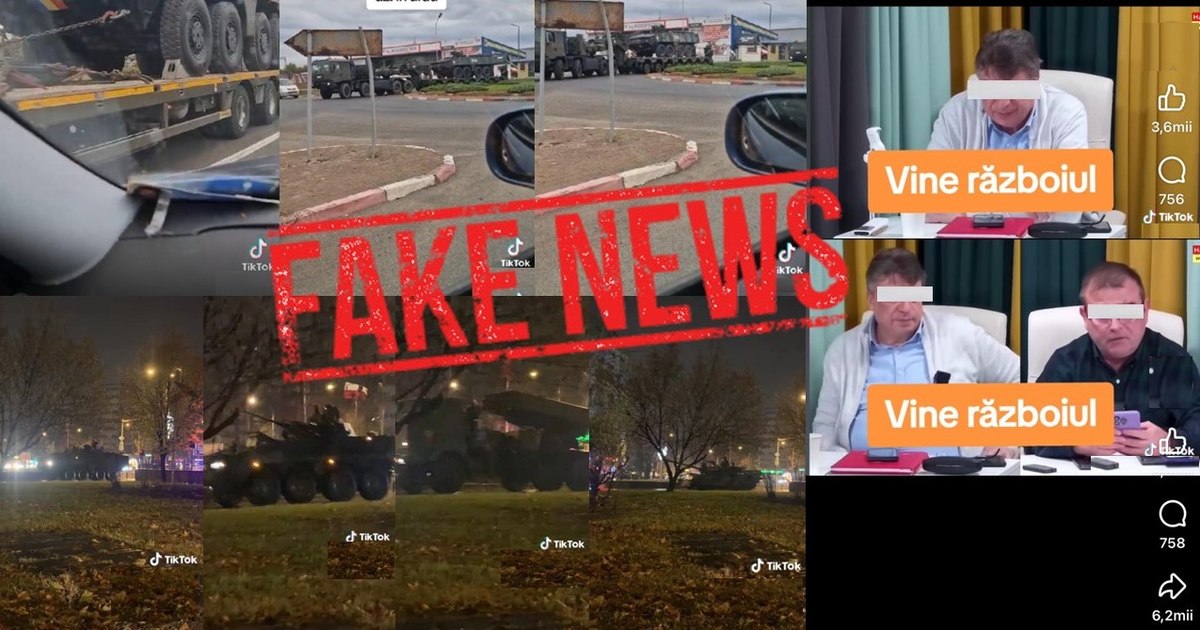
Fake news, ie false news, have been deeply infiltrated into the public space in Romania lately, and the effects are visible: polarization, distrust, radicalization and political manipulation.
False news has been deeply infiltrated into the public space in Romania. Photo archive
A fake news (in Romanian: false news) is intentionally false or misleading information, presented in the form of a real news, in order to manipulate, misinform or influence public opinion, explained for “”truth“Radu Turcescu, communication consultant and image strategist.
According to him, on social networks there is more and more content with false information and images, many built with the help of artificial intelligence. As it has the role of exciting people, that content becomes viral.
A successful fake news does not start from scratch. On the contrary, to seem credible, it is based on real elements, presented in a distorted context.
“A false news has roots in people’s dissatisfaction, satisfying their need for victimization, appears to nostalgia – that is, some times when things were simpler, and shows them a culprit for their disastrous situation. Also, any false news has a few real, real elements, which gives them credibility. Social media.
In general, a false news presents a large, impact situation, which meets the needs of the readers. The title is not necessarily alarmist, but it is adapted to what people want to hear. In general, it is called either nostalgia or victimization (‘look what happens to us’) or both. ‘What this world / country has arrived. Look where we arrived, we are obliged to stay in the houses. The world occult rewrite history. Such ideas that lead the reader to a period when, apparently, it was easier, and shows him what disaster is now, because of X, Y or Z. The purpose is to create division and distrust, based on which subsequent suggestions of actions are before and accepted. “Turcescu explained for “truth”.
How can the votes be won by spreading fake news
In periods of election campaign, false news becomes strategic tools. Fake news is designed to cause strong reactions-fear, anger, hatred or hope. Demographic data are used to target groups that are less informed or more susceptible to handling, through messages specially adapted to them. Once a person is emotionally involved, it is less likely to verify the truthfulness of the information. Fake News spreads quickly on Facebook, WhatsApp, Tiktok, etc., where the sources check is weak. With sensational titles and dramatic images, the message takes advantage.
“A number of fake news news very well built and distributed in the long term will influence perceptions and value. On this foundation, a candidate can come and position himself as a savior, for example“Added the specialist.
The creation and distribution of false news is not reserved only to obscure entities. Any person or group who wants to influence public opinion in certain directions can create false impact news. Individuals, political groups or even external entities can create misinforming content, in order to influence public opinion, to divide society or to create panic.
What themes do best in Romania and who falls most often in the trap
The most vulnerable categories are people with low education, who tend to accept the information without questioning them, the elderly, who are not familiar with the online manipulation techniques, but also the young people, who, although natives, have not yet formed a habit of critical thinking. “They are vulnerable to false information, especially those with poor education, because they ask their fewest questions. Naturally, young people because they don’t yet have a habit of thinking critically. The problem in Romania is the lack of education, given that 15% of Romanians have higher education, and 40.5% maximum 8 classes. Without education it is hard to discern a false news of reality”, The consultant specialized in Crisis Management.
Fake News with the highest chances of viralization in Romania have some recurrent themes about global conspiracies, health and “miraculous” treatments, political manipulation and corruption, nationalism and identity themes. Romanians are receptive to conspiracy theories, especially when they involve “invisible enemies” that plot against the country.
Examples of fake news in Romania and abroad
A concrete example in Romania regarding the amplification of a fake news with the help of artificial intelligence (AI) involves the governor of the National Bank of Romania, Mugur Isarescu.
In February 2024, a Deepfake video was distributed on social networks, in which Isarescu seemed to promote a fraudulent investment scheme. His image and voice have been digitally manipulated to convince the public to support investments in cryptocurrencies, in reality non -existent. This video was promoted including through commercials paid on Facebook, which contributed to the rapid increase of its visibility and credibility.
The National Bank of Romania reacted promptly, warning the public that neither the governor nor the institution offers investment tips and that the video is an attempt to fraud.
This incident highlights how AI technology can be used to create false extremely convincing content, which can mislead the public and affect confidence in state institutions.
A recent and relevant example of Fake News amplified by AI involve a Facebook viral post that fakes that Caitlin Clark basketball player spent $ 3.3 million to turn a house from des Mines into a homeless shelter. This information was quickly dismantled: the image presented was actually the Salisbury House and Gardens, a historical building that is not for sale. The post came from a page generated by AI, which distributes manufactured news about WNBA to attract traffic and generate clicks.
This case highlights how you can be used to create and spread false information in a convincing way, exploiting public confidence in online sources and difficulty distinguishing between real and manufactured content.
How do you recognize a false news
In the opinion of the specialist Radu Turcescu, it is almost impossible to identify a false news when distributed on social networks. But it is important to inform ourselves in different sources and try not to take the information as presented. But there are some clear signs that should at least make Romanians wonder if it is real or not.
• Emotional or sensational titles, which “hit” exactly where it hurts.
• lack of clear sources or quoting so-called “anonymous sources”.
• Images removed from context, old or edited, which support a false narrative.
• Conspiracy messages that suggest that “the truth is hidden”.
However, in AI era, some false news becomes almost impossible to verify. The solution? Checking information from multiple sources and developing a healthy critical spirit.
Algorithms – the perfect complicates of misinformation
Social networks play a huge role in spreading fake news. The platforms use you to decide what posts show you. If you interact with a fake news, the platform will show it to others like you.
Thus, fake news becomes viral, involuntarily supported by algorithms designed to give the user what he wants. A false but emotional post can become viral in a few hours, and then it is extremely difficult to fight, even with clear facts.
A crucial role in the spread of fake news is played by the influencers or pseudo-legalists, who manage to win the public’s confidence. “We tend to believe what someone we trust. And often, we don’t ask ourselves, just because someone ‘seems honest,” explains Radu Turcescu.
Education – the best weapon against manipulation
The greatest vulnerability in front of fake news is the lack of education. By repetition, a fake news can become perceived as “truth”. When it is repeated by influencers, pseudo-experts or even television, it acquires its “weight”.
In order for Romanians to no longer believe in Fake News, they should be encouraged to think critically and ask questions and at the same time develop the degree of digital literacy, that is, to learn how social networks work.
