
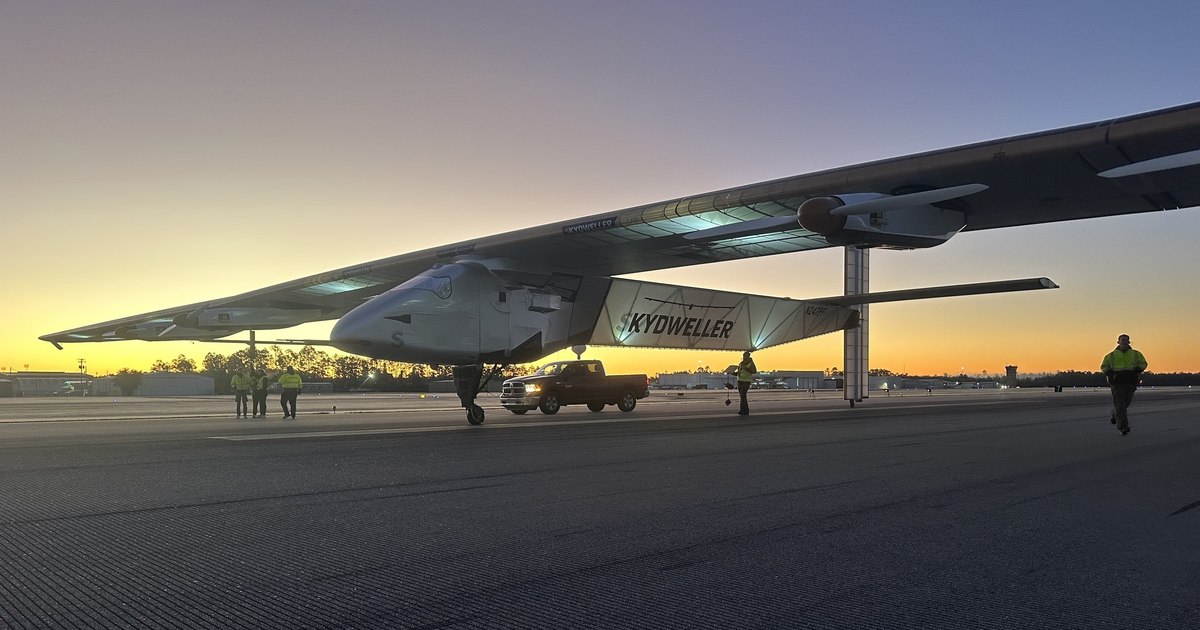
Meet Skydweller! Live Science presented this week the characteristics of a solar power drone, which can fly for 90 days in a row without requiring landing. The device is 160 times easier than a Boeing 747, but wider than such an aircraft.
Skydweller has a 72 m wings. Facebook photo Skydweller Aero
The American Start-up Skydweller Aero has team up with Thales, a French electronics company specialized in defense systems, to develop a new maritime surveillance drone that can remain in the air more than the existing devices.
Skydweller drone feeds exclusively of solar energy and aims to be capable of continuous flight. For now, however, the initial flight stone of the flight will be to stay in the air for 90 days, but it has the potential to fly much more.
How to capture Skydweller solar energy and how it uses it
Over 17,000 individual solar cells, held over 270 square meters of surface wings – on a large wings of 72 m, 7.6 m longer than a Boeing 747 – captures the solar energy that feeds Skydweller.
Solar cells can generate up to 100 kilowatts of energy for the aircraft, under optimal conditions.
The day, solar energy is used to keep the flight, to supply the aircraft on board and to charge the batteries.
At night, however, Skydweller uses the 635 kilograms of batteries, which are used to feed the aircraft, which allows the drone to maintain an almost continuous flight.
Skydweller usually flies at an altitude of 7,500 -10,500 meters, but can climb up to 13,600 m during the day, before lowering up to 1,500 – 3,000 m at night, to minimize energy consumption.
Although it has a major similar to a long -range commercial aircraft, Skydweller is 160 times lighter than a “Jumbo aircraft”: it has 2.5 tonnes, at maximum capacity, compared to 400 tonnes as it has a Boeing 747 at a full useful load.
