

Popularly called pomace, the skins and seeds of grapes left over from pressing them in winemaking could bring a lot of health benefits, according to the latest studies. One such research analyzed the properties of cranberries from 17 grape varieties.
Grapes are among the foods recommended for health. Photo: Freepik.com
In Romania, almost a million tons of grapes are harvested annually, and most of this amount is used in wine production. The tradition of winemaking has millennial roots in the current territory of Romania, with hilly regions and sandy soils suitable for vine cultivation.
Some scientists have included grapes among the health-promoting “superfoods.” During the winemaking process, a part of the grapes (about a quarter of their mass), called pomace, is a secondary product, for which the Romanians either looked for uses or considered it useless.
Specialists have shown over time that the skins, seeds and bunches left after squeezing can be extremely useful, even in the field of health. A study recently published under the title “Transylvanian grape quince as a sustainable source of antioxidant phenols and fatty acids”, by specialists from the universities of Agriculture (USAMV) and Pharmacy (UMF) from Cluj-Napoca show the health potential of some white and red grape varieties from the region.
Tescovina, rich in fatty acids, phenols and antioxidants
The research analyzed the polyphenolic profile and fatty acid composition and antioxidant activity for 17 grape varieties. The skins and marks from the cranberries resulting from the winemaking process were analysed.
After pressing the grapes, the pomace was collected and dried at room temperature. The dried samples were then stored in paper bags under controlled conditions to minimize oxidative degradation for a period of three months prior to extraction.
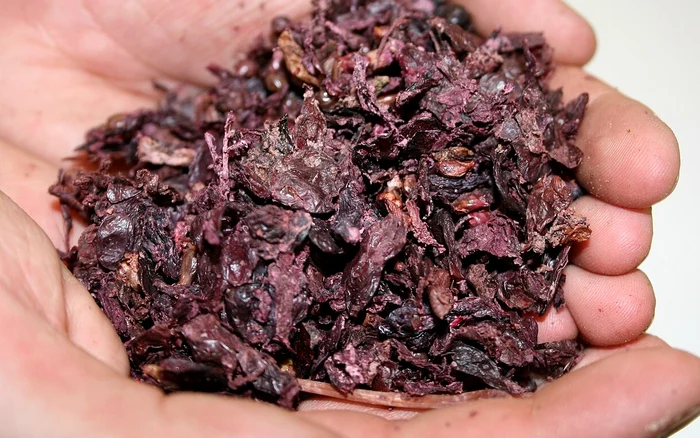
Marc. Photo by Adrian J. Hunter. Wikipedia
“The results showed that Neuburger (NE), Radames (RA) and Regent (RE) cultivars had the highest concentrations of phenolic compounds, especially catechin, epicatechin and procyanidin dimers. Neuburger (NE) and Fetească Regală (FR) cultivars showed the highest radical neutralization activity and the best electron transfer capacity in several antioxidant tests. Rose Blaj (RB) and Astra (AS) had the most favorable fatty acid profiles (…) suggesting cardioprotective potential”, shows research published on the online platform of the US National Library of Medicine.
The study authors claim that the results show the potential of grape pomace, particularly from the Neuburger, Radames, Rose Blaj and Astra varieties, as valuable sources of health-beneficial compounds with applications in food, nutrition and other health-related fields.
During the winemaking process, grape skins and pomace are considered a by-product and represent approximately 10–30 percent of the total mass of crushed grapes.
“Their utilization has been explored in various contexts, including animal nutrition, food industry, cosmetics and pharmacology. These applications are largely determined by the presence of bioactive compounds in the residues, influenced by the grape variety and viticultural and oenological practices. Tescovina is rich in nutritional and bioactive constituents, including carbohydrates, fibres, proteins, lipids, vitamins, minerals and polyphenols”the researchers also show.
The results of the research show the significant variation existing between the varieties, some presenting particularly promising profiles in the context of human health, complete the authors of the study.
Tescovina, the secondary product with hidden qualities
Pomace is the grape residue resulting from the winemaking process and, often, after the grapes have been pressed, it is thrown away. Over time, however, it was mainly used as animal feed, its nutritious properties and the appetite with which animals consume it being well known.
The Romanians also used it in the manufacture of vinegar and brandy, but also as a natural fertilizer for soils. Tescovina was kept in pots, and its preservation was done by covering it with earth; some specialists recommended salting it to be lightly “pickled” during the winter, sweetening or drying it.

All parts of the grape can be used. Source: Freepik.com
Pomace fodder was used as a substitute for classic grain fodder and fodder plants. They contain appreciable amounts of fat and protein, as well as large amounts of mineral salts, and are often used to fatten cattle.
“The bunches are a valuable raw material for the extraction of tartaric acid and can be used at the same time as cattle feed or can be dried and used as fuel. The pulp and must parts, fermented, give alcohol which can be extracted by distillation. The remaining pomace contains the skin and pulp, which can be used as cattle feed. A coloring matter is stored in the skin of red grapes (oenocyanin), very good for coloring some food products, such as candies, soft drinks and juices. The seeds contain tannins in the shell, and the core consists of fatty substances.” showed the engineer I. Simionescu, in the Revista Industriei Alimentare.
Tescovina was kept in pots and silos, and its preservation was done by covering it with earth; some specialists recommended salting it to be lightly “pickled” during the winter, sweetening or drying it.
In order to be preserved, the cranberry must be as dry as possible, well beaten so as not to come into contact with the air, be fresh, not airy and not show the beginning of spoilage (spoilage).
