
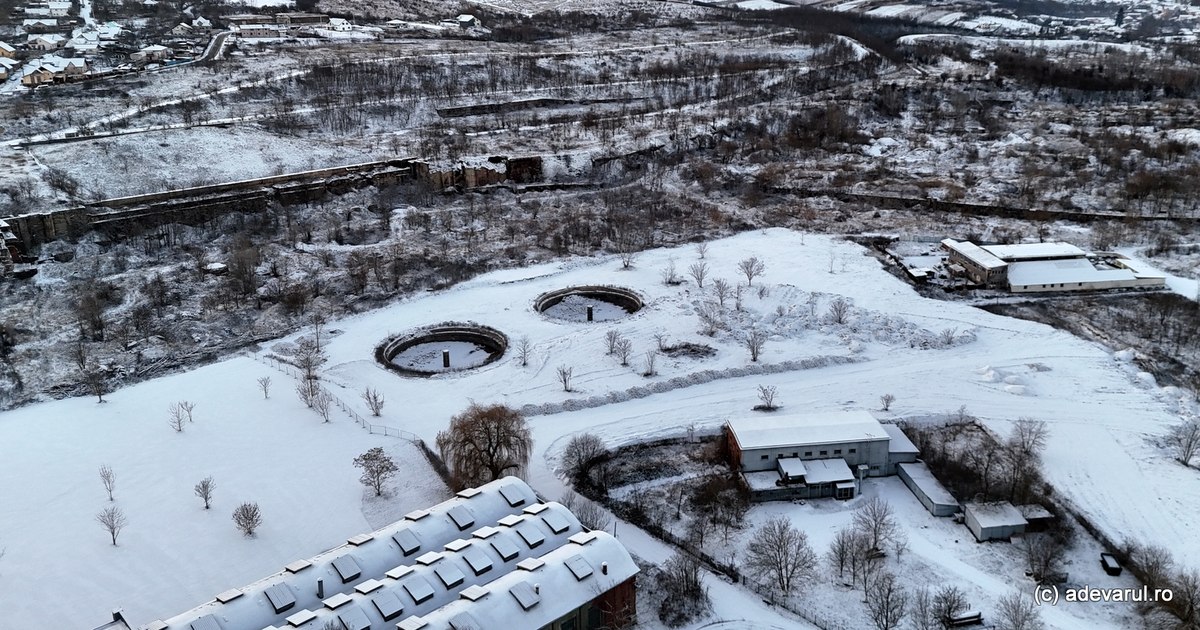
Formerly polluted industrial areas, swamps, pastures and vacant lands have become ideal places for the construction of extensive parks, intended to revitalize Romanian cities. Some investments are estimated at tens of millions of euros and promise spectacular recreation areas.
A little over 60,000 people live in Hunedoara, a former large steelmaking center of 20th century Romania, on which the decline of heavy industry has left visible traces. The old industrial platform was decommissioned in the 2000s, and since then more than 100 hectares have remained vacant.
The lands of the former factories are covered with rubble, but also with polluting residues from the old coke-chemical section of the combine and from other ruined metallurgical installations.
Hunedoara, from industrial ruins to urban garden
Vast areas, left to nature, were gradually occupied by lush vegetation and invasive tree species, which grew out of control, turning former industrial lands into wild places.
In other places, old streams captured and regularized in the past, together with rainwater, have formed lakes and marshes, around which birds and wild animals congregate.
At first glance, it seems that nature has regained its territory, and the regeneration of these lands has taken place without the intervention of humans. But the soil has remained contaminated with heavy metals and industrial residues, and the land cannot be used properly.
The former industrial platform (video), located on the banks of the Cerna river, near Corvinilor Castle, offers a chance for development to the city, which the locals want to make more attractive as a tourist destination.
An investment of 20 million euros, financed from European funds through the Just Transition Program, will transform nine hectares of the former compound into an urban garden, called “Corvinia”. The new park will be set up after the decontamination and greening of the area occupied in the past by sections of the coke-chemical plant and the Agglomerator, thus solving some of the environmental problems left over from Hunedoara’s industrial age.
“The Corvinia Urban Garden will be a space where both Hunedorians and tourists can have fun and relax. We want to have a fairly large splash of water, leisure and relaxation areas, an alpine coaster route and many other attractions for all ages. It is an ambitious project, because we want to give real utility to a fairly large area on the old steel platform. Being located close to Corvinilor Castle, the the most suitable destination for this area is for entertainment”said the mayor Dan Boboutanu recently.
The investment is under evaluation at the West Regional Development Agency.
Gusterland, built with EU funds in Sibiu
Investments in the construction from scratch of new extensive parks have also been proposed in other Romanian cities.
The sites of former factories, disused railway areas, former nurseries out of production for several years, swampy areas and pastures have become attractive for their location. In the central areas of cities, setting up new parks or expanding old ones is difficult, due to insufficient space.
Sibiu is one of the expanding cities in recent years, development accelerated by the attraction of important investments and the expansion of the highway network. The city in the center of Romania is congested, but the municipality has identified a suitable place for the construction of an amusement park of almost 33 hectares.
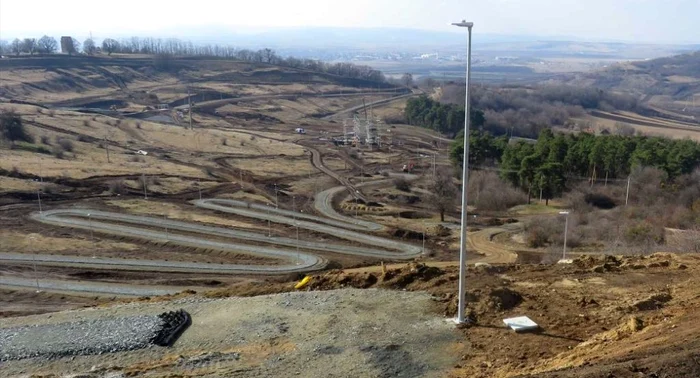
The new park, called “Gușterland”, represents an investment of over 20 million euros, mostly co-financed by European funds, attracted through the “Central Region” Program 2021-2027.
“In the Tilișca area, a mountain of rubble that has been ugly on the landscape for decades has been transformed into a recreational area that includes a mini-golf course, children’s playgrounds, alleys, a wet area and a mini-zipline. In the diametrically opposite area, on the Gușterita hill, 33 hectares of unused land will be transformed into a new park for the health and leisure of local residents, completing the cultural and tourist offer of the city by diversifying leisure opportunities“, informs the Center Regional Development Agency.
According to the municipality of Sibiu, the new park will be developed by around 2028 and will include a summer sled and bobsleigh facility, playgrounds, an adventure tower, a ski slope and tubing with a synthetic surface, a zip line, a panoramic terrace, a pond, pedestrian and bicycle paths, as well as a tourist stop area. A multifunctional building will also be built, parking lots will be arranged, and the entire area will benefit from all the utilities and services necessary for optimal functioning.
“Also for the smooth functioning of the project, exchanges of best practices and know-how with operators of similar leisure structures from Austria and Germany will be organized”, recently informed the Sibiu City Hall.
The largest park in Cluj-Napoca, designed from scratch
In Cluj-Napoca, a swampy land between the Someșeni and Gheorgheni neighborhoods will be transformed into the largest park of the municipality, with a total area of 54 hectares.
“The area that already bears the name East Park has a total area of 45.5 hectares (it was not expanded later) and includes the water surface and the shores of Lake 3, the area of the former RADP nursery and a wet portion which, together with a forest of lakes, constitutes a unique biotope in the urban environment. By integrating into the system of other urban plantations, the future East Park will become an important node in the green network of the city and the eastern area of Cluj-Napoca municipality”, inform the City Hall of Cluj-Napoca, in 2021, at the launch of the project.
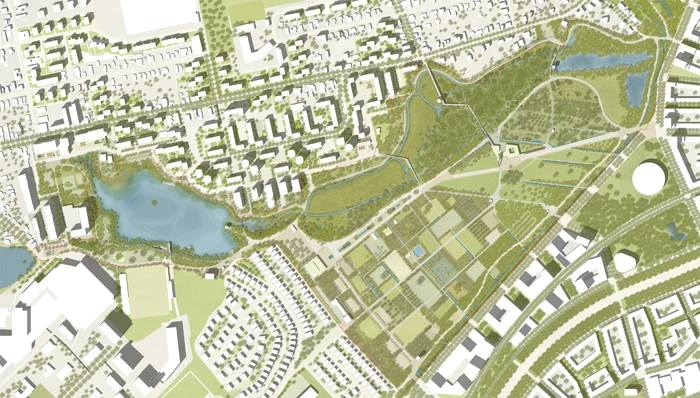
Recently, local councilors approved the Zonal Urban Plan for the first phase of the East Park project, which aims to develop 38 hectares.
“At Park Est we approve a PUZ for 37.98 hectares, a project worth 18.5 million euros. The first part of this project – the development of the Becaș Valley corridor between Sopor street and the Someșeni district, approximately 10 hectares in total – immediately goes to authorization and auction”. informs the mayor Emil Boc.
The future park was considered the most important green project in the history of Cluj.
