
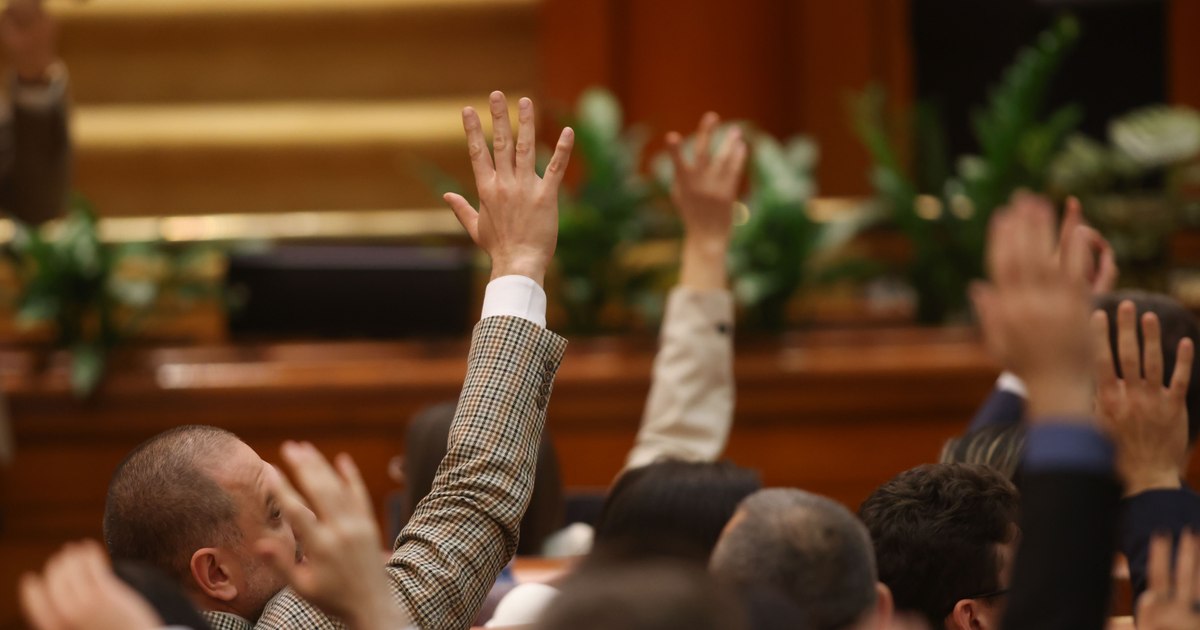
Between the unfulfilled promises of politicians or even scandals regarding plagiarism or the CVs of elected officials, a recent proposal by two former ministers, members of USR, raises questions about the mandates of elected officials.
Claudiu Năsui and Cristina Prună, former members of the USR and former ministers, in their third mandate in the Romanian Parliament, proposed that all public positions in the USR – parliamentarians, mayors, MEPs – be subject to a limitation of the number of mandates.
Political scientist George Jiglău believes that “proposing and limiting the number of mandates makes sense, especially when we are talking about elected public offices, which are unipersonal, i.e. mayors and president”. However, “when it comes to parliamentarians, MEPs, local council members, here is a bit more complicated discussion, because they are elected members, but they are members of some collective assemblies”he explains, pointing out that the limitation should be applied differently.
“It’s a proposition that deserves further discussion. We have all kinds of characters who have somehow become accustomed to public office and who are beginning to lose the dissociation between the temporality of the office and the view that they themselves are the institution that they run with limited terms. And then, I think that this principle of limiting the presence of a single person to some office is something that should be taken into account more broadly, as a way of ensuring some health in our democracies everywhere. So it’s not just a Romanian problem at this moment.
This proposal targets a more fundamental matter, our electoral law, through which we choose those who hold office, namely, the fact that it is not uniform. So we have the limitation of the number of mandates rather at this moment only for the president and that’s it. Which is an exception that no one has ever clarified. And obviously an important exception. We could say that it is the most important elected position.(…) I think that the mayors, in certain matters, could have an even more important role”.
The role of parties in the reform of the political class
However, the political scientist points out that there is no “a miraculous solution” for the reform of the political class. “Since the 90s, they have been looking for that solution that would solve the quality of the political class. Uninominal voting, voting in two rounds. It doesn’t exist. So there are small things that can be done. But like this, solving the problems in Romanian politics by a matter that is done somewhere in the electoral legislation is rainwater”.
According to the political scientist, the political class has been renewed, but what has not changed is the way politics is done: “This seat-limit proposal could be a step in a direction that helps,” but you have to “accompanied by many other things to talk about.”
“We need many years like this for antipathy towards politicians to begin to be mitigated” – George Jiglău, political scientist
“Whatever he does at the moment, the feeling of frustration that exists in the population towards politicians will not disappear. So, it is so rooted that many years of politics done well, coherently, differently than before, with competent and performing and likeable figures on TV must pass. But we need many years like this for the antipathy towards politicians to begin to soften, it will never completely disappear.”he points out.
Regarding the solutions, the political scientist points out that “the core of the problem” belongs to parties: “If the parties don’t change the way they select their people and don’t put competence and good faith, if they don’t put these first and we keep talking about criteria, personal sympathies, clientele, finances, and so on, then nothing will change.”
“We can’t find 100 good MPs”
Former president Traian Băsescu stated in a show on Digi24 that, in his opinion, the country’s fundamental problem is the quality of political representatives, explaining that he would “you want a political class in which we no longer have incidents with people who have seven grades and enter the Parliament. A political class that must focus on a Romania of the future”.
At the same time, he pointed out that “we don’t need 460 parliamentarians, because we can’t find 100 good ones. We should do something to increase the quality of the political class.”
