
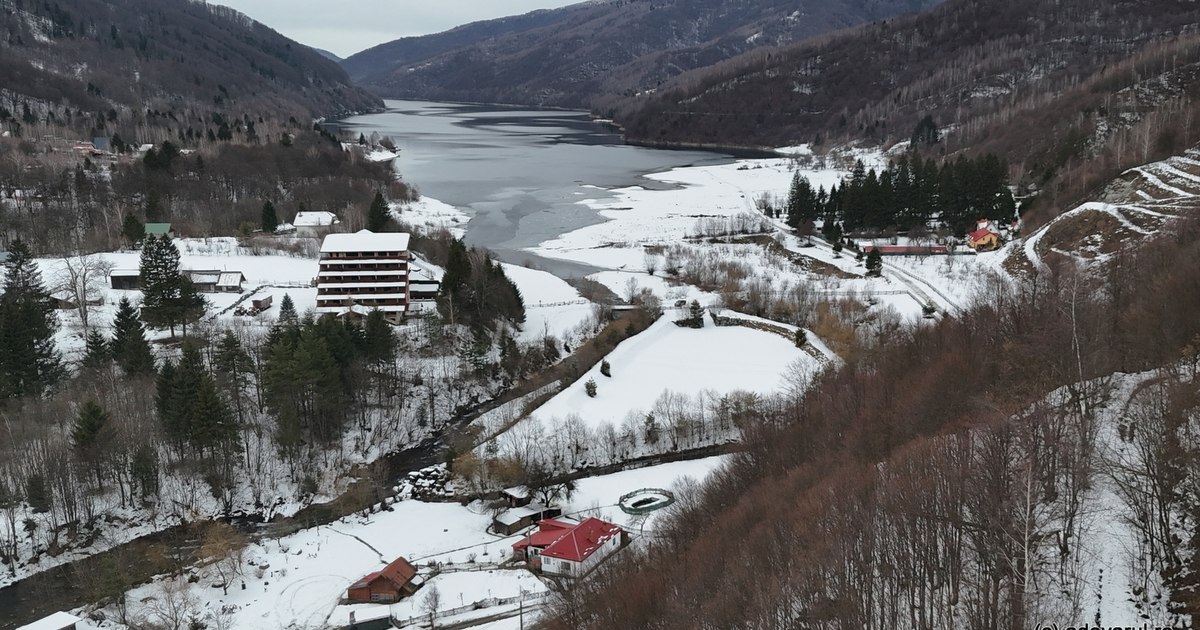
A hotel with over 170 rooms, abandoned since the 90s, recalls the years when the Poiana Mărului resort was sought after by Romanians. The Poiana Mărului reservoir was built more recently, but it failed to boost tourism in the Banatul Montan, affected by the region’s economic decline.
Poiana Mărului, a mountain resort in southwest Romania, was for several years considered the “Pearl of the Banat”, but the economic decline of the region affected it deeply.
Currently, it is praised for the clean air and wilderness around the 270-hectare reservoir, but also for the picturesque Ţarcu Mountains, in its vicinity, with heights of up to 2,200 meters.
“It’s an excellent place for a getaway: about two hours by car from Timișoara and about 45 minutes from Caransebeș. If you want to spend a weekend – or even several days – keep one thing in mind: here it is said to be one of the cleanest atmospheres in Europe. Not in Switzerland, but in Poiana Mărului, in Caraș-Severin county. In the area you can also go hiking, off-road with a motorcycle or mountain biking”recommends a local.
The huge hotel built in the heart of the mountains
But tourism in Poiana Mărului has developed less than the locals from Caraș-Severin had hoped. The county in southwest Romania has suffered a sharp population decline, falling by almost 17 percent between 2011 and 2022, according to the latest census, and industrial cities in the area have suffered from the closure of many mines and factories. However, Caraș-Severin is among the counties with the most offers in terms of tourist attractions, thanks to the nature reserves, the mountain area, the vast forests and the numerous natural monuments.
For many Romanians, the Banatul Montan resorts have remained almost unknown, even if the tourist areas here have been sought after since the 19th century, when the region in southwest Romania was famous for its industry and natural resources.
Poiana Mărului, hidden in the Țarcu Mountains, has been mentioned as a tourist destination since the end of the 19th century, with the first mountain cabins built here. In the mid-1930s, the patriarchal settlement, located about 20 kilometers from Oțelu Roșu and 40 kilometers from Caransebeș, became a climatic resort, appreciated for its ozonated air and for the beauty of the Bistra valley. It was also then that the first large guesthouse, Vila Bistra, was built, which could accommodate over 100 people.
In the first years of communism, the cabins at Poiana Mărului were nationalized and housed a TBC prevention center. In the 70s, it was abolished, and Poiana Mărului became a tourist resort again. A hotel with over 400 rooms was built in the center of the settlement, on the valley of Bistra Mărului, and the place became a holiday destination for the families of workers from the factories and mines of Caraș-Severin.
“With two building bodies and having an architecture with modern lines, located on a plateau with wide perspectives on the landscape, harmoniously integrated into the mountain environment, the complex offers 412 accommodation places, two restaurants, two bars and a terrace, the public catering units totaling 1,135 seats at the tables. An entertaining-educational games club and the services available to tourists (hairdressing, hairdressing, tailoring, etc.) complete the range of factors that ensure optimal conditions for holiday party”, informed in 1978 Ioan Trulea, the director of the tourist complex.
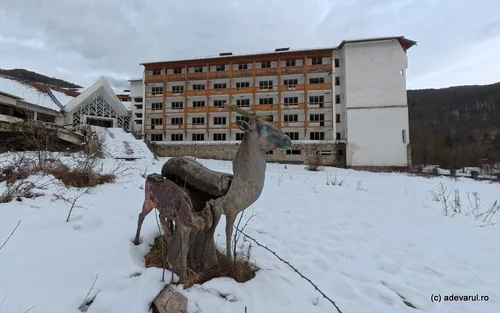
The hotel inaugurated in 1977 was named Scorilo, after the name of the legendary Dacian leader. The administrators of the resort explained the name by appealing to mythology.
“An old Romanian legend says that the place where the complex is located is called Pietrele lui Scorilo. The legend shows that the Dacian king Scorilo, the father of the brave Decebal, came here, attracted by the wealth of the places in alpine game”. says Ioan Trulea.
The seven kilometer long reservoir
In the 80s, Poiana Mărului would develop in a new direction. Below the resort, the valley of the mountain river that crossed it would give way to one of the large reservoirs in the Banat region.
Construction of the Măru Dam began in the mid-1980s, and a decade later the 125-meter-high clay-core anchorage dam was completed. More than 2,000 people worked on the hydropower development, many being housed in the workers’ colony at Poiana Mărului. In 1992, the filling of the reservoir began.
“11 years ago, work was started on the Bistra Mărului River, 16 kilometers upstream from its discharge into the Bistra River, at the Măru Dam. A rock dam with a clay core was built, which will eventually have a height of 125.5 meters. Thus, an accumulation with a volume of 96 million cubic meters of water will be created, mainly intended for the production of electricity in the plant Ruieni, a power station with an installed power of 140 MW and an average annual production of 262 GWh. Lake Poiana Mărului stretches for seven kilometers. The dam has a maximum height of 125.5 meters and a crest length of 408 meters, at an elevation of 625 meters. informed in 1992 Ștefan Pop, director of the Caransebeş Branch of Hidroconstrucția.
According to the engineer, the hydropower development required the construction of almost 30 kilometers of tunnels, and for the Măru and Zervești dams, over five million cubic meters of earthworks were used
“All this, along with other categories of works – impossible to enumerate in full – were possible thanks to the work of more than 2,000 workers, including 200 engineers and 100 foremen”, says the engineer Ștefan Pop.
The abandoned hotel in the center of the resort
Also in 1992, the “Poiana Mărului” company, which managed the Scorilo hotel and several tourist villas around it, started auctioning the buildings, in an area where mass tourism had declined.
The complex was concessioned, going through a series of controversial transactions, after which it remained derelict. At the same time, at the “tail” of the reservoir, local residents began to chaotically build holiday homes and villas, often without permits.
More than 50 such constructions were erected in the first four years after the Revolution, informed the publication Renaștea Bănățeană in 1994.
With the new reservoir becoming an attraction of the area, the new owners of Poiana Mărului hoped that the resort would develop, although the road to the recreation area, which went up the left bank of the lake, remained difficult to access and often affected by the works on the dam, which continued into the 90s.
The Scorilo complex, the largest hotel in Poiana Mărului, was closed in the mid-90s, and its buildings remained abandoned. Around it, some guesthouses have developed, tourist services have diversified in recent years, and the local economy is also boosted by the establishment of a brewery.
