
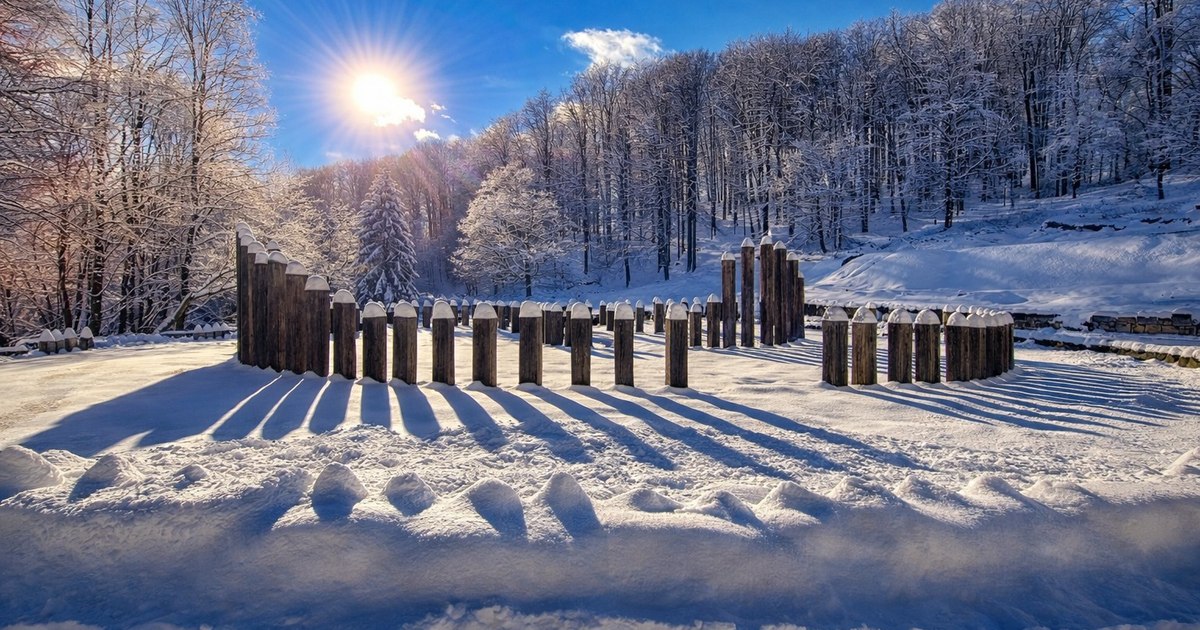
The Șureanu Mountains shelter the most Dacian fortresses in Romania, but, apart from Sarmizegetusa Regia, visited annually by tens of thousands of people, most of the settlements attract few tourists. The history of the Dacians continues to fascinate Romanians, but their authentic settlements remain bypassed.
Annually, more than 50,000 tourists visit Sarmizegetusa Regia, the “capital” of the Dacians from the time of King Decebalus, destroyed by the Romans at the beginning of the second century and rediscovered in the 1800s, when the fever of ancient gold treasures swept the land of the Dacian fortresses.
Sarmizegetusa Regia, the most visited Dacian fortress
The UNESCO site is located in a secluded place in the Șureanu Mountains, about 40 kilometers from Orăștie and 50 kilometers from Hunedoara, and on the last 20 kilometers of the route, starting from the village of Costești, travelers cross the Grădisti Valley, sneaking through the slopes covered with forests, with meadows occupied by archaic houses and new guesthouses.
The Dacian citadel is located in an isolated area, but it attracts many tourists due to its popularity. In 2024, more than 70,000 people visited it, and the recently modernized road between Orăștie and Costești is expected to bring more and more travelers. Sarmizegetusa Regia is the only Dacian citadel in the Șureanu Mountains located on the “Via Transilvanica”, a hiking route that has become increasingly popular in recent years, a fact that ensures many visitors during the summer.
Although they are in the UNESCO World Cultural Heritage, the Dacian fortresses of Costești, Blidaru, Piatra Roșie, Bănița and Căpâlna are less successful among Romanians. Along with them, the fortresses of Fețele Albe, in the vicinity of Sarmizegetusa Regia, and Ardeu, in the Metaliferi Mountains, but also dozens of other less known settlements remain of more interest to archaeologists, while the number of their visitors is reduced.
In some cases, such as that of the Dacian fortress Bănita, due to the difficult access, tourists can be counted on the fingers. Most sites are located in relatively isolated areas, where travelers can reach by walking the last part of the route, so for many Romanians, the lack of a road “to the gate of the fortresses” can be an impediment to visiting them. Some have preserved few visible vestiges, which are of no interest to ordinary tourists.
Romanians, proud of their Dacian origins
While authentic Dacian settlements are, with the exception of Sarmizegetusa Regia, rarely sought by tourists, places with names inspired by Dacian mythology, but also some places known through recent Dacian legends, are increasingly popular.
Dozens of restaurants and guesthouses opened in recent years in Romania pay a symbolic tribute to our ancestors, bearing names such as: Hanul Dacic, Perla Dacilor, Bodega Dacilor, Casa Dacilor, Casa Dacilor Liberi, Vatra Dacilor, Ferma Dacilor, Coliba Dacilor, Stâna Dacilor, Clubul Dacilor, Zamolxe, Scorilo, Decebal, Burebista, Deceneu, Lupul Dacic.
Other places have borrowed legends about the Dacians, with locals taking advantage of their popularity. Decebal’s face, the most famous sculpture reminiscent of the Dacians, was carved in the 90s on a rock on the left bank of the Danube, at the entrance to Mraconia bay, between the towns of Ešelnița and Dubova, located about 15-20 kilometers from Orșova. Although the art monument has recent origins, it has been given an aura of legend from the beginning.
“Through this place, the emperor Trajan entered Dacia. And here, today, he returns and remains forever, as a symbol and pavement, Decebalus. His legendary face takes shape in a rock 111 meters high, with a diameter of 180 meters. The bas-relief, when it is ready, will be 38 meters high and 25 meters wide, being the sign on the Romanian shore of Danube, ‘on which nothing is marked’ – as Mr. Prof. Dr. Iosif Constantin Drăgan notes in the work “History of the Romanians”, 1993, a sign placed out of the goodwill of his reign and, equally, out of love for the history and eternal values of our nation”. informed in 1995 the publication Renaștea Bănățeană, founded by the billionaire Iosif Constantin Drăgan, the financier of the work.
An iron cross was placed above the sculpture, the press reported in the 90s, to commemorate the supposed bloody battles between the Dacians and the Romans, fought at a time when the Christian symbol was most likely unknown to our ancestors.
Below Decebal’s Face, in the Danube Cauldrons, the Veterani Cave has also borrowed a recent legend. Many tourists are excited that the grotto may have functioned in Antiquity as a sanctuary of Zamolxis, because at sunrise, the rays illuminate the cave through an opening.
In the Banatul Montan, the Scorilo hotel in the Poiana Mărului resort, built in the 70s and abandoned in the 90s, received this name, thanks to a recent legend, which stated that here, in the place called Pietreel lui Socilo, Decebal’s father used to hunt. Poiana Omului in the Șureanu Mountains is also known thanks to a legend, which identifies it as the place of Decebalus’ death, while another, older legend says that the Dac king was buried in the Citadel of Deva.
