
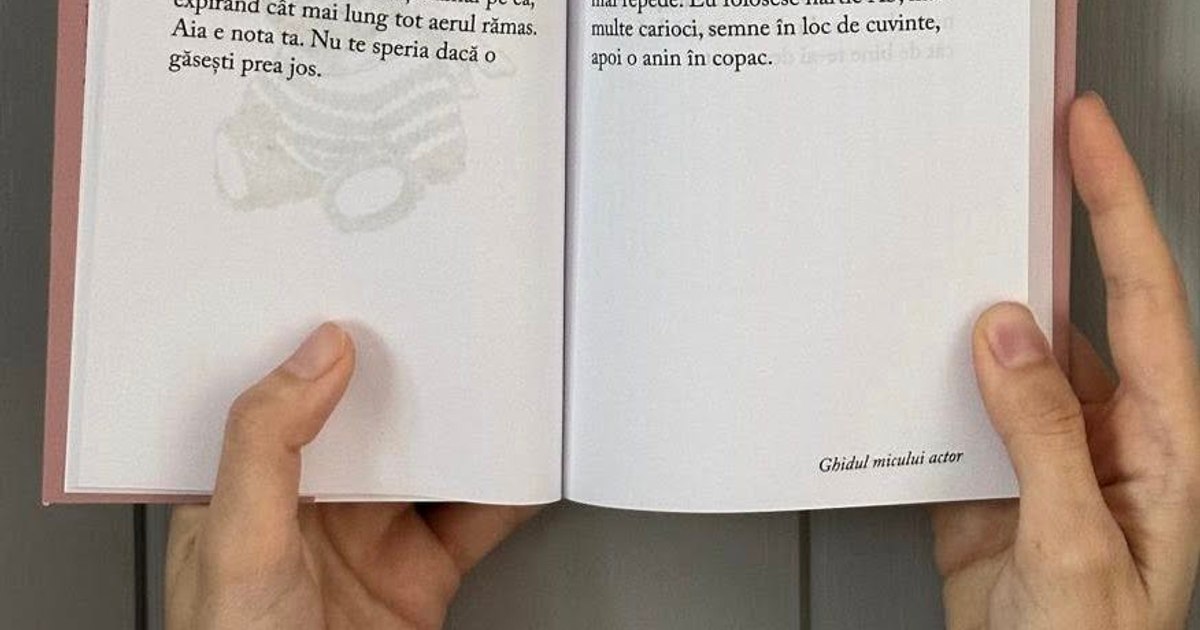
Step 56: “The discovery. Some object is taken, placed in the center, and the actant will enter the scene and play the fact that in his life he has not met such an object“. This is how part of the world built by Patricia Brad looks in the volume published in 2025 by Vellant Publishing House – a book with 99 exercises that invite the reader to understand how to use their voice, body and gaze. Originally intended for children, “The Little Actor’s Guide” is, in fact, a collection of exercises built in the form of a game, designed to develop attention and availability for work.
Patricia Brad is an actress at the National Theater in Cluj-Napoca, where she has been acting since 2006, and a former university assistant at the Faculty of Theater and Film at “Babeș-Bolyai” University. Among her most recent roles are The Second Englishwoman in “Pedestrian of the Air” by Eugène Ionesco (dir. Gábor Tompa, 2024), Geta, the theater manager in “The Untamed Scorpion”, after William Shakespeare (dir. Leta Popescu, 2023) and Babe the dancer, brooding Baba, Interpol agent in “Un altre de Harap-Alb” (dir. Ionuț Caras, 2025). “Weekend Adevărul” spoke to Patricia Brad about how “The Little Actor’s Guide” was born, about the exercises that connect it to the student body and how the theater can become an exercise in learning to pay attention – for children, but also for anyone who wants to learn to simply be present.
How a guide was born from an accident
The idea of the “Little Actor’s Guide” came from a random moment, at the meeting 20 years after graduating from high school. Then, a former colleague told Patricia Brad that he works with secondary school students who would like to do acting, but they don’t have a suitable textbook. “They talked to several people in the field, but some didn’t know how to get started, and some didn’t have the necessary experience. So he asked me to write the book.” says the actress.
At first, he postponed the project. He had two young children and his time was fragmented, but one day he remembered the first exercise he did in college: a circle of students, a large, warm loaf of bread, shared quietly. From there the thread of the book began. “I realized then that I was waiting for the acting to come with many explanations. But they came naturally, in the great silence that was created, while we were sharing the bread. It was an extraordinary feeling“, says the actress. The exercise stuck in her mind as a lesson about silence and how a simple gesture can say more than explanations. For Patricia Brad, that moment was the beginning of a way of learning from what you live, which would later become the essence of the book.
The book was built organically, from exercises designed for children, but inspired by a lifetime of stage and study. The 99 exercises are not a random number. The choice comes from a reference to the novel “99.99” by Frédéric Beigbeder – a psychological threshold that marks a limit that leaves you close, but not quite: “You buy a product for 99.99 more easily than if it were 100For Patricia Brad, the number also had a symbolic value – an invitation to always be on the way to something, never quite arrived at.
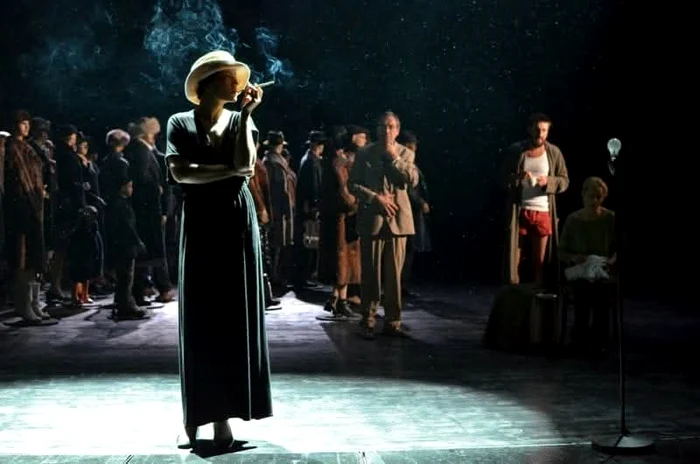
The title itself, “The Little Actor’s Guide”, was chosen precisely because it is simple. “I really wanted it to be a guide; it’s a little book, through which I try to instill the love of theater“, says the actress. Her goal was to create a tool of discovery: for children, but also for anyone who wants to learn how to build a relationship with their own body, voice and imagination. Along the way, she realized that the volume can reach a wider audience than the one for which it was originally designed – teenagers flirting with the theater, teachers interested in expressive teaching methods or adults interested in re-understanding the way they speak and express themselves.
When she tells how she worked, Patricia talks about an effort to explain what she does on stage in a way that everyone can understand: how to express complex experiences in simple words, how to transform years of training into a language accessible to anyone who approaches the theater. Each exercise is an attempt to “a translate what I do to people at the beginning of the journey“, an exercise in pedagogy, but also in empathy.
From the classroom to the theater street
After finishing the faculty, Patricia Brad remained for five years as a university assistant, but in parallel she continued her work at the National Theater in Cluj-Napoca. The double work, between the stage and the chair, was intense: “I actually didn’t see the light of day anymore sometimes – I was working so much in collegeIn the end, he chose to stay only on the stage, but the pedagogical experience left a strong imprint on the way he understands theater.
Over the years, her training has been supplemented by attending numerous workshops that have broadened her understanding of the profession. He worked with groups such as Shoshin Theater and with foreign directors and pedagogues who came to Cluj – among them, Raul Iaiza, known for his approach based on physical presence and live contact with the audience, also explored in the theater workshops organized by the Shoshin Theater Association. From him, says Patricia Brad, she learned perhaps the most important lessons about presence and authenticity: “He wanted you to be as alive as possible, to be present. And this happens in the street performance, where the speech is already on a completely different level“.
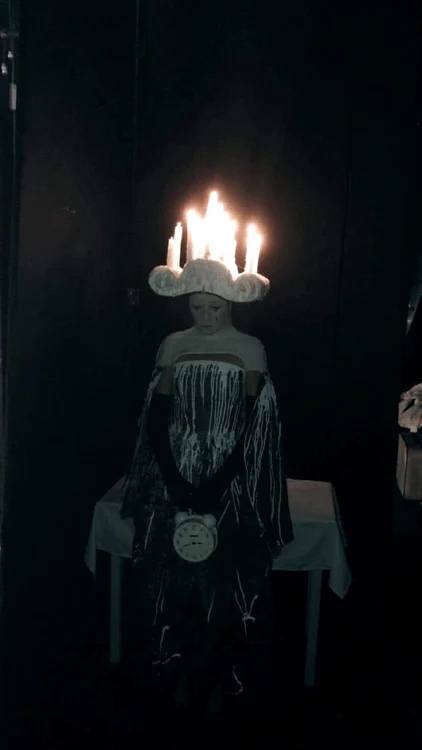
The street theater experience changed everything for her. He discovered a different way of looking and a much more direct relationship with those in front. Raul Iaiza asked the actors to work barefoot – a mental and physical exercise to reconnect with their own body. “He said that since you do all the exercises barefoot, you will know how to step. For him, the most important element, when discovering a character, was the shoe. It started from there, because walking changes your breathing“.
This philosophy of working with the body and concrete detail decisively influenced the way Patricia Brad thought of her “Little Actor’s Guide”. Many of the exercises in the book come directly from these experiences, from the discovery of a form of acting that doesn’t just happen “warmly”, in a room, but in the living space of the world, where the way you approach, look and move comes to communicate by itself.
The body and its limits: sincerity and presence
The actor’s work begins with his own body, says Patricia. Each exercise in the Little Actor’s Guide relates to breathing, balance, attention and how the body responds to emotions. “In acting, your body is your brush. The exercises are just a starting point – from there you can go further, search, read, understand what others have discovered before you“, adds Patricia Brad.
Over time, exploring her own body led her to other forms of practice – yoga and tai chi, where she found the same principles related to attention and the way you control your breathing. “70% of what theater exercises mean comes from these areas“, she explains. Curiosity pushed her to dig deeper: “Yoga means sitting in a position where, over time, you manage to quiet your thoughts. What interested me was that I did all the exercises with my eyes closed – a state of concentration that brings you very close to the way you work in acting too“.
During her student days, exercise was meant to train the body and at the same time remove inner barriers. “We work a lot with boundaries. That’s why, during college, you will always have about four or five hours of physical exercises, after which you move on to improvisation. Being exhausted, you remove your own blocks that prevent you from going too far. We all have blockages. We all think about ourselves that we don’t sing perfectly, that we don’t look our best. these things are learned over time. That’s why it’s very important to work with yourself. Understand that your body is a tool“.
Through the way he moves and breathes, the actor gets personal things that he can use in the construction of a role.
“The better you know yourself, the more you can find within yourself resources for the characters you have to make.”
In the process, physical exhaustion leaves you without masks. “By being exhausted, you effectively remove the blocks that prevent you from going too far into Macbeth’s madness.“. The same logic applies to working with the character, who continues to transform long after the first show. Patricia Brad says that the roles “they are not fulfilled at the premiere“, but they deepen with each performance. The relationships between the characters, the meaning of the lines and the small details settle over time, from one performance to the next. “They are always working in you and that’s why you go home with them. You can’t leave them at the theater gate“.
A role is built on personal experiences and emotions that the actor has already experienced, even if they are very different from the character’s situation. “You play a queen who mourns her children killed by their uncle. You were never a queen, you never lost children, but maybe you had a moment in your life when your most beautiful puppy died and you suffered. You take that pain and transform it“. It is also from this willingness to know yourself that authenticity on stage is born, she says. “We have to work a little with ourselves, ask ourselves questions, play, imagine things – and get to know ourselves, because that’s what acting is all about“, says the actress. Thus, the “Little Actor’s Guide” remains, in essence, a book about this process: about how you work with yourself and your limits, until acting becomes natural.
Theatre, as an exercise in attention and self-knowledge
If she had to choose only one change that “The Little Actor’s Guide” could bring to the reader, Patricia Brad would say without hesitation: attention and listening. “I think these are the most important things I have learned in college and in my experience since“. The student years were a period of continuous effort, followed, in the years of teaching and training, by a calmer learning, complemented by the experience of workshops and street theater, where he discovered a different way of being in relation to the public.
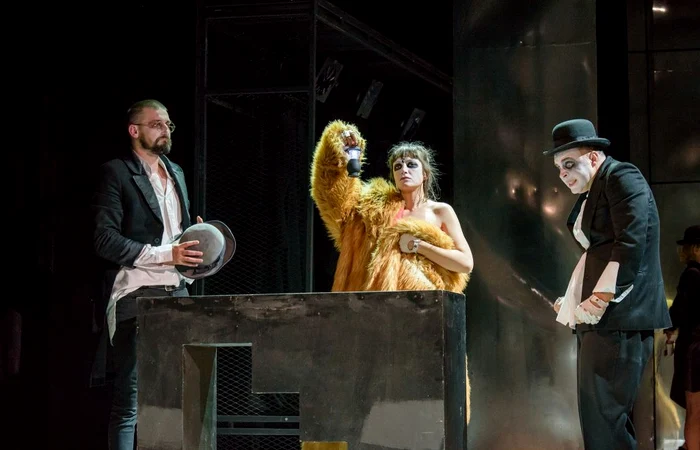
The idea that theater should reach children earlier has remained constant, and Patricia Brad supports its introduction into schools, as a form of education through attention to others, expression and the ability to understand what the person in front feels. “It would be nice if there were people who really know the situation, to implement something like this in schools. I’ve always dreamed of doing workshops with 11th and 12th grade students, especially those who want to go to the theater, who understand what you need to do in an improvisation, how you can gather yourself. For example, the exercise of reading aloud is the best exercise of speaking and self-control“.
Finally, for Patricia Brad, theater becomes, over time, a way to understand yourself better. “The Little Actor’s Guide” thus remains a book about beginnings – about the desire to explore and what you can learn when you really pay attention.
