
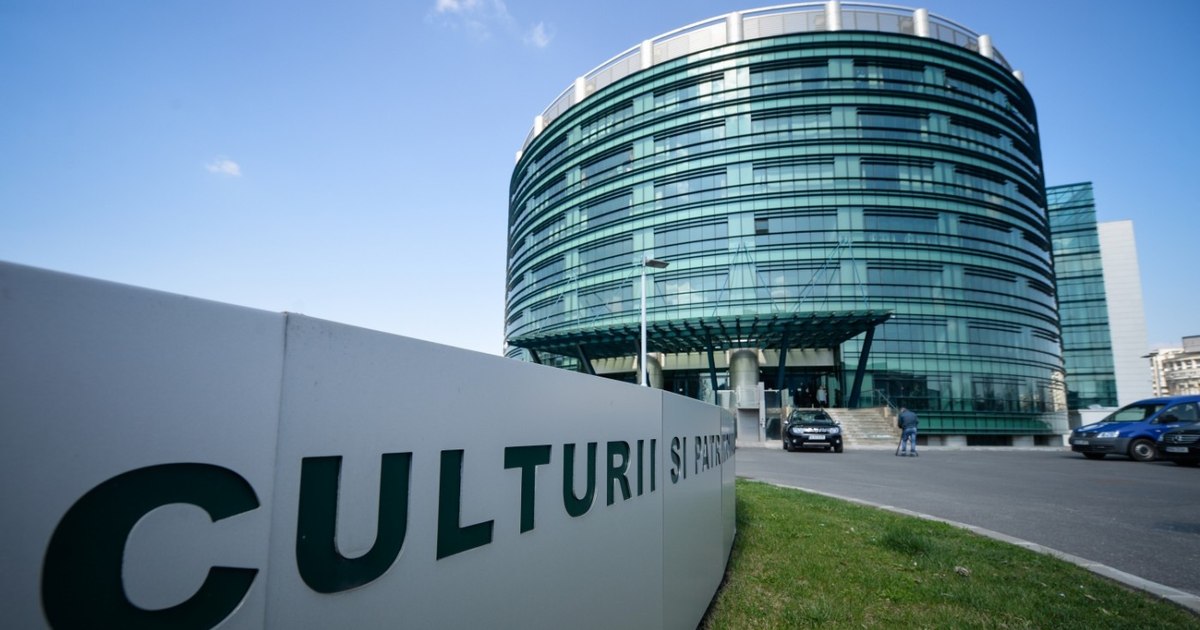
The Federation of Trade Unions in Cultural Institutions (FSIC) requested on Monday, February 10, the withdrawal of the proposal of the Ministry of Culture by which the actors should have presented the weekly work schedule, drawn up individual reports and signed the attendance sheet. Later, the Minister of Culture, Demeter Andras, present at the protest at the Bucharest National Theatre, announced the suspension of the project.
“In a formula devoid of democratic principles, the Ministry of Culture developed, without a consultation of the social partners entitled according to the legislation, a procedure to quantify the activity/work of the employees of the artistic department in the performance/concert institutions.
A set of instructions intended to establish rules regarding the recording of the working time of artists, in the form of timekeeping”FSIC sent in a statement.
The FSIC says that the problem of recording working time exists, but the solution proposed by the Ministry would bureaucratize the artistic activity and violate the institutions’ autonomy.
The union recommends discussing an adapted system in the Social Dialogue Commission, which would focus on the actual performance of artists in rehearsals and performances, not on the number of hours worked.
The Federation of Trade Unions in Cultural Institutions emphasized that it does not criticize the reporting of the activity itself, showing that in the cultural sector there are already record systems implemented since 2017 and adapted to the specifics of the activity, which it considers necessary, but “unitarily adjusted in a feasible manner”.
At the same time, FSIC claims that the rules proposed by the Ministry of Culture do not simplify the adaptation to the general normative framework, but complicate the activity by bringing the artistic act closer to the administrative work.
“In conclusion, the FSIC rejects this set of INSTRUCTIONS-NORMS created by the Ministry of Culture, requests their withdrawal and calls for communication, consultation with all the factors involved for debates on this subject.
We invite all interested artists to draw attention to the deficiencies in this regulation together with our colleagues, in front of the National Theater in Bucharest or other performance institutions in the country, starting on Tuesday, 10.02.2026, at 2:30 p.m.”, the FSIC press release states.
The actors from TNB are protesting
The actors of the “IL Caragiale” National Theater in Bucharest (TNB), together with the staff who serve the stage from all sectors of the theater, organized a peaceful protest on Tuesday, at 2:30 p.m., in front of the TNB, against the application of a pilot program received from the Ministry of Culture, a directive of the Court of Accounts. Colleagues from other theaters are also invited.
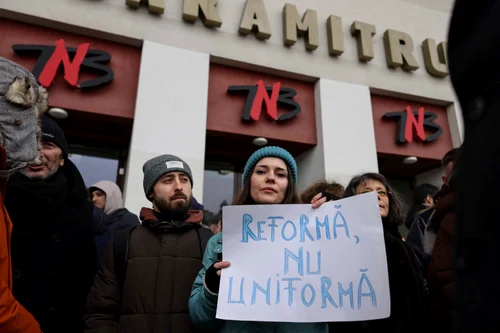
They protest against Circular no. 766/03.02.2026, which obliges daily activity reporting and turns creative work into bureaucratic work.
They argue that the project stifles creativity and does not reflect the nature of artistic work, which cannot be rationed in hours.
The proposal was suspended
Later, writes Digi24, the Minister of Culture, Demeter Andras, announced the suspension of the project after consultations with the actors.
The controversial project according to which the actors would have been forced to work 8 hours/day and bridge their presence was withdrawn. Following these complaints, present in front of the protesters, the minister announced that he was withdrawing this proposal.
“It’s a very, very old problem. The reaction of the guild colleagues shows us a truth, namely that the problem of recording working time and, more importantly, training time, is a very old one.
It has been 36 years since there have been any legislative initiatives or all kinds of other provisions. Including the theater law, which I personally worked on in 2007, provides for these distinctions, but they could not be accepted or did not find general acceptability”. said the minister on TVR.
He explained that the project on recording the working time of artists is not a classic legislative initiative, but a pilot test process, initiated at the request of the Court of Accounts. The documents were drawn up by colleagues from the guild, not by ministry officials.
The minister showed that, although the activity of artists is specific and unevenly distributed, there is a legal obligation to demonstrate working hours.
“The work is irregular, the work is unevenly distributed, but those parts of the work that are not carried out in the institution – the individual study of the instrumentalist, the vocal and technical training of the actor – should somehow be shown, proven, because this is the request of the Court of Accounts“, said the Minister of Culture.
At the same time, he stated that the need for clarification also comes from within the guild.
“It is also the need of the guild, so that we understand each other well, because we also point the finger at each other that I work more and you work less. Everyone needs it, we just can’t seem to agree on the form”, said András István Demeter.
Tudor Chirilă: “You can’t compare museographers with actors”
And the artist Tudor Chirilă criticized the Ministry of Culture, declaring that “you cannot compare museographers with actors, instrumentalists with librarians, dancers with cultural managers and apply templates in which no one fits.”
“Sure, time-keeping has always existed according to the Labor Code, but you expect from a minister of culture the regulation of the specifics of the artist profession, not the regimentation in the existing legislative aberrations.
A simple example is that many times, even if an actor wanted to, he would have nothing to look for in a theater just to act as a bridge”. he sent it on Facebook.
Tudor Chirilă explains that in a theater, not all actors play in every production, and that some may have fewer roles or none, but still receive higher salaries for other reasons, such as having a doctorate.
The artist states that the new measure of record of working time does not reflect reality, where not all actors play daily and the distributions do not cover the entire collective. He argues that daily tipping doesn’t change things at all, because some artists can sit in the theater without going on stage, and the pay doesn’t necessarily reflect the actual amount of work.
