
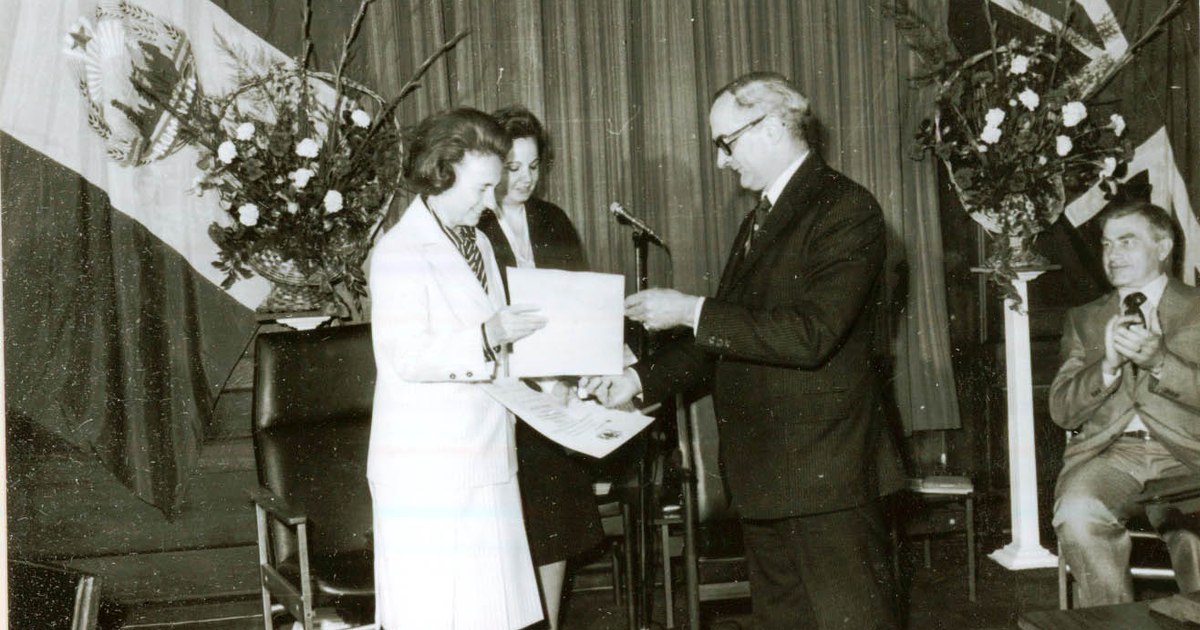
In the 70s and 80s, the image of the female scientist in Romania had the face of Elena Ceaușescu. Present in textbooks, in news journals and in official delegations, she had become the central figure of Romanian science in the public space – not only as the life partner of the state leader, but as “academician doctor engineer”, a title repeated obsessively until it was confused with her name.
How this image was built and what it meant, beyond propaganda, for the status of women in science, historian Cosmin Popa explained for “Weekend Adevărul”.
“Weekend Adevărul”: How does this construction of Elena Ceaușescu’s image as a scientist actually begin? What are the first moments that publicly fix her in this role?
Cosmin Popa: The construction of the personality cult of Elena Ceaușescu, to a good extent, followed the patterns of that of Nicolae Ceaușescu. What appeared in addition to Elena Ceaușescu was this irresistible temptation for scientific titles. Practically, this ascent started quite early in 1967, when Elena Ceaușescu was already the director of the National Institute of Chemistry. He was part of a series of committees intended to publicly mark various round dates of science and culture institutions in Romania. So he had an absolutely keen interest in public scientific recognition. Although everyone was aware of the precariousness of his training, in fact his lack of training. What happened in 1973, when Elena Ceaușescu was admitted to the New York Academy of Sciences, was, in fact, a happy convergence for Elena Ceaușescu and Nicolae Ceaușescu.
The moment 1973, entering the New York Academy of Sciences, seems like a turning point. What did he mean in the political and international context of that time?
Basically, Nicolae Ceaușescu was still quite well regarded in the United States of America. And the New York Academy of Sciences, which co-opted Elena Ceaușescu in 1973, was itself in a fairly rigorous process of attracting women to science, of encouraging women’s participation in science. Thus, through this policy, Romania connects to an international fashion. Against this background, the co-optation of Elena Ceaușescu in an academy that emphasized not only the scientific performances of its members, but also their ability to create networks of influence in the academic world, so the co-optation of Elena Ceaușescu appeared to be an ideal solution. She was the wife of a well-regarded head of state in the West who opposed the Soviet Union, she could put some genuine chemistry papers on the table in her turn – on the covers of which her name was written; it didn’t matter that she wasn’t able to express herself in any foreign language, and the people at the New York Academy of Sciences certainly didn’t understand Romanian, so they could see her intellectual precariousness. So, from this point of view, Elena Ceaușescu fell into an extremely favorable political context, which, as always, Ceaușescu exploited, I think, quite well. Moreover, the scenario of Elena Ceaușescu’s ascension was thought from the beginning in this double key: of the scientific ascension, doubled, isn’t it, meritorious, by the political ascension, so that the two events were simultaneous. Both the co-opting in the Executive Political Committee and in this New York Academy of Science, which, by transfer, gave credibility to the co-opting in the Executive Political Committee, since Elena Ceaușescu’s scientific merits had been recognized nowhere else than in the epicenter of the capitalist world.
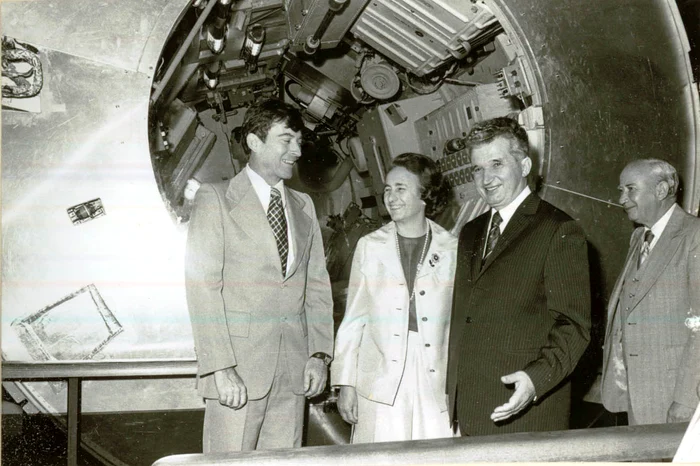
This is the beginning. From here, things went by themselves. London, a number of other universities followed, and not only from Latin America or Africa, but also many from Western Europe. Not only Greece, Portugal, Spain, but also Sweden. From this point of view, the formal recognition of the so-called scientific merits of Elena Ceaușescu entered the Romanian diplomatic package, with which Bucharest went to all the capitals of the world. So when Nicolae Ceaușescu went to discuss certain economic issues, his people, mainly Ștefan Andrei (we – the Minister of Foreign Affairs), also came with this special requirement, namely that in some way and somehow, the scientific merits of Elena Ceaușescu be recognized. In addition to that, the practice of inventing fictitious scientific forums was routinely used, which actually recognized the merits of Elena Ceaușescu. And this was a widely used practice also regarding Nicolae Ceaușescu.
Facade performance
Has this promotion helped the careers of other women in science or distorted the general image of the female scientist?
This is a question that carries nuanced answers, in the sense that willy-nilly, no matter how well-targeted these advantages, theoretically created for all women, the regime had to accept a new infusion of women in science. If you ask me whether the promotion of Elena Ceaușescu facilitated or made the path of women in science easier, my answer is no. If the obstacles that women who wanted to participate in this science race currently faced were reduced, I would say yes. Because there was nothing else but the traditional Romanian patriarchal culture, there were no formal obstacles to this access.
Looking back, what did this symbolic construction produce: did it open paths for other women in science or did it affect, in the long term, the very idea of academic authority in Romania?
What I can say with certainty is that no matter how many advantages this elevation of Elena Ceaușescu to the rank of international scientific authority may have brought to women in science, the disadvantages she created were much greater and much more important. The evolution of Elena Ceaușescu is synonymous with the deterioration of academic standards in Romania. Of course, this cannot be attributed exclusively to Elena Ceaușescu, but to the communist regime, which constantly pressed and acted for a deliberate confusion between politics and science, conditioning academic careers on political loyalty.
However, this caused that over time, with the strengthening of personal dictatorship and clan dictators, we witnessed, in Romania, an accelerated deterioration of academic standards, which culminated, from the mid-1980s, with the genuine replacement of intellectuals by polytricks, by activists converted, theoretically, into scientists. The direct effect of this situation consisted precisely in the absolutely uncontrollable desire of politicians to attach academic titles to their buttonholes in post-communist Romania and the plagiarism epidemic. All these phenomena have their origins precisely in this rise of Elena Ceaușescu, in this perversion of academic standards. In fact, Elena Ceaușescu knew exactly that she did not deserve any of those distinctions that were granted to her and, under the pretext of political consolidation of the regime, she fought, until its disappearance, for the dilution and perversion of scientific and academic standards in Romania.
