
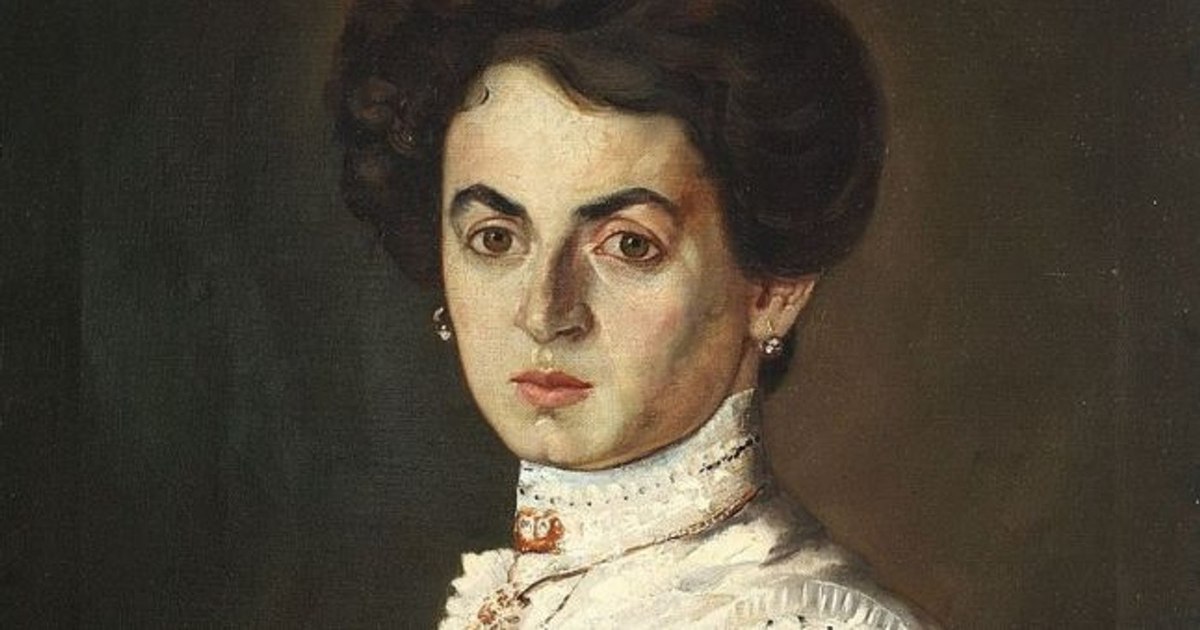
Although it seems hard to imagine these days, in the 19th century many European intellectuals believed that women were naturally less intelligent than men. One of the arguments presented as “scientific” was that women had smaller brains. In Romania, the famous literary critic and politician Titu Maiorescu was one of the supporters of this idea. However, the theory was disputed by the writer and journalist Sofia Nădejde, who became one of the first important feminist voices in Romanian culture.
Who was Sofia Nădejde
Sofia Nădejde was born in 1856, in Botoșani, and became one of the most important figures in the Romanian culture of the time. In a period when women did not enjoy the same rights as nowadays, she marked a series of awards: she was the first woman in Romania who had the right to take the baccalaureate in a boys’ high school and the author of the first feminist novel in Romanian literature (“Passions”).
At the same time, Sofia chose to get directly involved in cultural and political polemics. She wrote articles, edited literary magazines and constantly promoted the idea that women should have equal access to education and public life. Among the publications where he wrote are “Femeia română”, “Contemporanul” and “Evenimentul literar”.
Her intellectual courage was all the more remarkable as Romanian society at that time was deeply dominated by men, and women’s opinions were often ignored or marginalized.
On a literary level, he wrote novels, plays, short stories and sketches. His most famous novels are “Passions”, “Robia banului” and “Parents and children”.
She was married to Ioan Nădejde, professor at the University of Iasi, publicist and translator, and together they had six children.
Sofia Nădejde was also involved in the socialist movement. In 1893, at the initiative of the Nădejdes and other intellectuals, the Social-Democratic Workers’ Party of Romania was founded in Bucharest.
What was the “smaller brain theory”
In the 19th century, ideas about biological differences between the sexes were often used to justify social inequalities. In Europe and America, researchers and philosophers compared the brain size of men and women and argued that a smaller brain would indicate lower intellectual capacity.
These theories. presented as “results of scientific research” were used to argue that women should not participate in political life, pursue university studies or occupy intellectual positions.
In today’s Romania, such ideas circulated intensively in cultural and academic circles. One of the most influential voices that supported them was Titu Maiorescu.
The debate between Sofia Nădejde and Titu Maiorescu
In a series of articles, Sofia Nădejde contradicted Titu Maiorescu and dismantled the arguments supported by him, through a series of logical arguments.
“If we look comparatively at the brain cavity of primitive humans and that of the brain of modern man, we find a decrease in capacity and volume, both in men and in women. Which means either that the man also regresses with the woman, or that a smaller volume indicates an evolution. If we are to judge intelligence by the weight of the brain, then we should say that some birds, which have a heavier brain in relation to the body, are more intelligent than man.” wrote Sofia Nădejde.
At the same time, Sofia Nădejde showed that the lack of women in intellectual life was not the result of a natural inferiority, but the consequence of social restrictions. Women had limited access to education, could not pursue many professions, and were rarely involved in public debate.
Why Sofia Nădejde’s idea was revolutionary
Today, Sofia Nădejde’s arguments may seem obvious. But in the 1880s, the social context was quite different. Most academic institutions were dominated by men, and the idea that women could have the same intellectual capabilities was viewed with skepticism or even hostility. This debate was a turning point.
Over time, her arguments against biological determinism have been rediscovered and discussed in wider contexts, including studies of the history of science and feminist philosophy.
The debate between Sofia Nădejde and Titu Maiorescu is often cited as an early example of criticism of ideas presented as “scientific”, but which actually reflect the values and prejudices of the society in which they appear.
