
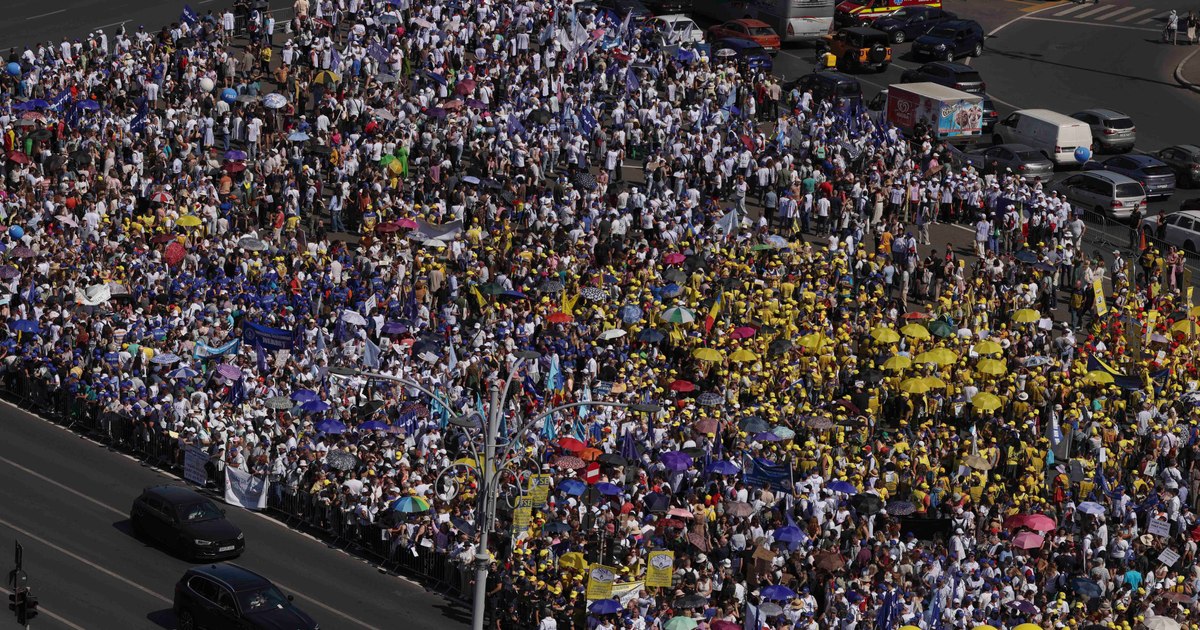
Pre-university education unions have announced that more than 50% of teachers have decided by signature not to participate in national exam simulations, in what they call a final warning. “The Ministry of Education and the Government of Romania must understand: non-participation in the simulations is only the preliminary step to a large-scale protest scheduled at the end of the school year, exactly during the actual national exams!”union leaders threaten. In this context, will the simulations continue or not? And how does this protest affect the students? I analyzed the situation with several teachers, but also with an education specialist.
What the unions announce
“Simulations at the national exams will be seriously disturbed” – is the title of the post in which the two major pre-university unions – FSLI and Spiru Haret – announce that some of the teachers will not participate in the simulations scheduled next week, between March 16 and 18.
“More than 73,000 employees (more than 50% of the teachers who are members of the union) decided by signature NOT to participate in the simulations of the national exams. More than 40,000 colleagues (approx. 28%) opted directly for the strike during this period! (…)
The Ministry of Education and the Government of Romania must understand: non-participation in the simulations is only the preliminary step to a large-scale protest scheduled at the end of the school year, exactly during the actual national exams!”, support Simion Hăncescu and Marius Nistor, the leaders of the two unions.
Protesting teacher: “Boycott is not directed against students”
Marian Ursu, a teacher of Romanian Language and Literature with over 20 years of experience, is among those who decided not to participate in the simulations. And he sees the protest as a form of dialogue between the teachers and the authorities.
“At the moment, overtime hours are paid very poorly, and at the same time they are discussing the increase in working hours and other measures that put increasing pressure on teachers. Under these conditions, the discontent in the system is real. Simulations are used as a form of protest to draw attention to these issues. Teachers are not protesting student assessment, but trying to convey that the education system cannot function properly if teachers are overworked and underpaid.” says this one.
At the school where he teaches – Neagoe Basarab National College from Oltenita, Călărași County – 31 other teachers voted not to participate in the simulations, while only nine voted against it. Out of solidarity with their colleagues, however, they may not participate either.
“The boycott is not directed against the simulations, nor against the students. Teachers do not dispute the usefulness of simulations in exam preparation. In reality, this is a gesture of protest against austerity measures that directly affect teachers”argues the teacher.
Teacher who does not boycott: “The children are not to blame”
Also in Călăraşi county, the teachers from the Secondary School in Curcani decided not to boycott the simulations. Vali Neagu, teacher of Romanian Language and Literature says:
“Although I originally signed up to boycott next week, I thought that at the end of the day, children are not to blame for what happens to adults and that it is normal for them to give these simulations. Especially since it’s an advantage for them, in this way they realize what gaps they still have and they can recover, they can still learn. (…) We will support the simulation. The team for next week that will participate has already been formed. We are all dissatisfied, you realize, but on the other hand we have realized that the children are not to blame and this is not necessarily a solution to make ourselves heard “.
Like most teachers, she is dissatisfied with the measures taken by the Government recently, but says that it is not the students who should pay the bill.
“Regarding the cuts, I feel it. The norm of food is no longer the same because I exceed a certain budget. And my income has decreased since last year, by almost 1,000 lei. And then it definitely affects me, and I wish we could somehow resolve this situation, but not affect the children or the parents. Who in the end have no fault that I chose this job or for what is happening.”
At the same time, he says that also in other schools teachers who signed in favor of the form of protest, could actually participate in the simulations: ,“There are schools that somehow returned, even though they signed on the table with the union leader that they would like to boycott”.
Director of the IL Caragiale National College: “I fully understand the teachers”
And in Bucharest, at the IL Caragiale National College, the simulations will take place. “Without any pressure applied (I have not applied pressure in the life of my lives) the simulations will run. There are 41 registered assistants and 29 evaluators. Some of the assessors are also assistants. This was their choice, no one imposed it on them.” says Andreia Bodea, director of the educational unit.
Toxic relationship between students and phones in schools, described by teachers: “I left crying after talking to them”
However, she states that she understands the guild colleagues who decided not to participate.
“Simulations, as they were designed, are important because children see what time management means, how things work, what the procedure is. It’s like a dress rehearsal. (…) They are important, but we should not now have this catastrophic idea that if the simulations are not given or if there are schools where the simulations will not take place, a misfortune will happen. The misfortune is that it has come to the point where we have a problem and there are teachers who refuse (and I fully understand them) to participate in these simulations”.
However, Andreia Bodea does not believe in the effectiveness of the protest measure: “It now seems too late for any form of protest. Not that I disagree. (…) It was serious that the strike in education two years ago stopped at a point where something was achieved, but nowhere near what was demanded. And it wasn’t just about money, because it was discussed a lot that the teachers only asked for money. It is not true.
I don’t see at this moment and in this economic situation – in which not only Romania, but almost the whole planet is – what form of protest could shake some decisions that have already been taken. That’s what happens when you give in along the way and give in 30 years, you expect in the grace year 2026 to have all the repairs done. Excluding something like that!”, show this.
Regarding the general strike during the national exams, the other protest measure with which the unions threaten, Andreia Bodea says that she believes that the human resource will be found, even if it may be more difficult.
The impact of the general strike on students
Teacher Vali Neagu talks about the impact that the strike during the exams could have on the students:
“It is clear that one of the parties will suffer if this decision is taken in relation to the national exams. And in the end I don’t necessarily think that’s a solution. We are a team and we depend on each other, but the children or parents are not to blame for what happens to us.
Neither we nor them would agree that they no longer give the National Assessment or the Baccalaureate. It’s an important moment in their lives and I think we should solve the situation in this way, and those in the ministries should understand this and negotiate correctly and honestly, without involving the children.
I have a granddaughter who is now in the 9th grade, and I am putting myself in the situation where last year this thing would have happened and she would not have given the National Assessment. Or he wouldn’t have given it in time. Already the emotions are very high for them, the stress, the high school admission. And for them to come with another strike would not be ok”, explained the teacher.
Education Specialist: “Students end up in the middle of a conflict that doesn’t belong to them”
Education specialist Gabi Bartic also talks about the impact on students. It states that boycotting the simulations would not necessarily raise problems from the point of view of preparation for the summer exams, but that it raises ethical issues:
Tensions in Education: about 40,000 teachers prepare to strike before national exam simulations
“In any field there is a legitimate right to protest and negotiate. Education is no exception. But there is also a special moral responsibility when working with children. Moments of major assessment – national exams – are probably the most tense in a student’s school life. For this reason, using these moments as a pressure tool in negotiations between adults raises, in my opinion, a serious ethical problem. Students end up, without their will, in the middle of a conflict that does not belong to them.”
Regarding the first method of protest he announces, the boycott of simulations, Gabi Bartic says that the real pedagogical impact on students is not as great as it seems at first glance. “Simulations are especially useful for familiarizing students with the test format, the pace of work, and the type of assessment. They reduce exam anxiety because students know what to expect. At the same time, it must be made very clear: the simulations are not the exam itself. Their absence does not automatically lead to poorer results on the exam, especially for students who already have experience with the type of testing associated with exams. And most do.”
The real problem is not a pedagogical one, but a public signal one. When conflict between adults ends up manifesting itself around key moments in students’ lives, the message is that school becomes a battlefield. And students should never be put in that position.” Bartic points.
Instead of a boycott, he recommends alternative forms of protest:
,,There are many legitimate forms of protest that do not involve critical moments in students’ lives. Public protests, administrative strikes, refusal of bureaucratic activities or collective actions to pressure decision-makers are forms by which the teaching profession can make its voice heard.”
And the dialogue between teachers (whether they choose to protest or not) and the authorities is an essential point at the current moment.
