

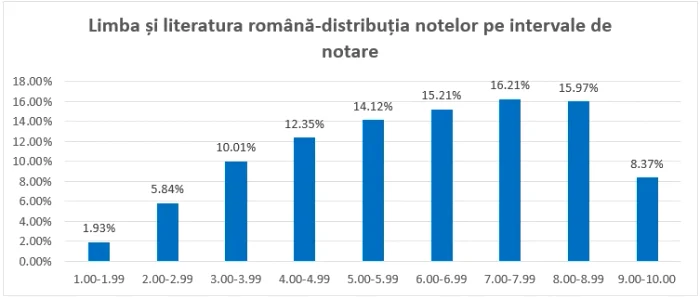
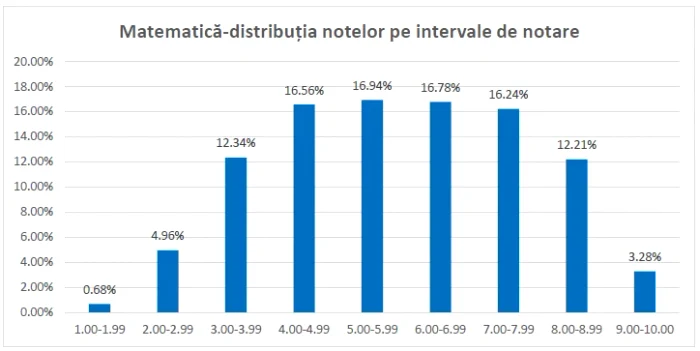
The 8th graders found out how prepared they are for the real exam at the beginning of the summer. 70% of them got passing grades in Romanian and 65% in Mathematics. But, in both subjects, the percentage of grades between 9 and 10 is lower than that of results between 3 and 4. The distribution of grades, in both subjects, however, raises questions about how we teach, how we evaluate and how well we prepare students for high school.
What the numbers say
In Mathematics, almost 35% of students got grades below 5. In Romanian, the percentage is 30%.
The distribution of marks in Mathematics adds another level of concern. Most grades were concentrated in the 5–6 range, meaning that many students passed the mark, but just barely. At the opposite end, just over 3% of students scored between 9 and 10 — less than those who scored between 2 and 3, who reached almost 5%.
Compared to the 2025 simulation, the picture is mixed. In Romanian there is an improvement of about six percentage points — from 64% to 70% passing marks. But in Mathematics, things got worse: last year, almost 72% of students got grades above 5; now it’s only 65%. A regression of seven percentage points in a single year.
What the Minister of Education says: A snapshot of the moment
Mihai Dimian, the new Minister of Education, attributes the results to the students’ motivation.
“The results provide a snapshot and offer the opportunity for each student and the teacher in the class to see together what they need to improve. Part of these results is explained by a weaker preparation, due to a lower motivation to study. And in the past we also have statistics in the PISA tests that show us that in Romania the students’ motivation for studying science was the lowest among all the countries analyzed and here we have work to do,” the minister told TVR Info.
He also talked about two other factors that, in his perspective, could improve things.
“We have work to do in bringing the students more to the laboratories and presenting the theoretical concepts through practical applications precisely to strengthen these theoretical concepts. And together with the teachers, through the curricular reform that we are developing at this moment, let’s try to make these notions more attractive for students”.
Student representative: “The learning process, perceived as an obligation towards parents and teachers”
Bogdan Gogan, vice president of the National Student Council, also says that there is a link between motivation and results.
“The percentages regarding the low grades, both in Romanian and especially in Mathematics, emphasize the fact that, in most cases, students no longer have that desire to learn or study, perceiving the learning process as an obligation towards parents, teachers, etc. and not as a way of personal development”.
Beyond motivation, the student representative raises a deeper question about the current structure of the National Assessment.
,,I believe that the current high school admissions method could be improved and that it should, in one way or another, prepare the student for what is to come. Because what you do both in Romanian and in mathematics in secondary school, in most cases, does not correspond to what you are going to study in high school“, says Bogdan Gogan.
The Maturity Test of the Education System: What’s Behind the Percentage of Schools That Ignored the Simulation Boycott
Gabi Bartic: “In Romanian, the test no longer succeeds in sufficiently differentiating between good and very good students”
The most nuanced diagnosis comes from Gabi Bartic, an expert in Education and director of a testing platform. Analyzing the results by subject, she notes that the numbers say different things and that treating both subjects with the same general conclusion is a mistake.
“In Mathematics, we see quite clearly that there are a large number of students with real gaps, and the distribution of grades is relatively balanced, with values across the board, which means that the test manages to differentiate well between levels.
In Romanian, on the other hand, I think there is also a measurement problem. If we look at the distribution of grades in the ministry release, we see a much higher concentration in the 8–10 zone. This means that the test no longer succeeds in sufficiently differentiating between good and very good students”.
Thus, the results from Română raise questions about how efficiently and objectively we test.
In assessment, a good test is not one that gets high marks, but one that manages to distribute students across the scale and make it clear who is where. When scores are compressed high, fine differences between students become fragile and much more sensitive to correctional variations. However, this is precisely what we must avoid: introducing subjective factors into an exam after which we make decisions regarding the children’s future educational path.
“We rarely test and, most of the time, too late”
The results from Mathematics, where most grades fell between 5 and 6, and the percentage of results between 3 and 4 exceeded 12%, do not show that the subject is too difficult, believes Gabi Bartic, but that ,,it becomes difficult for many students to follow because it is built cumulatively. If you lose basic concepts early on, it becomes very difficult to catch up on the fly.”
At the same time, he cites a recent UNESCO study that shows that in many educational systems — including the Romanian one — assessment is used more for reporting than for learning.
,We test infrequently and often too late. This means that for many students, the first time we really see where they are is in the 8th grade. And then it is, in fact, too late to correct the differences accumulated over the years
Motivation or loopholes? An incomplete diagnosis
Regarding the explanation of the Minister of Education, that part of the results are due to low motivation, Gabi Bartic says:
“It is possible that motivation plays a role, especially since we are talking about a simulation and not the final exam. It is normal for the engagement to be lower. But it would be a mistake to put the main explanation here. When we see that almost a third of the students are below 5, we are no longer talking about motivation, but real learning gaps and extremely large differences between students. In addition, in some cases, we also need to look at how precisely we measure these performances. Motivation matters, but it cannot alone explain a phenomenon of this magnitude.”
Is National Assessment still the best high school admissions system?
This is perhaps the question with the greatest practical stakes. The answers are predictably more complicated than simple Yes or not.
Bogdan Gogan believes that the current system could be improved, especially in terms of the consistency between what is evaluated in the exam and what the students are going to study in high school.
Gabi Bartic offers, again, a more nuanced answer:
In its current form, when grades in Primary and High School are not necessarily related to real performance (I remind you that we have more than 80% of students with averages above 8), the National Assessment is an imperfect but necessary solution. The problem is not that we have an exam, but how well it is constructed, how precisely it measures, what skills it measures, and which of the skills are needed in each of the possible routes the child takes in the next cycle.
In the long term, the expert advocates for a more complex system: clear assessment standards, more milestones along the way and a combination of continuous assessment and final exams — on the model of other educational systems.
Simulation National Assessment 2026. Students left the exam hall full of hope. “I expected harder”
“But until we get there, the priority should be to make this exam more robust and fair“, concludes Gabi Bartic.
