
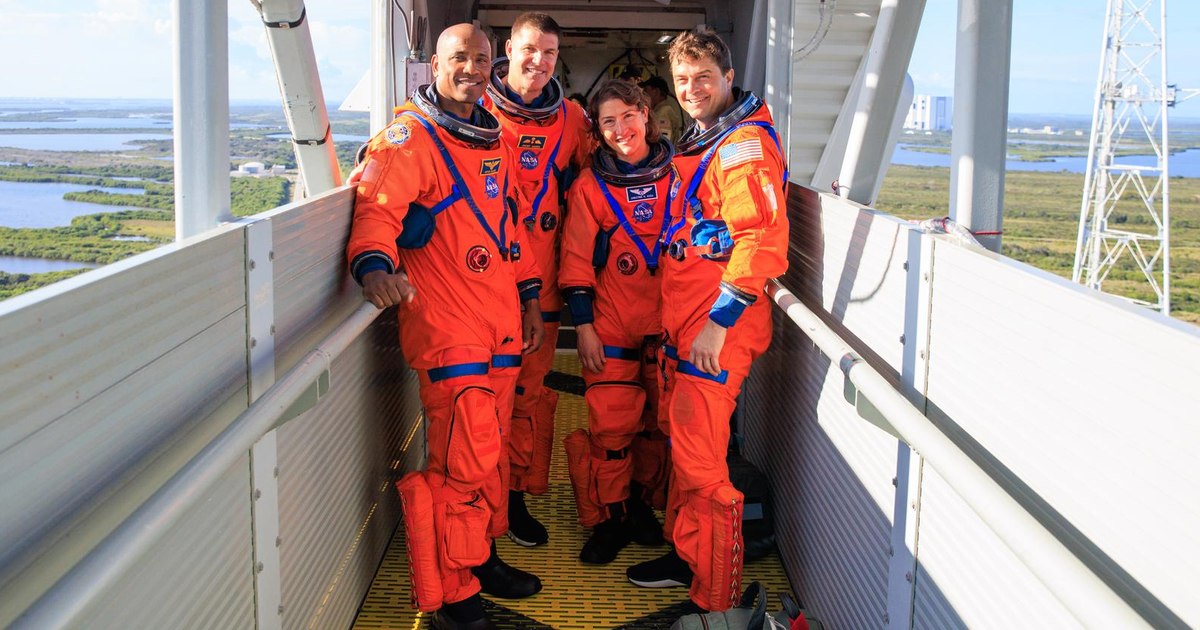
After more than half a century, NASA is sending astronauts around the moon again. The Artemis II mission, launched on April 1, 2026, marks the first crewed flight of the Orion capsule and the first test of the Space Launch System rocket, setting the stage for the return of humans to the lunar surface.
It has been 50 years since a man last walked on the moon. Eugene Cernan, commander of the Apollo 17 mission in 1972, was the last astronaut to touch the lunar soil. No one could have predicted then that it would be five decades before humans would return near the Moon.
“If there were no political risks, we would have already been on the moon”former NASA administrator Jim Bridenstine explained in 2018, quoted by Indy100. “In fact, we probably would have already been to Mars. Political risks prevented these missions from happening. The program took too long and cost too much money.”.
A 10-day trip around the moon
Four astronauts – a woman, a Canadian, an African-American and a white American – will complete a 10-day circumnavigation of the Moon. The crew will test the Orion capsule’s systems, including manual control, and travel more than 7,000 km beyond the far side of Earth’s natural satellite before returning to Earth and landing in the Pacific Ocean.
“This will be the first human mission since Apollo 17 in 1972 to reach lunar orbit,” NASA officials say, according to Axios. The return is scheduled for April 10, 2026.
Video source: X/ @NASA
Record delays and costs
The mission, originally scheduled for 2023, has been postponed several times due to cold weather and technical problems. Despite the difficulties, the Artemis program has attracted huge investment: according to Reuters, NASA has spent $93 billion so far. These funds supported the development of lunar systems, logistical support for life in space, communications and space navigation technologies, and related industrial contracts.
What the homes of future colonists on Mars and the Moon could look like
“This was a tremendously successful mission”, said Bill Nelson, NASA administrator, at the launch of the Artemis I mission, emphasizing that all stages were carefully monitored for the safety of the crew.
Preparing for a new space age
If the Artemis II and Artemis III missions (expected for 2027) are successful, NASA will begin Artemis IV in 2028, aiming for the first manned landing since Apollo 17. The rocket carrying the astronauts could be SpaceX’s Starship or Blue Origin’s Blue Moon.
In the long term, NASA plans to build the Lunar Gateway lunar orbital station and a permanent base on the moon within the next 10 years, a step that could prepare the first manned journey to Mars and other destinations in the solar system.
A new space race and lessons from the past
The return to the moon is not only a scientific mission, but also a technological and geopolitical strategy. The US is trying to maintain its supremacy in space as China develops its own space program. The experience of the 20th century space race, in which the Soviet Union was the first major player in space, reminds us that leadership is earned with great precision and investment.
In December 1968, astronauts Frank Borman, Jim Lovell and William Anders became the first humans to orbit the Moon. At Christmas, they read passages from the Book of Genesis regarding the creation of the Earth while filming the rise of the blue planet: “In the beginning God made the heavens and the earth. And the earth was unformed and empty. Darkness was over the deep, and the Spirit of God moved over the waters. And God said: “Let there be light!” And there was light”.
Frank Borman died in 2023, William Anders in 2024, and Jim Lovell in 2025.
