
Catholic Easter is celebrated, this year, on April 5. Like Orthodox Easter, Catholic Easter celebrates the Resurrection of Jesus Christ, the Son of God, after His crucifixion on Good Friday.
Although the Catholic Easter is celebrated on a different date than the Orthodox one, the traditions are quite similar. The holiday does not have a fixed date, but is celebrated annually in the spring.
Why Catholics celebrate Easter on April 5th
The difference between Orthodox and Catholic Easter is given by the fact that the Catholic Church refers to the spring equinox according to the Gregorian calendar, while the Orthodox Church calculates the same astronomical event according to the Julian calendar.
Thus, there are years in which the holidays fall on the same day, but also years in which the gap is greater than a week. In 2026, the Catholic Easter is celebrated on April 5, and the Orthodox one a week later, on April 12. Catholic Easter can fall in March or April and never in May, while Orthodox Easter can fall in April or May and never in March.
Lent
Catholics have a milder fast, being allowed to eat eggs, milk or cheese. With the exception of breaking fish, twice during Lent, the Orthodox fasting are not allowed to consume anything of animal origin (meat, eggs, or dairy). Catholics go to the cemetery on Easter and share in the memory of the dead, while the Orthodox light candles at the graves of their loved ones at night, immediately after the Resurrection service.
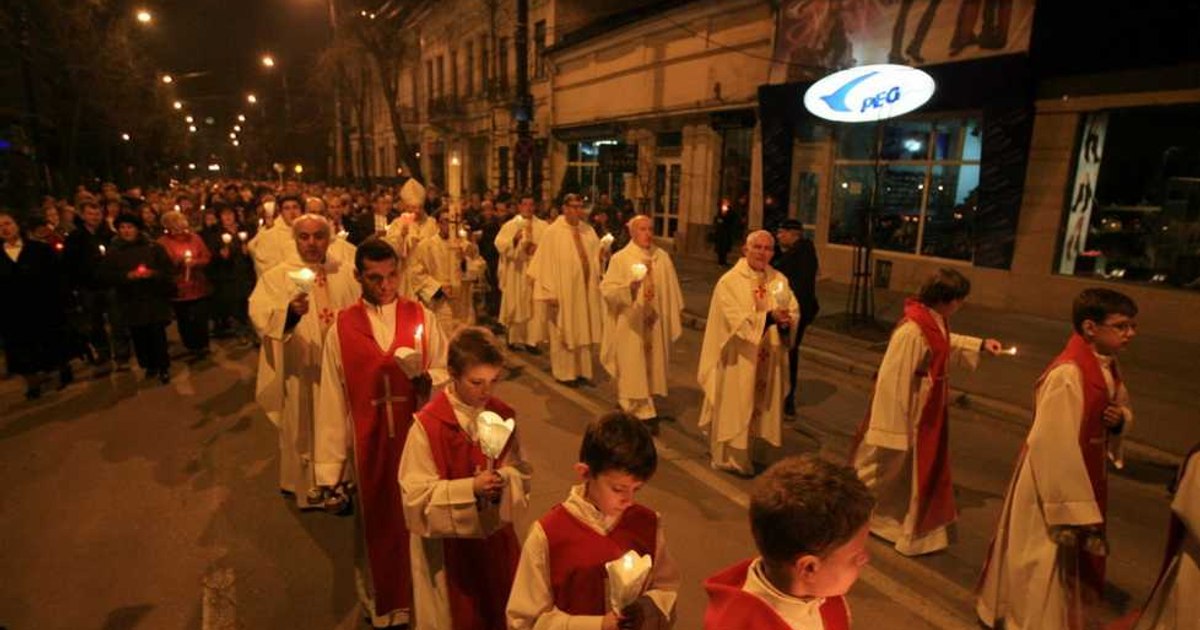
For Catholics, the light of the Resurrection is taken at the end of the service, for Orthodox, at midnight. Roman Catholics do not have Haric Fire brought from Jerusalem. For Catholics, in the first moment, the blessing of the new fire takes place, which is done outside the church, in the form of a pyre, then follows the blessing of the paschal candle, which represents the symbol of Christ.
For Catholics, the entrance to the church, in which no light is lit, is done with the Paschal candle lit, carried by the deacon. The first time, the protoss lights his candle from the candelabra, then all the clerics and the faithful do the same.
How to celebrate Catholic Easter
Catholic Easter Sunday is marked by Pope Leo’s speech in St. Peter’s Square, in the Vatican. He appears in front of thousands of believers to say the traditional Easter message and blessing in dozens of languages. His speech begins with “Urbi et Orbi”.
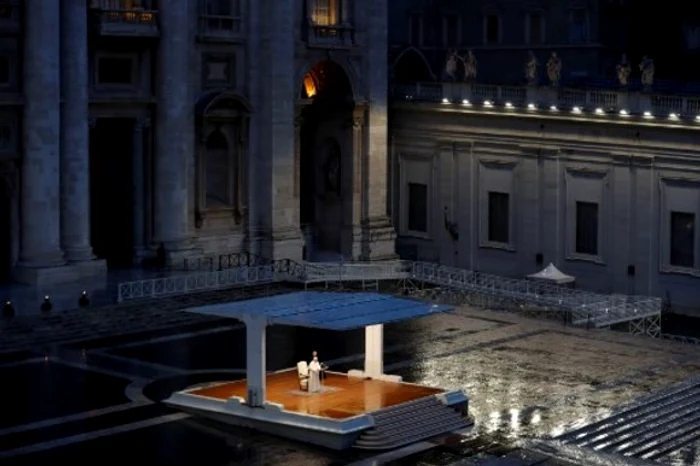
Urbi et Orbi translates to “To the city and to the world”, referring to Rome. This construction was often used in the Roman Empire when starting various official addresses. Currently, the Urbi et Orbi building is used to open the Pope’s official message at Christmas and Catholic Easter. It can also be used on other exceptional occasions.
What do Catholics eat at the Easter meal
The traditional dish of Catholics for the Easter meal is all lamb, and the traditional dishes do not differ from the Easter meal of Orthodox Christians. Instead, in some regions on the Easter table we find biscuits that cover a whole egg. The egg represents life and rebirth, and its covering represents the crown. Stuffed eggs are indispensable on the Catholic Easter table.
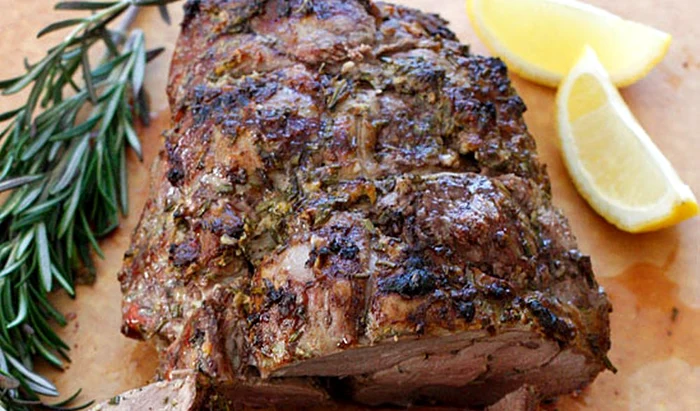
Also, in the menu for the Easter table of the Catholics there are also dishes such as lamb shank, made, of course, according to a special recipe for those who want something new, lamb soup, roast rabbit with mustard, Easter stuffed with cottage cheese and raisins, simple shortbread, filled with cocoa cream and walnut.
Traditions in Romania
In Romania, several Catholic Easter traditions are practiced: egg hunts in gardens or houses; the sprinkling of unmarried girls – a custom practiced in many villages in Transylvania; egg giving and hatching; serving traditional Easter dishes: Easter, lamb, red eggs, etc.
CATHOLIC EASTER Why Catholic and Orthodox believers celebrate Easter on different dates
The best-known Catholic tradition in our country is sprinkling. This custom comes from Germany, and at first, the sprinkling was done only with water. Currently, perfume is also used.
The sprinkling of water is said to symbolize purification. And because the water comes from wells, the egg-decoration of wells in villages populated by Catholics also appeared later.
A custom that is practiced on Easter among Catholics is the giving and breaking of eggs. On Good Friday, all believers bring home, from church, an olive branch. In Genesis, in the Bible, when the waters of the flood receded, the dove returned carrying an olive leaf in its beak. This tree has become the symbol of peace and the dove is the representation of peace and reconciliation. Its fruit was the emblem of prosperity, divine blessing, beauty, power.
Catholics have fascinating customs and traditions related to Easter. The Easter tree decorated with eggs, the Easter bunny, the hunt for eggs brought by flying church bells are just a few of them.
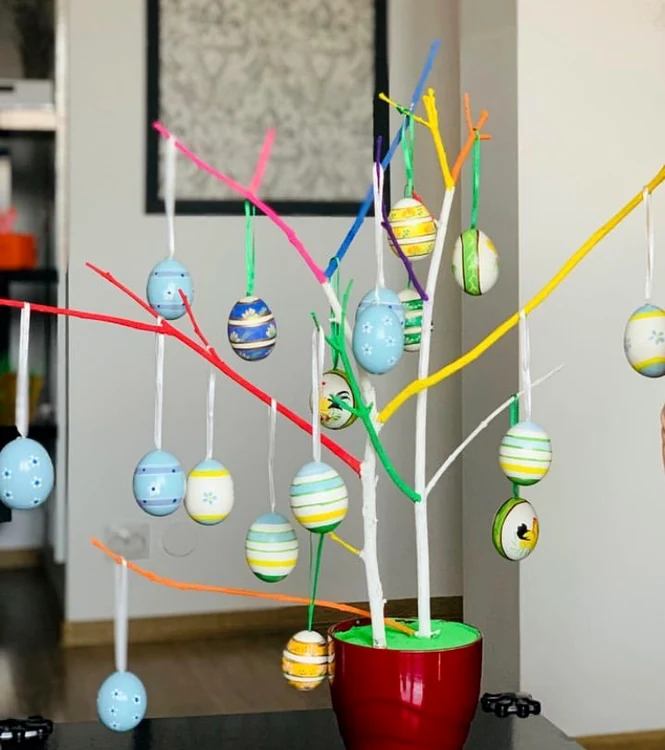
In Catholic areas of Germany, the “Osterbaum” (Easter tree) is very popular. Whether using a real tree or branches cut from a tree and brought into the house, these trees are decorated with painted Easter eggs.
The Easter Bunny in Europe
Germany she is also the originator of the Easter Bunny tradition. The bunny bringing red eggs symbolizes fertility.
The first appearance of the bunny as a symbol of Easter took place in Germany, appearing in books around 1500, although it is likely that it has been present in popular lore for much longer.
The Germans are, moreover, the first to invent sweets in the shape of bunnies, in 1800, from dough and sugar. The symbol of the rabbit dates back to the pagan festivals dedicated to the goddess Eastre.
Legend has it that Eastre found a wounded bird in the field one winter; to save her from death, the goddess turned her into a rabbit, but she kept the ability to lay eggs. To thank her benefactor, the bunny decorated the eggs she made and gave them to the goddess. From this legend was born the tradition of the bunny bringing gifts to the children.

In America, this tradition of the Easter Bunny bringing gifts of painted eggs to good children was brought by German immigrants.
Although not a very impressive animal, the rabbit is a sacred messenger of divinity in many cultures.
In Spainthe Easter celebrations begin before the actual celebration with what is called Semana Santa (Holy Week), with an extraordinary spectacle. Parades dating back hundreds of years take place on Palm Sunday and throughout the week.
Why do Catholics and Orthodox celebrate Easter on different dates
Catholics build “allegorical carriages” covered in flowers, candles and, most importantly, an elaborate statue of either Jesus or the Virgin Mary. These are carried on the backs of dozens of men (or mounted on allegorical chariots) and paraded through certain cities in Spain.
These processions are attended by hundreds of people carrying long candles and dressed in robes, often white or black, with tall peaked hats. These hooded costumes are hundreds of years old and represent repentance. The faces of penitents are covered to show mourning for the shame of sin.
As in Spain, in Italy solemn processions are organized on Good Friday or Holy Saturday, with costumed participants carrying statues of Jesus and Mary through the city. Some cities also organize skits on Good Friday with themes such as the Passion of Christ or the Stations of the Cross.
Italian Easter bread is woven with three strands to represent the Holy Trinity and is shaped like a crown of thorns with colored eggs baked into the bread. In some areas of Italy, the bread is baked in the shape of a dove that symbolizes hope.
Many of the traditions that originated in Spain were carried to the Central and South American colonies hundreds of years ago. Palm Sunday processions are traditional in some Mexican cities, commemorating Jesus’ triumphal entry into Jerusalem. The city of Iztapalapa has one of the largest scenes of the Passion, known as the Via Crucis.
If in Germany the Easter Bunny is the one who delivers the eggs, in France eggs are dropped by flying church bells on Easter morning. The bells in French churches are silenced on Maundy Thursday and are said to “fly” to Rome to be blessed by the Pope before ringing the Resurrection on Easter Sunday.
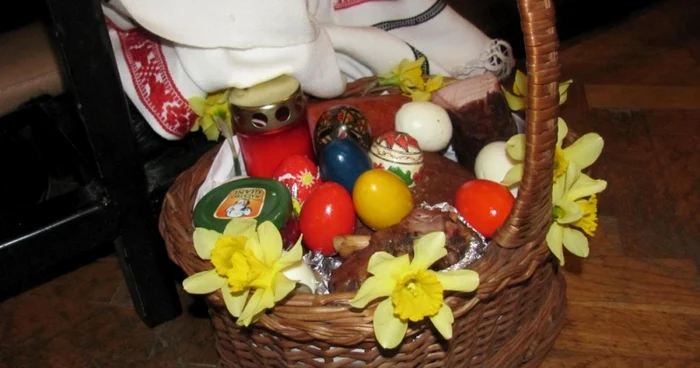
In Eastern Europe, in places like Poland, Slovakia and Hungary, Romania, there is a tradition of placing a basket full of certain foods at the church altar to be blessed. Every food item has a meaning in Christianity.
Some of the products are butter, which symbolizes the goodness of Christ; meat, in any chosen variety, as a symbol of God’s bounty; and, interestingly, horseradish mixed with grated beetroot representing Christ’s passion and bloodshed.
These baskets are usually covered with an elaborate cloth that resembles the burial shroud of Christ. And, of course, eggs are part of the Easter tradition as a sign of new life, painted most elaborately in some Eastern European countries such as Romania, Todayscatholic reports.
