
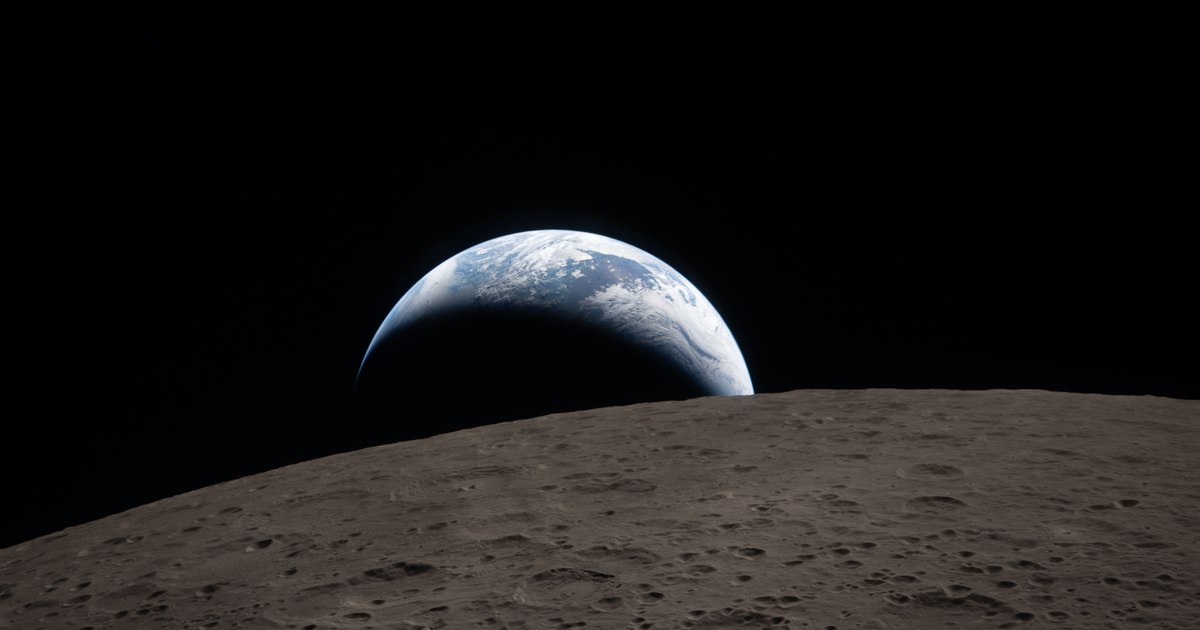
Astronauts of the Artemis II mission captured a spectacular image of a phenomenon called on Tuesday “sunset of the Earth” – the moment when our planet descends below the Moon’s horizon – during the long journey home.
The photograph is a deliberate reference to the famous image “East of the Earth” from 1968, made by astronaut William Anders during the Apollo 8 mission, when he became one of the first humans to enter lunar orbit, writes Science News.
Unlike the current photo, that image was captured spontaneously: Anders was amazed to see the Earth rising above the lunar relief and rushed to a porthole to take pictures. The image has become one of the most famous in history and is considered, in part, a catalyst for the environmental movement.
Instead, the Earth sunset shot was carefully planned. The Earth appears in the form of a crescent moon, and on the illuminated portion the clouds that rotate above the regions of Australia and Oceania can be distinguished.
“In the end, we will always choose Earth. We will always choose each other”said astronaut Christina Koch.
According to NASA, a solar eclipse observed so close to the Moon has never been seen with the naked eye by humans. “Everything seems unreal”mission pilot Victor Glover said as the solar corona formed a halo around the moon, according to National Geographic.
Glover described the color of the Moon during the eclipse as “a gray that blends and fades into deep black”, noting with amazement that the crew members could still make out details of the lunar surface even though the Sun was completely obscured by light reflected from Earth. “It’s the strangest thing—that you can see so much on the surface”he said. “Humans probably haven’t evolved to see what we see now. It’s really hard to describe. It’s amazing.”
Artemis II beat the record set by Apollo
The four astronauts of the Artemis II mission set a new distance record from Earth on Monday, surpassing the performance of the Apollo program.
Although the four astronauts did not land on the moon, their flight was still a first, because never in any of the Apollo lunar missions (1968-1972) were there female astronauts, black astronauts or non-American astronauts on board.
“It’s a historic day”Apollo 8 and Apollo 13 pioneer Jim Lovell told them Monday morning in a posthumous message recorded months before his death in 2025. “Welcome to my old neighborhood”he told them, expressing his pride “to pass them the baton” and even giving them a tip: “I know you’ll be very busy, but don’t forget to enjoy the view.”
For his part, US President Donald Trump spoke with the crew of the Artemis II mission on Monday evening, congratulating them on the historic flyby of the Moon, the first of its kind in more than half a century.
“Today you made history and made all of America proud, incredibly proud”the leader of the White House conveyed to the four astronauts on board the Orion spacecraft.
