

Imagine if melanoma could be treated with something that looks and acts like a simple patch. It is applied to the lesion, it is activated with a low-power laser, and then it does the rest: it attacks the tumor cells, blocks their spread and leaves no traces of toxicity in the body. It sounds like the script of a science fiction movie, but a group of Chinese researchers recently published in the journal ACS Nano the results of a study that shows that the technology exists, for now in the laboratory.
What is melanoma
Melanoma is a type of skin cancer and develops from melanocytes, the cells that produce melanin, the pigment responsible for skin color.
“It is the most aggressive form of skin cancer, with an increased capacity for local invasion and distant metastasis. The main risk factor is exposure to ultraviolet radiation, especially repeated sunburns, but genetic predisposition also plays an important role.” explains Dr. Irina Mihaela Anghel, medical oncology specialist.
Melanoma usually occurs in the outer layers of the skin, which theoretically makes it easier to detect than other types of cancer.
How it is treated at the moment
Treatment depends on the stage at which the disease is discovered and the molecular stage of the tumor.
“In the early stages, complete surgical excision is usually curative”says the oncologist.
In advanced stages, she explains, we can talk about three types of treatment:
- Immunotherapy, which stimulates the immune system to recognize and destroy tumor cells
- Targeted therapy – indicated in patients with specific mutations
- Radiotherapy or chemotherapy, in selected situations, but rarely used today
“In recent years, advances in oncology have been significant, especially due to the development of immunotherapy and personalized medicine. In the case of melanoma, these innovations have transformed a disease with a grim prognosis into a potentially manageable long-term one for a growing number of patients. (…) What was difficult to imagine a decade ago”, says Dr. Irina Mihaela Anghel.
How the copper ion patch works
The viral trend that increases your risk of skin cancer: nose tanning. Dermatologists’ warning
The new discovery starts from a known technical challenge: Melanoma forms in the outer and middle layers of the skin, making it amenable to local treatment, but killing the cancer cells without damaging the surrounding healthy tissue remains difficult.
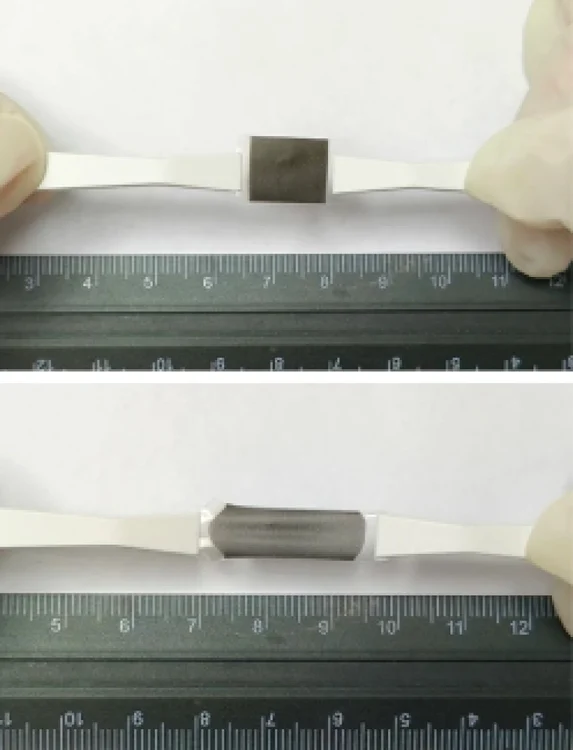
Researchers Xin Li, Shi Chen, Meijia Gu and Ruquan Ye used a porous carbon material obtained by laser, which they filled with copper oxide and embedded in an elastic silicone polymer. The result is a soft, flexible patch that is chemically inert and allows the skin to breathe.
Activation is done like this: a low-intensity laser heats the patch to 42 degrees Celsius. At this temperature, the patch releases copper ions directly into the cancer cells. The ions interact with the DNA of tumor cells and destroy them through a mechanism called oxidative stress.
This process would also trigger an immune response. which blocks the migration of tumor cells to other parts of the body – i.e. metastases.
An additional advantage would be that the patch is reusable and easy to administer without invasive procedures.
What the lab tests showed
In a first step, the researchers applied the patch to melanoma cells grown in vitro. Activated with the laser, the patch destroyed most of the cancer cells and slowed the movement of the others.
An animal study followed, carried out over the course of ten days. The patch was applied to mice with melanoma and activated with the laser on days one and five, one hour each time. The result: melanoma lesions were reduced by 97%. Tissue analyzes also showed that cancer cells did not migrate beyond the tumor boundaries, and copper ions did not accumulate in organs or blood.
How far are we from human use
Enthusiasm must be tempered with a dose of realism. All the results so far come from preclinical studies, in cell cultures and in mice. The road to a treatment available to human patients is long and involves rigorous, multi-phase clinical trials.
“The method represents an innovative direction of local treatment, based on the controlled release of copper ions, with a potentially cytotoxic effect on tumor cells. The major advantage would be the non-invasive character and the ability to limit the damage to healthy tissues. However, it must be emphasized that the results come from preclinical studies. For validation, rigorous clinical studies in humans are needed to confirm the efficiency, safety and place of this therapy in the treatment scheme. In the event of positive results, it could become a complementary option for the forms superficial disease”, is the opinion of Dr. Irina Mihaela Anghel.
Even without immediate clinical applicability, the research is of real importance. It shows that nanotechnology can be used to create local, non-invasive and precise treatments for skin cancer, a direction that modern oncology is pursuing with increasing interest.
