
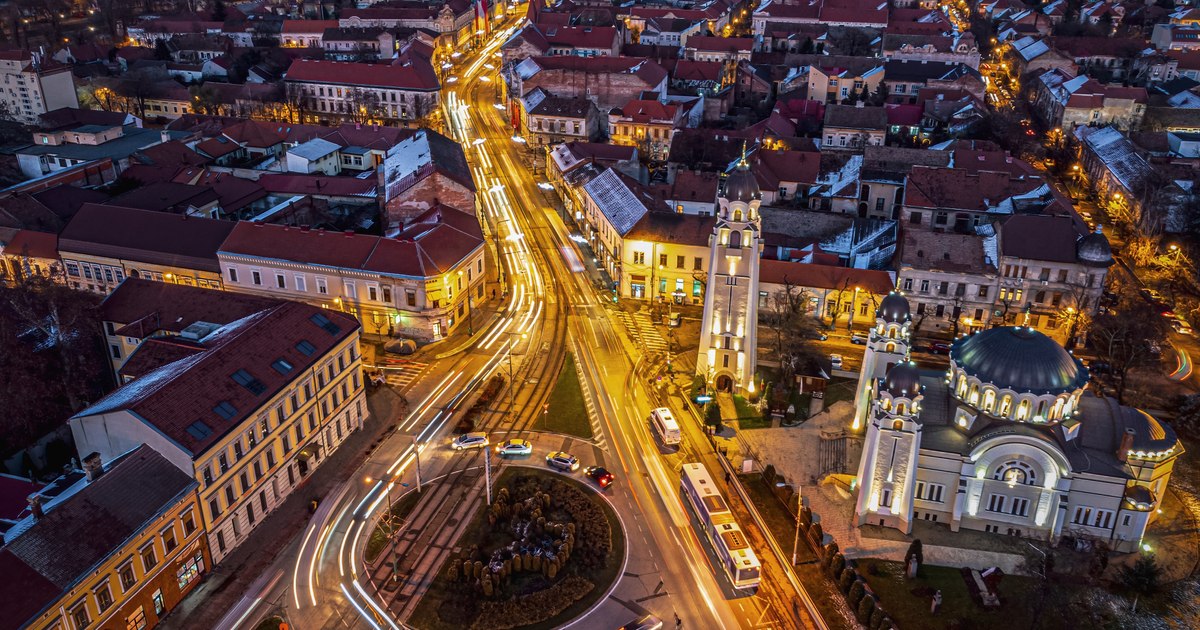
Timisoara ranks among the top five most accessible European destinations, along with Tallinn, Estonia, Krakow, Poland, Budapest, Hungary and Tbilisi, according to a study carried out by Accor.
Accor has compiled a list of the most sought-after European destinations PHOTO Shutterstock
Also known as the “City of Flowers” and the “Revolutionary Revolution”, Timisoara is the third largest city in Romania and is close to the border with Serbia and Hungary. He was named European Capital of Culture in 2023. With baroque architecture and charming cobbled streets and squares, the city is a destination on the rise, often dubbed the “Little Vienna of Eastern Europe”. The city was built on the site of an ancient Roman fortress and has over 10,000 historical monuments. It was the main industrial, commercial, financial and cultural center of the region between 1880 and 1914“, the report states.
Europeans are confident about their spending power for travel this year, despite continued cost-of-living pressure across the continent, and 54% of them believe they will have more money to spend on travel in 2024 than in 2023, according to a report prepared by a leading hotel group worldwide.
The report, based on a survey of 8,000 travelers from seven European countries, shows that only 11% of respondents say they will have less money to spend.
According to Accor, Poles were the most confident about their spending power for travel this year compared to last year, with 64% of them expecting an increase in their budget, compared to just 7% expecting to a decrease.
Germans were the second most confident Europeans (61% to 13%) and even in Italy, the least confident of the seven nations, there were almost four times as many budget travelers higher (44%) than those who anticipate smaller budgets (12%).
The number of leisure trips abroad that people expect to take is slightly increasing compared to last year, and international “workation” or “leisure” trips – that is, those that combine both business and leisure – will also register an increase.
“As working patterns are increasingly flexible and employers are increasingly willing to allow greater freedom of action regarding their employees' work travel, one in five Europeans (19% ) expects to take at least one trip combining work and pleasure in 2024“, states the quoted source.
Popular areas in southern Europe are still top of mind for European travellers, with one in four (23%) planning a trip to Spain this year, followed by Italy (18%), France (16%), Portugal and Greece (13%) ). Outside of Europe, 16% of European travelers plan to travel to North or Central America this year, and the same proportion plan to travel to Asia.
Although they are spending more overall, the economy is not far from consumers' thoughts – the vast majority (87%) taking steps to cut costs where they can, as a result of inflation and the rising cost of living. From choosing more affordable accommodation (27%) to cutting expenses (27%), cost-cutting measures could shape travel deals in the coming year.
Italians want greener travel
Seven in ten travelers (71%) say sustainability is important to their travel decisions. Among the European countries included in the sample, travelers from Italy are the most attentive to ecological travel, 82% of them stating that the existence of sustainable options is important in the decision-making process. This is followed by Spain (78%) and Poland (77%), with British travelers trailing behind (61%).
Three in four travelers (77%) say environmental concerns will have a real impact on their travel or booking behaviour. Among the actions they will undertake are to travel less often (11%), to choose shorter flights (14%) and to actively look for sustainable accommodation providers or tour operators (10%), states the quoted source.
However, despite good intentions, travelers admit that there are obstacles preventing them from making sustainable travel choices, including conflicting cost pressures, cited by 38% of respondents, and a perceived lack of information (23%).
Climate change also partially contributes to another trend, namely the avoidance of the peak season. One in three respondents across Europe (32%) say they will deliberately take a holiday in the off-peak season to cut costs, while one in five respondents (19%) expect to do so to avoid risk heat waves, such as those observed last summer in southern Europe.
As a result, some hot weather destinations could have a longer tourist season, with some tour operators already offering holidays in warmer destinations.
According to Accor, travelers primarily take into account the recommendations of friends and family when it comes to where to go on vacation, with 35% of them saying that these recommendations influence their vacation plans, followed by 29% who are influenced by reviews online from portals or hotel websites.
One in six people (16%) is influenced by the destinations they have seen in TV programs or movies. Approximately 12% of respondents are influenced by the destinations they saw on social networks – an equal share of those who are influenced by the advice of a travel agency.
Hotels dominate as the most popular type of holiday accommodation for European travellers, with two-thirds (65%) planning to stay in 2024. When it comes to choosing a hotel, cost and location are the most important factors. However, travelers are also attracted to hotels that offer excellent service, with 21% citing this as a key factor when booking a stay. Among other factors that determine the reservation are the quality of food & beverage services (37%), the special ambience (17%) and the contact with the local destination (11%), according to the data from the report of the international hotel group.
On the other hand, 17% of European travelers will go on a trip alone in 2024 while 9% of tourists plan to take their pets with them.
“A deeper connection: 36% of respondents say it is important to get in touch with the local cultures and communities they visit on vacation, and 13% need to feel they are making a positive contribution to the destination. Rest and relaxation are the most important thing in a vacation for 44% of travelers and 15% currently need a break because they have an uneven work-life balance 36% say it is important to choose a trip that allows them to have take care of their physical and mental well-being and leave stress behind”, the Accor report also states.
A percentage of 9% of travelers say they will make a trip oriented towards gastronomic experiences, such as wine tastings or a food festival, 9% around a musical event, such as a concert, and 6% will make an occasion trip of a sporting event, such as the Olympic and Paralympic Games in Paris.
As for the preferred means of transport, 19% intend to take a road trip this year, 9% a boat trip or a cruise and 3% a luxury train trip.
“Despite current macroeconomic and geopolitical challenges, 2024 looks set to be a strong year for European travel as consumers prioritize it over other forms of discretionary spending. This report reinforces several overarching themes, none more important than the climate crisis. cares about how travel companies approach sustainability issues, and this will become more and more important over time for their travel choices,” said Patrick Mendes, CEO, Premium, Midscale & Economy, Accor Europe & North Africa.
